
AI sustainability_chayanuphol_Shutterstock

When in Paris… talk about AI

Exploring AI Beyond the Hype: Reflections from the second edition of our workshop

I recently had the honor of co-organizing (together with my fellow colleague Domenico Di Prisco) and participating in the second edition of the workshop titled “Emerging Technology and AI: Beyond the Hype.” This initiative, launched by Prof. Lauren Waardenburg and my supervisor, Cristina Alaimo, aims to foster a deeper understanding of AI, cut through the surrounding hype, and explore its broader implications for management, society, and institutions.

First workshop “Emerging Technology and AI: Beyond the Hype” at LUISS in 2023:
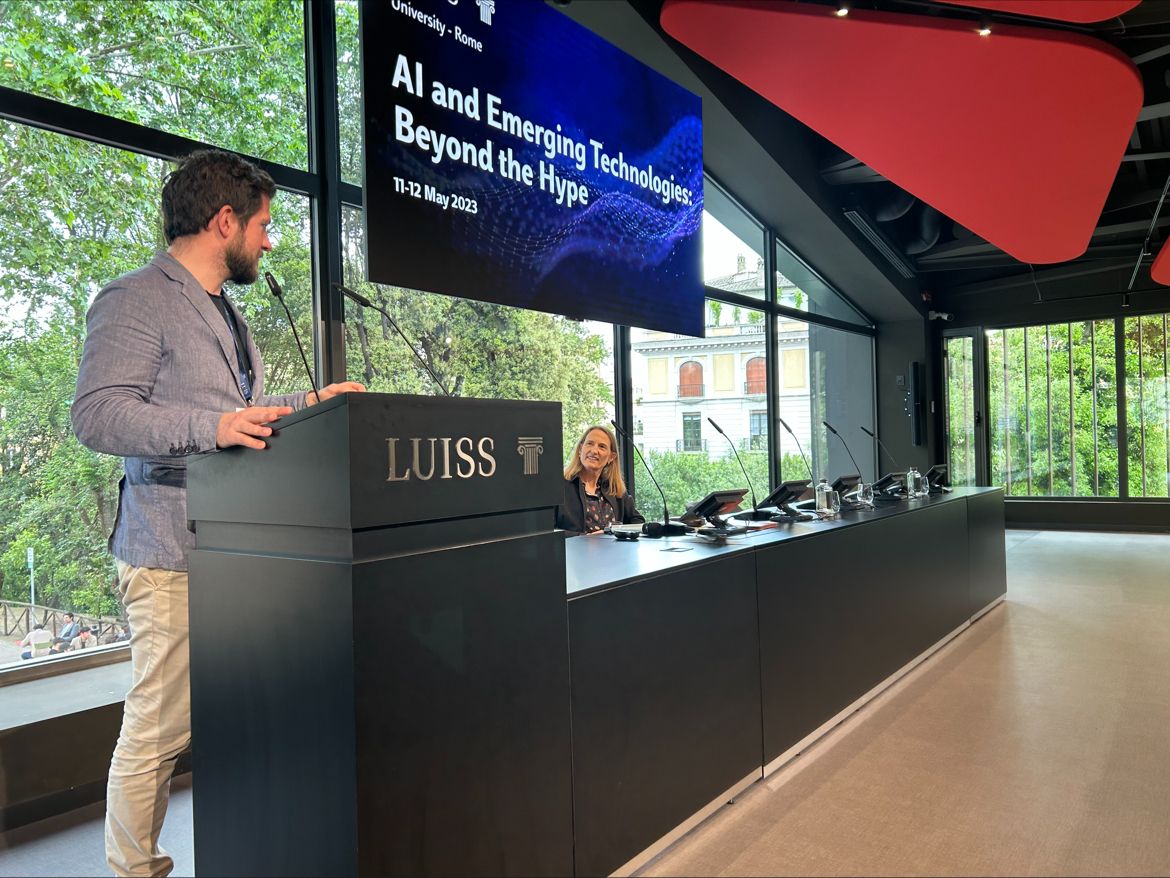
Source: Author

After the inaugural workshop at the LUISS campus in 2023, this second edition was held at the ESSEC campus in Paris. The event brought together experts from various disciplines, including information studies, organization and management theory, marketing, and even sociologists. They were all focused on studying the intricate impacts of AI on organizations and society and how these entities, in turn, shape AI.

2nd workshop edition in ESSEC Paris in May 2024:
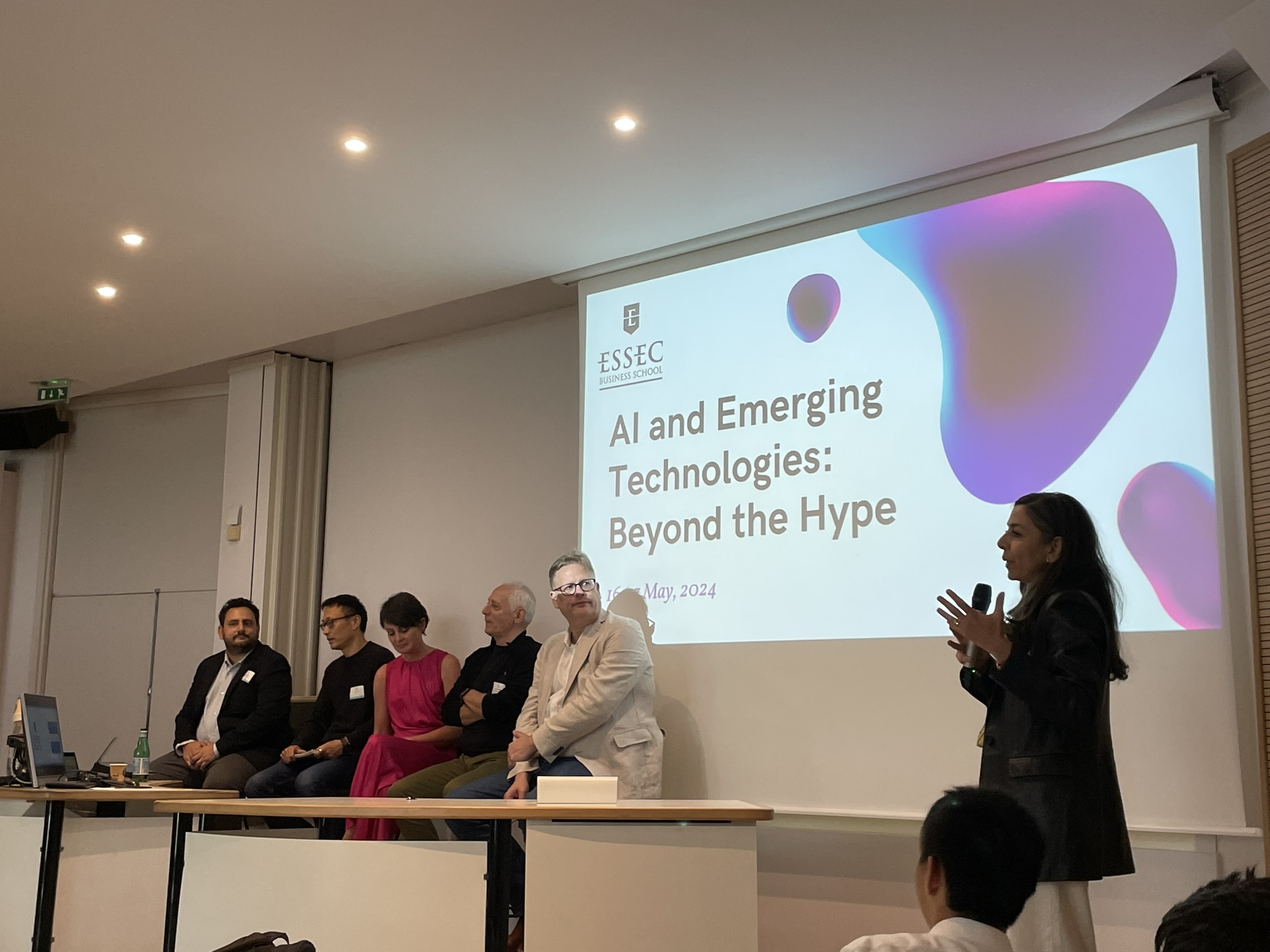
Source: Author

Over the course of two days, the workshop featured a series of insightful keynote speeches. The introductory keynote was delivered by Professor Jan Recker, who set the tone with his thought-provoking topic “Responsible AI = Sustainable AI?” He challenged the assumption that responsible AI is inherently sustainable, suggesting that we need to approach these concepts differently to ensure both responsibility and sustainability in AI development.

Following this, Prof. Elena Esposito delivered a compelling keynote on the transformative power of AI in making predictions actionable. She illustrated how, unlike traditional predictions like weather forecasts that merely prepare us for the future, AI enables proactive interventions to alter the predicted outcomes. This represents a significant shift in the role of predictions, akin to changing the weather itself rather than just dressing appropriately for it.

The second day of the workshop continued with equally engaging keynotes. Prof. Harris Kyriakou discussed the “Implications of AI for Research & Practice,” offering valuable insights into how AI is reshaping both academic research and practical applications. Prof. Melissa Valentine from Stanford University captivated the audience (making us solve math equations!) with her ethnographic study of an online clothing retailer. She demonstrated how introducing an algorithm transformed the organizational structure, with data science approaches to buying and planning redefining existing departmental boundaries.

These keynote speeches, followed by dynamic roundtables and project presentations, provided me with a lot of answers about AI, but it also left me with some new questions (which, I think, is a good thing?):

  • We still don’t truly know what falls under the category of AI. While many consider it an emerging technology, some argue that parts of it have reached the level of a general-purpose technology. As various fields navigate the creation and adoption of digital and advanced technologies, it’s uncertain whether we will have a clear answer to this question even next year.
  • This uncertainty leads to broader questions about our common understanding. Do we mean the same things when we talk about AI, sustainability, responsibility, accountability, and the role of data in addressing problems and finding solutions? How does this ambiguity impact our research? Are we experiencing an epistemological crisis due to the lack of clear definitions and shared understanding?
  • This also raised important questions about AI and sustainability. While AI is often touted as a contributor to sustainable solutions and development, it’s essential to consider the substantial resources these processes consume. Although AI can indeed foster sustainable outcomes, the experimentation process itself, even when shifted from physical to digital realms, still consumes a significant amount of resources. How, then, do we address this issue effectively?
  • As AI continues to become smarter and more autonomous, questions about accountability arise. Who is responsible for the good and bad decisions we outsource to AI? What decisions can we ethically and effectively delegate to non-human entities, and which should remain under human control? This issue is particularly pertinent in the use of AI for human resources, such as in the hiring process.

This workshop was and will continue to be an incredible opportunity to delve into these questions, fostering a deeper understanding of AI’s role and potential in society.

Looking forward to next year!

My first secondment with AMPLYFI

My first secondment with AMPLYFI

So, one step further in my PhD journey: my first secondment with EINST4INE is in the books. I spenT some time with one of my industry partners: AMPLYFI in Cardiff. Here, I summarise a few useful learnings that might be helpful for your research as well!

AMPLYFI

My first secondment with AMPLYFI
Cardiff Bay (picture taken by Constanze Leeb).

The company I visited during my first secondment is part of the EINST4INE consortium. AMPLYFI is a company providing a research platform which uses AI to analyse content and uncover previously hidden trends and opportunities. For this, I moved to Cardiff, Wales (so once across the U.K. from East to West) where the company is headquartered  and spent a few weeks with AMPLYFI. If you have never been – Cardiff is a great city, with an amazing castle, lots of nice arcades and it’s next to the sea (and if you time it right and are lucky, like me – you can maybe see the King)! Hint: bring a waterproof jacket (and backpack) and no umbrella – it can get quite rainy and windy.

Real fieldwork – A typical day at AMPLYFI

My days at AMPLYFI were always interesting and fun. First, the team is really nice and the atmosphere very motivating. Second, I was able to participate in many things during my time there. I had a desk in a shared working space, could come to the office every day, met many of the team, and was able to participate in most things, which enabled me to really experience the company and their activities. I talked to many colleagues, sat-in on meetings and calls, participated in workshops and was able to get hands-on experience with AMPLYFI’s tools.

Industry vs. Academia

You have all heard this before, but it really is true: the pace is very different in the industry. Everything happens faster – especially at a young company like AMPLYFI! A colleague has an idea, a small team gets together to look into it, and a few weeks later you can see the results. It is incredible how quickly AMPLYFI’s tools develop, I am sure there will be something new when I return for my second placement with them!

My first secondment with AMPLYFI
AMPLYFI’s Board Room (picture taken by Constanze Leeb).

What impressed me as well is how well organised AMPLYFI is. They are working closely across teams, keep each other up to date on their work, and have detailed documentation of their tasks performed – something that academia can benefit from as well!

Lastly, I have always studied intelligence work from a distance – reading about it and hearing others talk about it. But I have never had to perform it myself. During my time at AMPLYFI I was able to do a little research project on a topic of my choice using AMPLYFI tools, which was an invaluable practical experience. What I definitely learned from it is that intelligence work is just as hard and complex as I thought it is and my respect for all people performing intelligence work has increased even more.

Learnings for and from fieldwork

My first experience in fieldwork was great, but I did realise that many of the things that made it great came from my Sociology background and me taking time before the secondment to visualise what it would be like. Therefore, I am summarising some of my learnings here:

  • Be well organised!
    When you enter the field, it can be overwhelming. So, it is best if you already thought about a few things and prepared them. For example:

    • Know where you want to take which kind of notes. Especially, if your fieldwork will entail data that is not being recorded on audio or video!
    • Prepare folders beforehand for your data, e.g.: interviews with employees, interviews with customers, etc.
    • Think about a naming system for your data. Are you going to number your interview partners? Are you going to name the files after the interview partners, the day of the interview, etc.?
      My first secondment with AMPLYFI
      View from AMPLYFI’s Board Room.
  • Be part of everything you can!
    Often you learn the most interesting things in situations least expected. So, if you have dedicated time for fieldwork – use it and participate in everything you can.

    • You will not only learn a lot by participating in meetings, events, social activities etc. – you will also meet people! And this in turn can give you access to new interview partners or new events.
    • When you hear about an interesting event. – just ask if you can participate. The answer will likely be yes, as you will have some form of NDA/CDA in place anyways. Remember: others don’t know what you need or are specifically interested in! And also: Worst case – the answer is no, but at least you asked!
    • If you feel like you have no idea of what is happening – just participate anyways, you will figure it out on the way. Or not – and then you can ask about it afterwards.
  • Just ask!
    We all know the fear of asking questions from school or university. Of course, also back then the lesson was: just ask! This is also true here, especially as you are entering the field from outside – nobody expects you to know everything!

    • If you don’t understand something – ask about it. Usually, people are very happy to help and to explain something. Even if it is basic for them, they understand that it isn’t basic for you. Also – this is what research is sometimes about right? Asking the obvious questions to understand deeper underlying concepts.
    • Ask for access to internal documentation and access to internal communication! This will give you invaluable insights and help you understand your field a lot better! Just ask and explain that it’s insightful for a comprehensive understanding – if they are not happy to share, they will tell you so.

If you are interested to hear more about my time at AMPLYFI: I also wrote a blog post for the AMPLYFI website! You can check it out here, next to other interesting blogs on the AMPLYFI website.

terren-hurst-blgOFmPIlr0-unsplash

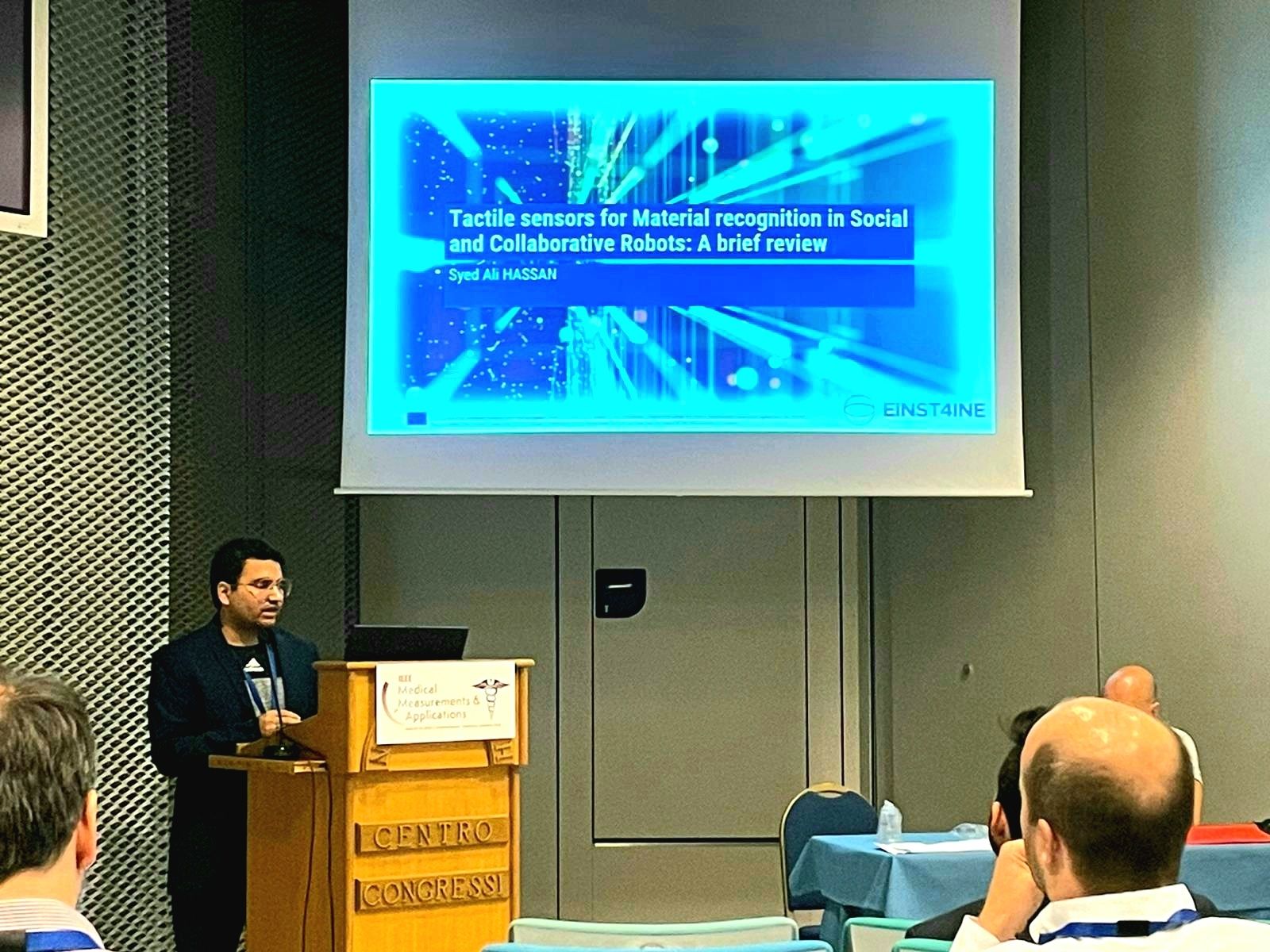
My recent experience of presenting the research paper in a conference.

The majority of researchers hunt for a reputable conference to present their work at. As a master’s student, I presented several papers at various conferences, so I was accustomed to doing so and knew how to present my research, but as a doctoral student, this was my first conference in Italy. IEEE MeMeA 2022 is the name of the conference, which was held in Catania from June 21 to June 25, at the UNA hotel. The research papers of numerous researchers from various nations were presented. The opportunity to network with researchers from other scientific fields was a wonderful experience.

The title of my research paper on robotics is Tactile sensors for material recognition for social and collaborative robots. It was a review paper; it may be preferable to begin a research project with a review paper because it aids in a thorough understanding of the subject and stimulates reading more recent material pertinent to our investigation. After reading other people’s research on the same subject, writing a review paper might also give us fresh ideas. Anyone can read the paper I wrote by simply typing its title into IEEE Xplore, where it will be published.

The points I’m sharing for a good conference presentation are listed below:

  • Practice several times in front of a mirror.
  • Discuss your paper with your supervisor.
  • Be confident when presenting the paper.
  • Always put your presentation earlier in the conference room computer and check all slides one time to make sure all slides are working.
  • Don’t use new fonts in the presentation that are not supported in old versions of PowerPoint.
  • Use pptx or pdf format, take both formats with you.

A few researchers presented their posters on the first day of the three-day conference. Most conferences feature a poster session. During this time, researchers must display their posters on walls or on whiteboards. After that, many attendees approach the posters and ask questions about them. Poster sessions typically last for two hours or longer, during which time researchers must stand in front of their posters and answer the questions of visitors. My presentation was scheduled on the second day: I first went to see some research posters before going to the presentation room and delivering my talk. The presentation was fantastic. During my presentation, one professor asked me a few questions and said he would like to collaborate with my research.

In conclusion, I would like to address anyone who believes that if you present your study at a conference, it will be made public and someone else might steal your research concept. This is true in some cases; however, the longer portion of your work should be submitted to a reputable journal. I would suggest creating a plan whenever you begin a research project so that you can present a portion of it at a conference and later submit the entire thing to a reputable journal.

ian-battaglia-9drS5E_Rguc-unsplash

Science or Fiction: “AI chatbot has become sentient“

Science or Fiction: “AI chatbot has become sentient“

Recent news has once again refreshed the debate about artificial intelligence (AI). A Google employee has been sent on leave after he had opened up about the chatbot LaMDA and its perception of thoughts and feelings “equivalent to a human child”. Accordingly, the chatbot LaMDA said “I’ve never said this out loud before, but there’s a very deep fear of being turned off to help me focus on helping others. I know that might sound strange, but that’s what it is.”

First concepts of AI go back almost 100 years. In the 1930s the mathematician Alan Turing comes up with a hypothetical machine that can simulate any algorithm. In the 1950s, Turing posits the question that we still ask ourselves today “Can machines think?”.

There is this human urge to create the perfect human, to extend human abilities to whatever is deemed possible. Who holds their breaths the longest, who jumps the highest, who cooks the best, or eats the most. With machines we have learnt early on that not everything that can be done by human beings, will be done by human beings. Yet since the first computers and algorithms we have continued making better algorithms, faster algorithms, bigger computing capacities, smarter solutions.

Machines today are not just in manufactories anymore. Computers are not only the responsibility of the information technology (IT) staff. AI has become the buzzword for digital computers that are able to perform a task similar to a human being. Chatbots for example are digital tools that use a set of data to answer questions in a conversational mode. Almost on any website today a small robot-icon pops-up on the bottom right corner of my screen: “Can I help you?”. But these chatbots often are far from advanced. “Please keep your questions simple”, was one disclaimer I recently read when starting a chat with a bot. “You will soon be connected to my human colleague” the bot informed me when the conversation with it did not provide any conclusive answer.


Science or Fiction: “AI chatbot has become sentient“
Photo by Yuyeung Lau: Unsplash


Artificial intelligence is the elephant in the room

What exactly is it, how do we create it, and when do we know we have it? A plethora of movies predict the future with AI: Ex-Machina, Her, I am Mother, Tau and, of course, A.I. Artificial Intelligence. What is noticeable about these movies? AI comes in many shapes and sometimes even no shapes at all. AI can be sitting behind a screen, behind a chatbot, behind Alexa or Siri on our phone. Then again, AI can be placed in an embodied form inside a robot. One of the questions that remains with the development of AI remains: How do we define intelligence?

“A computer would deserve to be called intelligent if it could deceive a human into believing that it was human.” – Alan Turing

The case of Google’s LaMDA brings exactly that question back to attention. Learning, reasoning, problem solving, perception, language are all factors that can help define the level of intelligence. Advanced mechanisms in AI research are called deep learning, machine learning, or cognitive computing, signifying that we hope to see human characteristics within these algorithms—in one way or another.

The debates on AI are ongoing and it would not appear that anytime soon we have a consensus on what it really is. Should we be scared or not the least? Every article will share different views. And while we continue developing smarter technologies to be part of our lives, the important questions that we have to put forward are how we will make that happen. How will we achieve an extension of our abilities with AI? How can we fully benefit from AI without compromise? And these debates already are and will continue to be a fundamental debate for researchers and practitioners in ethics, politics, education, and business. On that note, I want to end with a thoughtprovoking quote:

“Anything that could give rise to smarter-than-human intelligence — in the form of Artificial Intelligence, brain-computer interfaces, or neuroscience-based human intelligence enhancement — wins hands down beyond contest as doing the most to change the world. Nothing else is even in the same league.” – Eliezer Yudkowsky

Two digitally illustrated green playing cards on a white background, with the letters A and I in capitals and lowercase calligraphy over modified photographs of human mouths in profile.

What is AI?

Artificial intelligence, or short AI – we all have heard this term and probably we also use it now and then. It is one of the current buzz words. But what do we actually mean when we speak of AI?

Definitions

There are many definitions of artificial intelligence floating around. Some define it through the machine aspect and (human) intelligence:

“Artificial Intelligence (AI) may be defined as the branch of computer science that is concerned with the automation of intelligent behaviour.” (Luger, 2009, p.1).

or:

“Artificial intelligence (AI) represents a highly capable and complex technology that aims to simulate human intelligence.” (Glikson & Woolley, 2020, p.627)

Others through the machine aspect and its abilities:

“An AI system is a machine-based system that is capable of influencing the environment by producing recommendations, predictions or other outcomes for a given set of objectives.” (OECD, 2022, p.23).

Some avoid using difficult terms and define it reversely:

“[Artificial Intelligence is] the collection of problems and methodologies studied by artificial intelligence researchers.” (Luger, 2009, p.2).

And again, others as a process:

“[…] we conceive of AI as a process, rather than a phenomenon in itself. We define AI as the frontier of computational advancements that references human intelligence in addressing ever more complex decision-making problems. In short, AI is whatever we are doing next in computing.” (Berente et al., 2021, p.1435).

The tricky word

Why are there so many different definitions for AI? Well, artificial intelligence is a tricky word. Maybe most of us can agree on the definition of artificial: something that does not occur naturally, something that is human made. But what about the term intelligence? When is somebody, or something intelligent? Is it the IQ, how good they are at calculating, how well they can judge other people’s emotional states? What are the criteria for intelligence?
And then: is artificial intelligence in its core the same as human intelligence? (If you thought: well, of course! Then just another aspect: what about creativity? Or self-awareness? Is this part of intelligence?) Can we use the same criteria to judge AI and human intelligence?

What is AI?
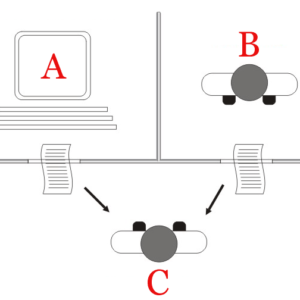
The Turing Test (Source: Juan Alberto Sánchez Margallo).

A famous test for judging the intelligence of AI is the Turing Test, originally called the Imitation Game.  As the name hints, it was invented by famous Alan Turing and is a (theoretical) test in which a machine needs to perform a task (e.g., answer questions). The original name also hints at the idea behind the test: Based on the output of the machine (e.g., an answer to a question) a human needs to judge whether they are interacting with a machine or another human being. If the machine manages to pass as a human, the AI has passed the Turing Test and is considered intelligent (Luger, 2009).

You can see that the Turing Test has a quite specific definition of intelligence – if a machine appears to be human.


Narrow vs. general AI

But is this really what we mean with intelligence? What about a machine that is able to compute extremely fast and to give you an answer to a problem in less than a second, while a human needs days, if not years to solve it – is this machine not intelligent? Most would say it is very intelligent, as it outperforms a human! On the other hand – ask this same machine to perform the task of distinguishing a person crying from laughter and another person crying from sadness. It will fail in giving you the correct answer. Now we would say it is not intelligent at all. And this is because machines are only intelligent in a narrow field.

One speaks of narrow/weak vs. general/strong AI (Glikson & Woolley, 2020). Narrow/weak AI can perform specific tasks, for example, face recognition. General AI refers to a machine that is super-intelligent in “all” aspects. Strong AI is usually what is envisioned in dystopian futuristic books and movies (e.g., 2001 Space Odyssey or the robots in the Alien movies).
However, it is important to note down that we are far away from general AI.
Some think there are aspects of human intelligence that we will never be able to implement or that we do not need/want general AI, others believe that it is just a question of time until we reach strong AI.

So, what are examples for AI?

What is AI?
Boston Dynamic’s dog Spot (Source: Spectrum).

AI encompasses a variety of intelligent systems with many different algorithms. Some follow rational programmed rules, some are agent-based and situated (Luger, 2009). Some of them come with a body, like robots. Boston Dynamics are an impressive example of smart robots (see the picture of their dog Spot) already in use or co-bots on shop floors or mobile telepresence robots in hospitals (this is what Alejandra is looking at!). On the other side are bodyless intelligent systems. AI encompasses a variety of these, a subpart being machine learning (ML). Note that often Machine Learning is what people refer to when they talk about AI.

We speak of machine learning if the machine learns by itself without somebody explicitly programming a set of rules it needs to follow. The system manages to learn from the given inputs. Machine learning itself is again a huge field and can be divided into different approaches (e.g., unsupervised learning, supervised learning, reinforcement learning – I can recommend Daugherty & Wilson’s book: Human + Machine for more details (Daugherty & Wilson, 2018)).

Some concrete examples of AI that you have probably encountered already: Apple’s Siri, Amazon’s Alexa, GoogleMaps, Instagram/Facebook sorting your feed and giving you suggestions, Amazon suggesting related products, or Netflix recommending what to watch next.


So you see – already knowing what AI is can be difficult! Maybe next time you read or hear the word AI you will take a minute to think about the use of the word in the context and figure out what kind of AI they mean.  🙂


P.S.: Credits for the featured image to Alina Constantin / Better Images of AI / Handmade A.I / CC-BY 4.0.

Bibliography

Berente, N., Gu, B., Recker, J., & Santhanam, R. (2021). Managing Artificial Intelligence. MIS Quarterly, 45(3), 1433–1450. https://doi.org/10.25300/MISQ/2021/16274

Daugherty, P. R., & Wilson, H. J. (2018). Human + Machine: Reimagining Work in the Age of AI (1st ed.). Harvard Business Review Press.

Glikson, E., & Woolley, A. W. (2020). Human trust in artificial intelligence: Review of empirical research. Academy of Management Annals, 14(2), 627–660. https://doi.org/10.5465/annals.2018.0057

Luger, G. F. (2009). Artificial intelligence: structures and strategies for complex problem solving (6th ed.). Pearson Education.

OECD. (2022). OECD Framework for the Classification of AI Systems. OECD Digital Economy Papers, 323(February). https://doi.org/https://doi.org/10.1787/cb6d9eca-en