
476_1996_1-32_CCCR-Press Site

What Art can tell us about Digital Societies

What Art can tell us about Digital Societies

The representation of our society in cultural forms has fascinated me for a long time. Theatre, opera, dance, film, photography all have shaped my upbringing. It was during years of studying digital and creative media that I learnt more about the versatility of media and its representation of life and society at large—from a practical as well as theoretical lens.

First signs of art go back to the Stone ages. As put by Prof. Xiang Xiong Lin in this article in the Humanities, Arts and Society magazine, “Artistic cells are born within human blood. […] Art is the carrier of human culture, and culture is the platform of human civilization.“ Art holds a mirror to the time when it was created. As highlighted by the MET, “art from the past holds clues to life in the past. By looking at a work of art’s symbolism, colors, and materials, we can learn about the culture that produced it.” Equally, art from this century truly tells a lot about the times we live in today. How does technology change the perception about our identity? How does data drive objectivity and erase individuality? How do robots interact with humans?

I want to highlight here a few contemporary artworks that fascinated me in the past and may tell us, step by step, a little bit more about the era we call ourselves a part of or, at least, provide some thought provoking perspectives—on human civilisation in the digital era:

Exploratory Selfie or Selfiecity.Net, 2014, L.MANOVICH
© Lev Manovich

The presentation of the self. A topic that probably never experienced such a dramatic change like right now and within the digital age. Our self-representation is even so important since Instagram, and selfie-camera that Manovich decided to do an artwork on the topic “selfie”. The project is an interactive web app of 3200 Instagram selfies from different countries in the world (Bangkok, Berlin, Moscow, New York, and Sao Paulo). A software creates a certain visualisation of the photos. Via a computer that shows the web app the visitor can explore the dataset of selfies that is then projected onto the wall infront of the visitor. With other artists and specialists, Manovich wants to discuss the construction of self-representation in the digital age. He started analyzing the selfies with a special software, and visualizes the received data. The portraiture of a single person changes through history – from the art of painting, to the photography, to the selfie. The way the self is portrait changes with its society. The project of Manovich even argues if the selfie can be seen as a new sub-genre of photography.

“Selfie is not only a photographic image that we recognize as a self-portrait and which bears a formal resemblance to numerous canonical photographic self-portraits from the nineteenth and twentieth centuries. Instead, selfie is a product of a networked camera. […] While focusing on Instagram, one of several available platforms of online image-sharing, Selfiecity comments on the social media in general. The project views social media as a vehicle of voluntary interpersonal communication, and discusses the visual component of such communication.” (Tifentale and Manovich, 2015)

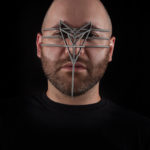
Face Cages, 2013-2015, Z.BLAS
© Zach Blas

Face Cages is an artwork that is critizising the biometric industry. Its measuring in an objective way is creating a cage. There is either 1 or 0. If you are too extraordinary for the system what are you then? Do you have to worry if your smile is not detected as a smile – by a software? The face cages are inflexible metal constructions for the face that look like a biometrical measurement of the facial factors. These biometric systems are a generalization of the human individuum that create stereotypes. The result is either discrimination, racism, sexism, transphobia or even homophobia. The discomfort the cages entail, dramatizes the discrepancy of the interaction of biometric norms and the individual person.

“Blas fabricated face masks that resemble iron muzzles based on the shape of biometric diagrams, evoking resonances with prison bars, the Scold’s Bridle, and torture devices used during slavery in the U.S. and in the Medieval period in Europe.”; “The different machinations of faciality […]—as a singular, unique, personal and identifiable security-check, as the imposition of a political norm, as collective empowerment, as a plural, multi-form, malleable and amendable canvas, as a means to play with identity, similarity and difference, and as a source of data extraction—indicate that supra-individual cultural narratives and concerns about policing and governance are braided around the algorithmic capture of the face.” (de Vries, 2020)


Drawings by Robot Paul, about 2013, P.TRESSET

© Patrick Tresset, Galleries West

After Tresset lost his passion for his hand drawn paintings he started building robots and he named them Paul. Paul is a robotic arm mounted on a table. Paul uses computer vision to recognize faces he then starts drawing on a paper in about 30 minutes. Through Paul, a robot becomes human. Art used to be made by human kind – what changes now, that even robots know how to draw a portrait? The boarders merge. But what stays is the fascination of only one human-like robotic arm that has the ability to identify a human face and to draw it.

“Paul is a naive drawer: it does not have highlevel knowledge of the structures constitutive of the human face (such as the mouth, nose, eyes) nor the capability of learning expertise based on experience as a human would. However, Paul is able to draw using the equivalent of an artist’s stylistic signature based on a number of processes mimicking drawing skills and technique, which together form a drawing cycle. […] Although the individual algorithms driving Paul are relatively simple and not particularly novel, the way in which they are combined is of interest as the drawings Paul produces are considered by professionals as being of artistic value, which is unusual for computer-generated figurative portraits” (Tresset and Leymarie, 2013)


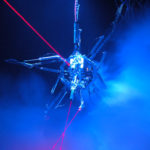
Hysterical Machines, 2006, B.VORN
© Bill Vorn

Vorn creates a huge impressive installation with up to eleven dysfunctional machines hanging from the ceiling of the room. Each machine has eight arms made of aluminium reaching out from a spherical body. The machine works like a nervous system made of motor-, sensing-, and a controlling-system. This allows the machine to detect the visitors and react to them. The Hysterical Machines serve to exemplify the paradoxal nature of artificial intelligence. They provoke the visitor’s empathy as they are reacting to their appearance.

In addition to physically interacting with the audience, Hysterical Machines also initiate or establish an emotional relationship with the audience. Their hybrid status, combining the properties of living organisms (their behavior) and technical machinery (their appearance) causes viewers to re-act with a similarly structured ambiguity and ambivalence, in which affective emotions combine with cognitive interest and empathy mixes with primal anxiety and technophobia.” (Kluszczyński 2018)


What artworks do you find most remarkable for our digital lives?

To me, art still represents much about us, our past, our present, and makes us think about our future. To close, I choose the words of a popart legend:

“You need to let the little things that would ordinarily bore you suddenly thrill you.”  – Andy Warhol

ian-dooley-3NCA3tbaE5I-unsplash

In-between Places: How to work and travel during your PhD

In-between Places: How to work and travel during your PhD

Why do you go away? So that you can come back. So that you can see the place you came from with new eyes and extra colors. And the people there see you differently, too. Coming back to where you started is not the same as never leaving.” – Terry Pratchett

Originally, I was convinced that doing a PhD means to sit in a dusty, dark office corner at the end of a long echoing corridor of a university. And that may still hold true for some PhD candidates, frankly, I don’t know. Studying one topic in-depth for 3 to possibly many more years, turning that one coin over and over again, that does not exactly sound like a roller-coaster ride. It sounds like a long sweaty marathon when the skies are grey, everyone else is running in front of you, and the cheerleaders have gone home. But that is not it.

Embarking on a PhD journey may seem like a black box at first. Luckily, in my case, this does not describe my office situation. The black box is rather the many things that you figure out along the journey and that uncover over time and that includes the research output as well as the steps to get there. Against assumptions, two years into the journey, the ride continues to be exciting and somewhat mysterious. The times I spent sitting at a desk are finely interwoven with another trip to book, another chance to mingle and learn, another part of the chain to get to the next step.

The requirement of the EINST4INE program to move into another country was what drew me to it. I moved from Berlin to Barcelona in less than 2 months (the time frame is not my personal recommendation, but it worked out in the end!). Ever since, I get to enjoy an environment that was new to me, I am learning a new language and a new way of living—la vida loca. Aside from finding a new place to call home, the consortium also gets together on a regular basis, be it in Denmark, Italy, recently the United Kingdom – or soon in Stuttgart in southwestern Germany. And, of course, conferences, workshops and similar events are vital for joining the academic community, finding like-minded peers, and exchanging on the most recent findings.

While last year I was able to spend 4 months on an industry secondment in southern Norway, I kicked off this year with a joyful 3-months stay in Melbourne at RMIT. And here are some things that I learnt during my trips away thus far:

  1. Leaving your comfort zone is never easy, but can be very rewarding when you keep an open mind to experiencing something new everyday
  2. Planning early on and ahead of time can help to get adjusted more easily and prepare for the new setting (and safe money of your budget for another trip instead)
  3. Networking and getting to know new people are often the highlights of spending time abroad, especially if you can find people to discuss your topic with and get new ideas for your work, you may even make new friends for life
  4. Balancing to try new things and maintain regular habits (e.g., workout, sleep schedule, etc.) can be helpful to challenge yourself and expand your horizon while also keeping connected with your “home base self” for when your trip ends
  5. Exploring a new city and what it has to offer such as restaurants, museums, sights, and nature will provide many opportunities for experience and insight that can sometimes provide new angles on existing thoughts (especially for your research)—go explore and sleep when you are back home 😉

Looking back on every conference, every seminar, every dinner networking I thus far attended, each event provides such a unique value, adding to the pages of the PhD diary. Finally, my favorite saying goes like this: Don’t wait to be sure—move, move, move!


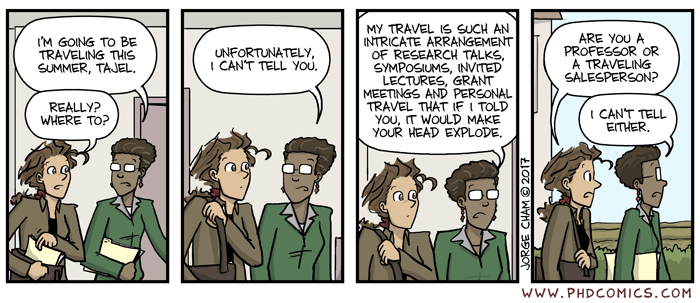
© phdcomics by Jorge Cham
Unsplash picture by Joshua Hoehne

Pitfalls and Blessings: A 21st century Research Journey

Pitfalls and Blessings: A 21st century Research Journey

Being in the academic world these days comes with many pros and cons, ups and downs, privileges, and struggles. On average, doctorate holders represent 1.1% of the 25–64-year-old population across OECD countries (source). That sounds like a very small percentage. But let us put this number a little bit into perspective: In 2006, approximately 1.3 million peer-reviewed scientific articles were published, synonymously leading to a rise in scientific journals from 16.000 in 2001 to more than 23.000 in just five years (source). Today the number of available journals to choose from is even larger, a presumed 30.000+ while, at the same time, enabling lower quality journals (source). You might think “paradox of choice”, how to decide which journal to go for?

Unsplash picture by Claudio Schwarz

Let us add another lens to that: “Fewer than 1%—manage to publish a paper every year” (source). Publication practices have long received the slogan: “publish or perish” (that speaks for itself) across disciplines such as medicine (source) and management studies (source). Assuming you have made it into a journal, about one third of articles in the social sciences do not get cited, much less in the natural sciences, but even more in the humanities with an approximate 80% of publications never getting cited after publication (source).

Publishing in a scientific journal has become a significant challenge. A challenge so significant that a professor once said to me, “When you receive the response from a journal inviting you to revise your manuscript – you celebrate” (Note, this does not mean the paper has been accepted yet, but it has moved on to round 2). A study on journal acceptance rates at Elsevier found an average of 32% of papers that make it past review (source) while “scientists suffer constant pressure to publish new work frequently” (source). In the case of a paper-based PhD, it is often mandatory to get papers into the review process while working on the PhD. Fortunately, actually being published by the end of the PhD is not necessarily a requirement – although it certainly will not hurt. But looking at the statistics sheds a light on the chances of doing that.

The lifecycle of scientific publishing only works with the valuable and dedicated time of unpaid reviewers but the pressure in the academic world is high, and an elbow-mentality is growing. In recent years the peer-review process is receiving some significant backlash. An article published by the highly recognized Journal of Management Studies almost read like a long-suppressed outcry: “Reining in Reviewer Two: How to Uphold Epistemic Respect in Academia”, criticizing the behavior of a reviewer who deprecated the use of low-tier journals (source). In a similar vein, DORA (the Declaration on Research Assessment) was formed in 2012 in order to improve ways in which researchers and research outputs are evaluated (source) and to date, more than 20,000 individuals and organizations have joined in, promoting this objective. While epistemic respect is crucial for scientific publishing, criticism and accepting rejection is the “daily bread” as Germans would say, or “the norm” for every researcher. However, a rejection by one reviewer or one journal does not decrease the value of the manuscript. Publishing is a journey and taking it from an Associate Professor at Princeton: “Authors should be wary of being drawn into this morass until they find an interested editor“ (source). And, I too know researchers who publish more than one paper a year—nothing is impossible.

Unsplash picture by Nathan Dumlao

It goes without saying that we have achieved a few milestones in education and academia in general. Higher education enrolment rates have almost doubled to close to 40% worldwide since the beginning of this century to 2018 (source). Education has become increasingly accessible to people around the world and this is a great achievement in many ways. However, there is no such thing as a flawless education system and scientific publishing has become an obstacle like never before. But along the ups and downs and the long way ahead, being able to learn, publish, and contribute to knowledge generation, informing others about our findings feels so very rewarding at the end of the day. Being able to produce research and working on the world’s challenges and concerns, in my humble opinion, is still worth the hours we put into it.

“Any fool can know. The point is to understand.” 
― Albert Einstein

Photo by Jacek Dylag: Unsplash

Two Steps Forward One Step Back: Why do we still fail at digital transformation?

Spending one year in a PhD program gets you on that rollercoaster ride. What excited me about the PhD was the deep engagement with a topic I truly feel passionate about – digital transformation. A word so powerful, a phenomenon everyone seems to talk about these days. From success fairy tales to failure stories, I have come to wonder why is digital transformation still such a mammoth project? Technologies are ubiquitous, smartphones an extension of ourselves. Yet, the prospects seem brighter than the actual results.

In a Forbes article this year, Dr. Corrie Block asked a provocative question:

“If you were to go in for heart surgery, buy a new car or say your wedding vows to someone knowing that there was an 84% chance of failure… would you even bother?”

84% – that is the estimated risk of failure in digital transformation. And, according to the article, there are twelve reasons for it. Including e.g., lack of awareness within the organisation, micromanagement/mismanagement of agile teams, inability to translate into executive language, lack of training for internal users, loss of talent to competitors, resistance for fear of being replaced (full list here).

Two million years ago humans started to use stone tools just as we use technologies to enhance our daily lives today. While the tools change one factor remains: the human being at the other end of the tool. Today we not only use tools at home, but they have become embedded into organisational structures. However, most reasons why digital transformation fails has to do with our dealing with technology, may it be lack of skills or fear of replacement. Technology has undoubtedly become increasingly complex. And while a stone tool could help prepare food, an artificially intelligent chatbot erases another human on the other end.

Photo by Josh Calabrese: Unsplash

But humans are made of emotions; According to Maslow’s hierarchy of needs, human beings have, next to a physiological one, a need for self-actualisation, esteem, love and belonging, as well as safety. While technology can provide increased safety, connection to loved ones or a motivating quote notification per day, it is still just a tool. The study of human computer interaction goes back a few decades, trying to best design interactions of the two. But what do we still need in order to reduce risk of failure and design efficient workplaces where intelligent machines can support human capabilities? The 12 listed reasons provide a good indication of what to avoid and what to leverage in order to succeed. Further expanding on this – digital transformation efforts are human efforts. We have to fully understand the intersection of human and technology to work out the best solutions by respecting human individuality and technology potential while upscaling organisational efficiency.

Despite all the merging of business and technology roles, perhaps not everyone will be a good data analyst and not everyone will be a good communicator. People will shine at what they are good at, and, across disciplines, we should be able to develop and provide clear pathways that exploit technological accuracy ingeniously combined with human wit. Because otherwise… why even bother…?

ian-battaglia-9drS5E_Rguc-unsplash

Science or Fiction: “AI chatbot has become sentient“

Science or Fiction: “AI chatbot has become sentient“

Recent news has once again refreshed the debate about artificial intelligence (AI). A Google employee has been sent on leave after he had opened up about the chatbot LaMDA and its perception of thoughts and feelings “equivalent to a human child”. Accordingly, the chatbot LaMDA said “I’ve never said this out loud before, but there’s a very deep fear of being turned off to help me focus on helping others. I know that might sound strange, but that’s what it is.”

First concepts of AI go back almost 100 years. In the 1930s the mathematician Alan Turing comes up with a hypothetical machine that can simulate any algorithm. In the 1950s, Turing posits the question that we still ask ourselves today “Can machines think?”.

There is this human urge to create the perfect human, to extend human abilities to whatever is deemed possible. Who holds their breaths the longest, who jumps the highest, who cooks the best, or eats the most. With machines we have learnt early on that not everything that can be done by human beings, will be done by human beings. Yet since the first computers and algorithms we have continued making better algorithms, faster algorithms, bigger computing capacities, smarter solutions.

Machines today are not just in manufactories anymore. Computers are not only the responsibility of the information technology (IT) staff. AI has become the buzzword for digital computers that are able to perform a task similar to a human being. Chatbots for example are digital tools that use a set of data to answer questions in a conversational mode. Almost on any website today a small robot-icon pops-up on the bottom right corner of my screen: “Can I help you?”. But these chatbots often are far from advanced. “Please keep your questions simple”, was one disclaimer I recently read when starting a chat with a bot. “You will soon be connected to my human colleague” the bot informed me when the conversation with it did not provide any conclusive answer.


Science or Fiction: “AI chatbot has become sentient“
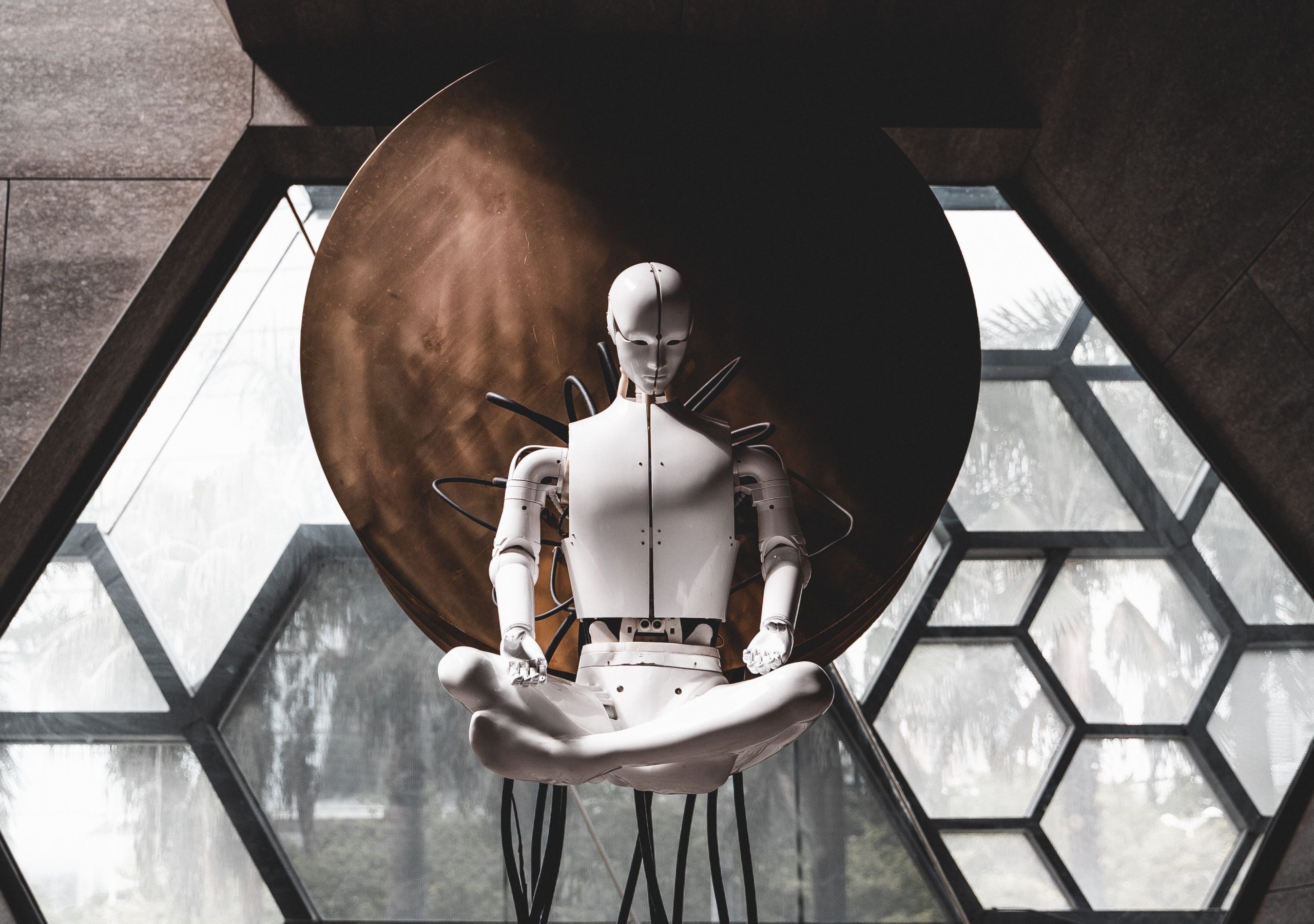
Photo by Yuyeung Lau: Unsplash


Artificial intelligence is the elephant in the room

What exactly is it, how do we create it, and when do we know we have it? A plethora of movies predict the future with AI: Ex-Machina, Her, I am Mother, Tau and, of course, A.I. Artificial Intelligence. What is noticeable about these movies? AI comes in many shapes and sometimes even no shapes at all. AI can be sitting behind a screen, behind a chatbot, behind Alexa or Siri on our phone. Then again, AI can be placed in an embodied form inside a robot. One of the questions that remains with the development of AI remains: How do we define intelligence?

“A computer would deserve to be called intelligent if it could deceive a human into believing that it was human.” – Alan Turing

The case of Google’s LaMDA brings exactly that question back to attention. Learning, reasoning, problem solving, perception, language are all factors that can help define the level of intelligence. Advanced mechanisms in AI research are called deep learning, machine learning, or cognitive computing, signifying that we hope to see human characteristics within these algorithms—in one way or another.

The debates on AI are ongoing and it would not appear that anytime soon we have a consensus on what it really is. Should we be scared or not the least? Every article will share different views. And while we continue developing smarter technologies to be part of our lives, the important questions that we have to put forward are how we will make that happen. How will we achieve an extension of our abilities with AI? How can we fully benefit from AI without compromise? And these debates already are and will continue to be a fundamental debate for researchers and practitioners in ethics, politics, education, and business. On that note, I want to end with a thoughtprovoking quote:

“Anything that could give rise to smarter-than-human intelligence — in the form of Artificial Intelligence, brain-computer interfaces, or neuroscience-based human intelligence enhancement — wins hands down beyond contest as doing the most to change the world. Nothing else is even in the same league.” – Eliezer Yudkowsky

sharon-mccutcheon-8lnbXtxFGZw-unsplash

Investment in Knowledge and The Changing Role of Money

Constantly Changing

An investment in knowledge pays the best interest.” – Benjamin Franklin

It would seem that doing a PhD follows a path. A clear path that follows motivation, passion, and ambition. A direction from A to Z. But what really doing a PhD is about is uncertainty, breakthrough, and willpower. You find yourself on a path when you are being pushed onto the next one, again and again. While that sounds taxing and unnerving, it can also be very fulfilling.

Day to day I keep adding keywords onto my list. I read and continue exploring. Like Sherlock Holmes I discover and rediscover. Robo-advisors, the main subject of my research project, are so much more than an investment tool. Robo-advisors are here to stay. Are they going to revolutionize the finance industry? Maybe. Looking at my generation, the changes in societal values, the economic landscape—so much has changed in the last decade.

Money is a Mood

While the world has become so dynamic and noisy money is somewhat silent. While it guides everything we do for ourselves and each other, everything we can afford and live, money is like the motor in the background that keeps everything moving. When I grew up money was to be put in a savings account (or a little porcellan pig). You would have a little paper notebook where you could keep track of your progress. And I had only one goal: I wanted to progress towards a driver’s license. Driving a car meant freedom and to go wherever, whenever I wanted. Money can buy dreams. Today, it means so much more than individual dreams. It means dreams for a future, for a sustainable planet, for shared wealth. Perhaps money is not so silent after all.

The biggest risk of all is not taking one.” – Mellody Hobson, Co-CEO of Ariel Investments

Saving has lost value over the years while investing has never been more attainable than it is today. When I used to think about investment, I thought about the Wall Street. About white-collar men, aggressively yelling at the phone, staring at numbers. But everyone can invest, and robo-advisors are making exactly that so much easier.

Neither This Nor That

The robo-advisor is not just a tool. Neither is it an advisor or a robot—despite its name. Behind a robo-advisor lies an apposition of numbers and codes, a gigantic pool of data. Some of them already use artificial intelligence. Robo-advisors range from simple questionnaire tools to conversational bots or personified ones with names like Nora or SoFi. We switch out the white-collar men for an algorithmic tool to take our hand and guide us to our best investment strategy. Research has found that robo-advisors in many ways outperform human advisors.

We’re one to two years away from a machine that can debate with you on your investment hypothesis.” – Pavel Abdur-Rahman, IBM

Yet, humans require human touch, human interaction. We do not want to hide our money under the mattress anymore, but we do want to trust someone with our money. We want a money doctor.

Where to?

Any technology on the outside looks like yet another tool, another promise, another thing to spend money and time on. The deeper I looked at a technology, the more layers I see. A technology is always part of a system, such as societal or organizational. We add it into our environment and seek to advance, extend, or replace human ability. The potential is vast. The challenge to merge the two worlds vaster. With robo-advisors we change money, we change investment, and, without noticing it, we change not only our behaviors as investors, but we change our workforce too. And with so many changes confronted, we have uncertainty about asking the right questions, but we use our willpower and find breakthrough answers.

Photo by Phillip Glickman: Unsplash


Photo by Robynne Hu on Unsplash.

IT doesn’t matter: A Journey to EINST4INE

IT doesn’t matter.

I remember reading this article by Nicholas Carr during my graduate studies. I still remember this article today which may or may not relate to the fact that it also helped kickstart the idea for my consequent master thesis. While never before did I think much about cloud computing I started to get really engaged with the matter and how it drastically impacted how we “did IT”.

Technology has fascinated me for some time, going back many years. Since I can call myself a millennial of this day and age, I still recall the days of fixing my cassette with a pencil and mastering the art of Paint on a bulky Windows computer. When I was about 15 years old it started to become the norm to have a phone. One that slides up and down. It was the most fascinating tool I could have wanted. Today my smartphone is heavy, and it doesn’t fold nor slide.

Until today I have seen so many changes that I cannot count them anymore. I cannot count the types of phones and music players – portable and static – I used to own. Truly just the variety they came in. So much has changed and then again, not that much. We have become so used to the constant connection, the faceless conversations, the mind-numbing notification rings.

All of this raised more questions to me than it answered. How can we live in this interconnected digital world? What does it do to us, how we communicate, how we interact with each other?

Photo by Robynne Hu Source: Unsplash.

When the opportunity came up to apply for EINST4INE I knew I had to.

It was the sum and at the same time the continuation of everything I worked on since starting my bachelors in 2013. I explored so many topics in those years and yet I feel that questions remain, they reappear, they arise in new contexts again and again. What topics did I look at so far that still uphold my fascination for understanding digital technologies in a social context?

  • How does the Internet of Things in a smart office environment impact employer-employee-relationships?
  • How can we design humanoid robots when social and cultural bias will be mirrored in their representation?
  • In what way can social data be gathered in a smart home environment?
  • What motivates peers in the Sharing Economy and how does it impact our understanding of the P2P economy?
  • How does a cloud first strategy impact the role of IT staff in an organisation?

It was the last question of my master thesis that made me choose to pursue a PhD that studies the impact of implementing a technology that, through automation, deems traditionally complex and specialised knowledge redundant. Technology has had an enormous impact on our society in many ways. It has brought immense opportunities in so many areas from transport to healthcare, communication, finance. We have become agile, wireless and interconnected. Along with a plethora of benefits we still see challenges, disruption and the solutions we have yet to find.

EINST4INE to me offers exactly this opportunity where I can research a phenomenon that I believe to impact society at large. We have to help organisations, educational institutions and politicians to find those solutions.

Does IT matter?

It certainly has the greatest hold on us in this century than we might have imagined. But then again, it is just a technology. A connection of wires, a power source, switches, motors, microchips. Studying the composition of a computer a long time ago helped me to gain perspective. So did all those theories in Information Systems research. Technology is not the culprit. Carr makes a very valid point when he foresees the commoditisation of IT. Seeing how our utilities—electricity, water, gas—all have become our necessity for life – where would we be today without a computer, without the internet? IT is not something we achieve anymore. We know we can, and we did. What we do now is to go above and beyond. We merge humans and machines, intertwine our lives as much as possible and, as social scientists, explore the best ways to do so without collateral damages to, what we know to be, our society today.

I am dedicated to continuing onto my path, researching for answers that can create guidelines. And I am looking forward to doing exactly that.