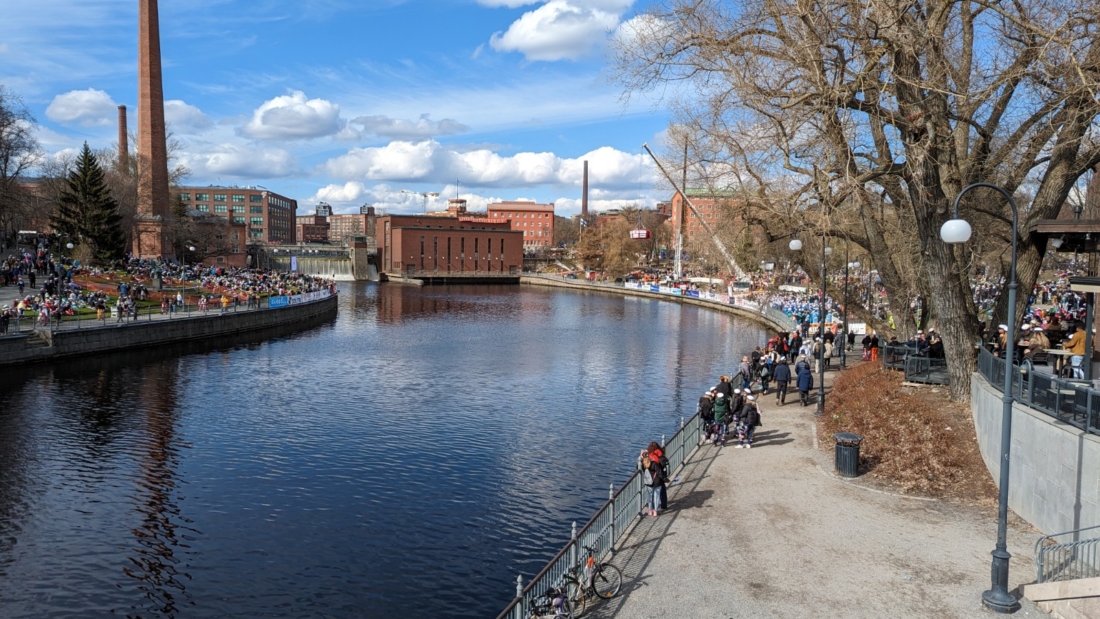
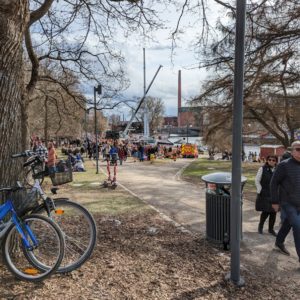
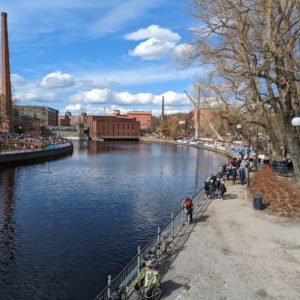
During my first weeks in Tampere I experienced the first of May celebrations in Finland also known as “Vappu”. In contrast to some other countries, the first of May is less important for workers’ rights and more relevant for the university students. The night before is often spend partying, while on the day itself everyone joins for huge public gatherings with sweets, picnics and alcohol. Sima a mead like beverage and munkki, a suggar coated donut are typical for those celebrations and sold in small booths all over the city. Freshly graduated students as well as alumni wear their white student cap and every city has its own traditions on what else is organized on the day. In Tampere, students will be submerged into the river running through the city. This is done in the most convenient way possible: by picking up a cage with students by crane. This spectacle is observed by the whole town, who gather at the riverside and bridge to have a look.
Party and picnic at the riverside. Picture by Finn TryggvasonDipping the students into the water by crane. Picture by Finn Tryggvason
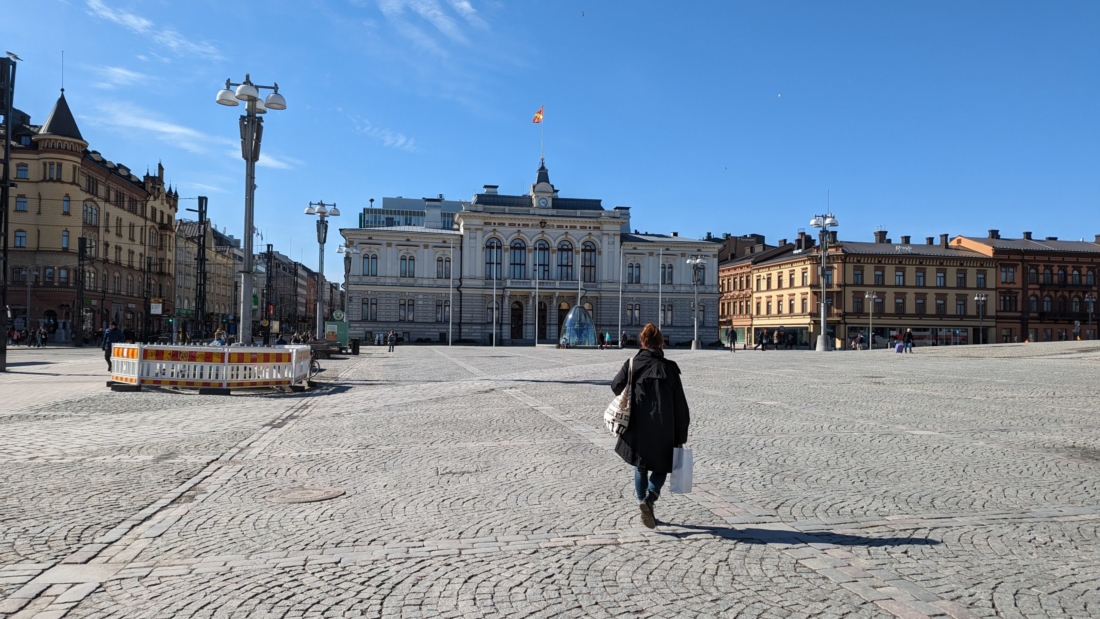
As part of the program I have the opportunity to go to Finland and visit both my industry partner Jakamo, as well as the LUT university. Now the time has finally come and I have arrived in the lovely city of Tampere, where I will be staying for my first two months. I was lucky to be met not only by great weather, but also the amazing team of Jakamo. During my stay I will conduct research in the field of ecosystem legitimacy, using Jakamo as a case study. At the same time, I will gain important industry insights and can engage with the team here so that we can learn from each other. For now I will focus on settling in, which does not seem too hard with such great company showing me the sights of Tampere 😉
I am thankful for this opportunity and am excited to see where my journey here takes me. While working with Jakamo, I will also post on their blog on supplier experience, so stay tuned for more to come!
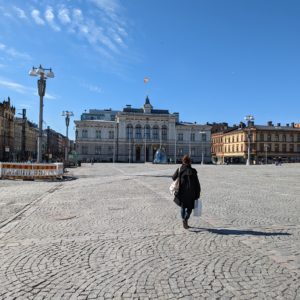
Approaching Tampere. Picture by Finn TryggvasonTampere Town Square. Picture by Finn Tryggvason
After work sunbathing with the team. Picture by Timo Rossi
“The best way to predict the future is to invent it.” – Alan Kay
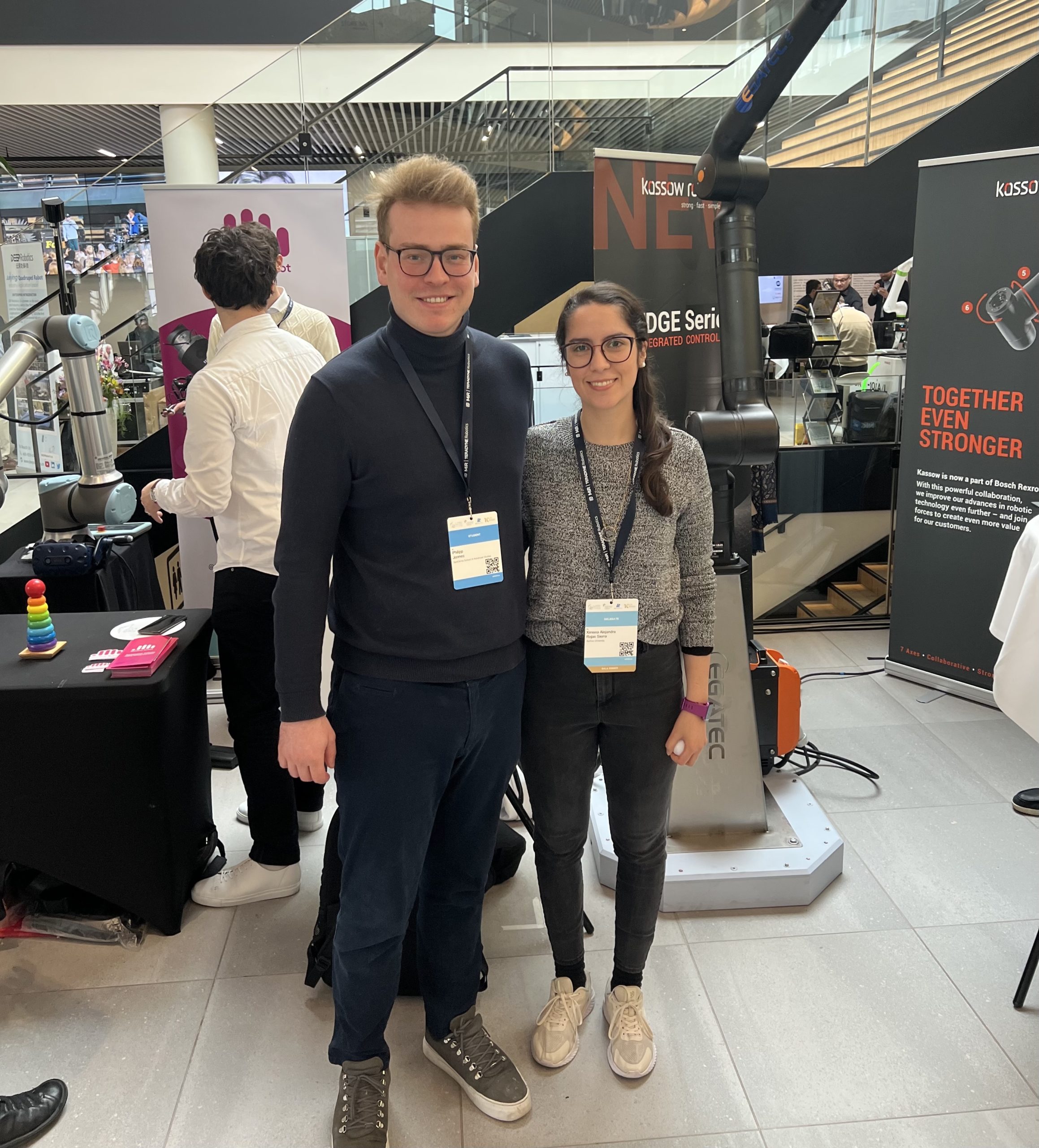
Hello everyone! I’m happy to share some experiences that I’ve made during the last month. Recently, I had the incredible opportunity to accomplish my academic secondment at Aarhus University in Denmark and attend the European Robotics Forum in Odense with my EINST4INE colleague Alejandra Rojas.
ERF23
The European Robotics Forum (ERF) is an annual event that brings together experts in robotics from industry, academia, and government to discuss the latest developments in the field and explore potential collaborations. The forum is organized by the European Robotics Association (ERA) and typically features keynote speeches, technical sessions, panel discussions, and exhibitions showcasing the latest robotics technologies and applications.
The ERF serves as a platform for researchers, engineers, and entrepreneurs to exchange ideas and knowledge on a wide range of topics related to robotics, including industrial automation, healthcare robotics, service robotics, and artificial intelligence. It is also a forum for policy makers and industry leaders to discuss the challenges and opportunities presented by the rapidly evolving field of robotics, such as ethical and legal considerations, workforce training, and investment strategies. Even Crown Prince Frederick, His Royal Highness of Denmark, attended the event this year!
ERF23 with EINST4INE colleague Alejandra Rojas. Source: own photo.
As a visiting researcher, I was thrilled to be able to connect with so many people who are passionate about robotics and human-robot interaction. I was able to learn about the latest developments in this field. I was particularly interested in discussions surrounding collaborative robots, which are designed to work alongside humans in manufacturing and other industries. During the forum, I had the pleasure of engaging with some brilliant minds, from both the academic and practitioner side. Their contributions to the discussions were invaluable, and I learned a lot from them.
Exploring the Fascinating World of Robotics
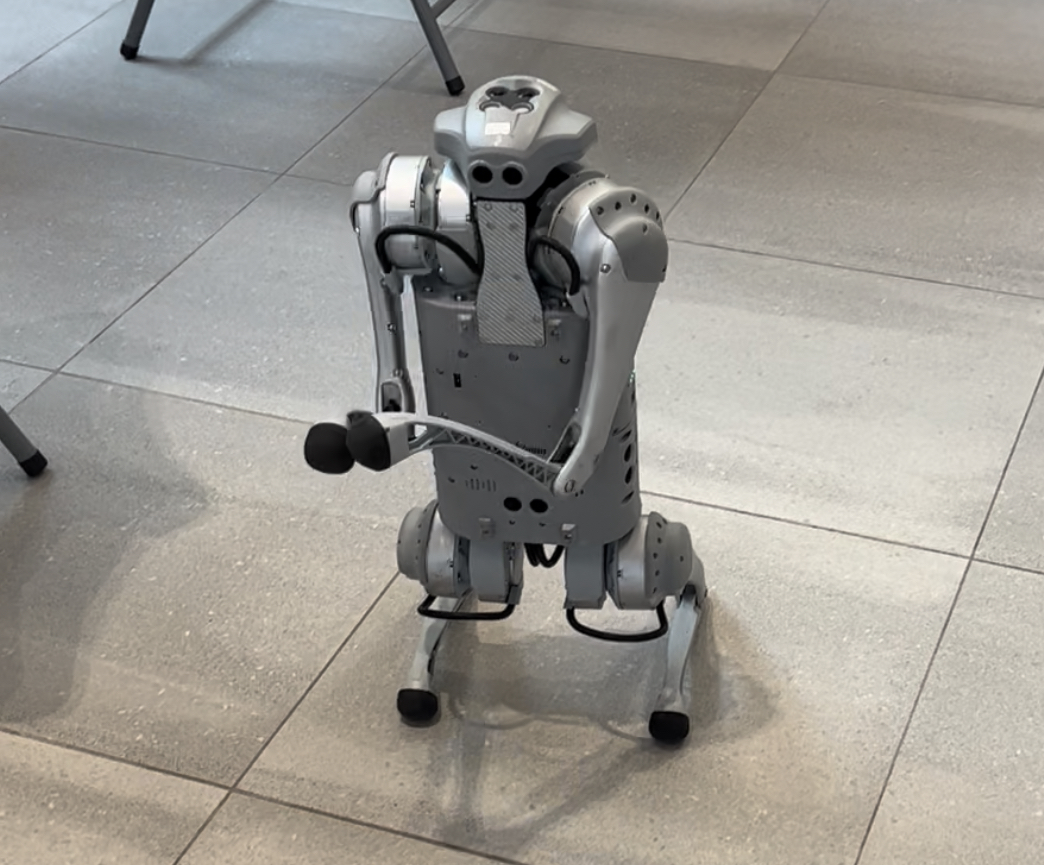
In addition to my research on collaborative robots, I’m also fascinated by other robotic technologies such as drones and robotic dogs. These technologies are shaping our world in profound ways, and I believe they have enormous potential to improve our lives. For example, drones have the ability to conduct aerial surveys, deliver packages, and even help with search and rescue missions. Robotic dogs, on the other hand, can be used in a wide range of applications, from military and law enforcement to assisting people with disabilities. I find the intersection between these technologies and human needs to be particularly interesting, as it challenges us to think about how we can design and use robots in ways that are safe, ethical, and beneficial for society as a whole.
Robotic Dog ERF23. Source: own photo.
The Journey Goes On
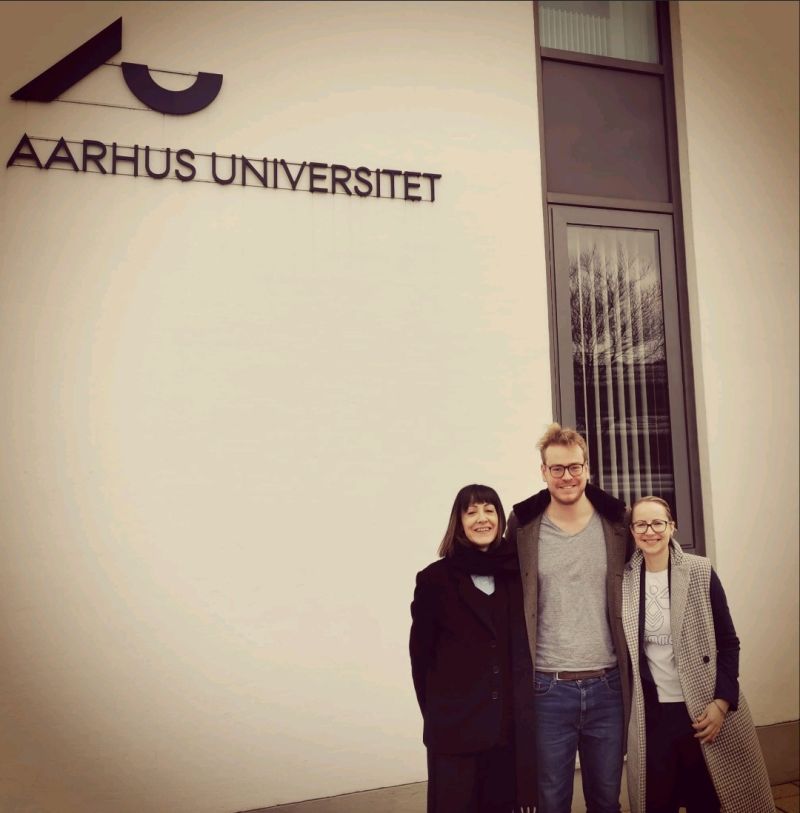
Aside from the forum, I also spent time at Aarhus University, where I was conducting interviews with SMEs located around Denmark. These interviews are an important part of my research, as I’m studying the implementation of social and collaborative robots in organizations. By understanding the effects of cobots on an individual and firm-level, I hope to achieve a clearer understanding of cobot implementation processes, organizational opportunities and challenges.
Visit at AU with Agnieszka Radziwon and Cristina Marullo. Source: own photo.
Overall, my trip to Denmark was an amazing experience, and I’m so grateful for the opportunity to connect with so many brilliant minds in the robotics field. I’m excited to continue my research and see what developments the future holds for human-machine interaction models. I am also looking forward to the next EINST4INE Summer school and see my ESR friends in person again. Thanks for reading!
During my current academic placement with RMIT in Melbourne, Australia I have the chance to network with colleagues from the School of Business, attend talks and seminars and collaborate with other departments and researchers from different fields!
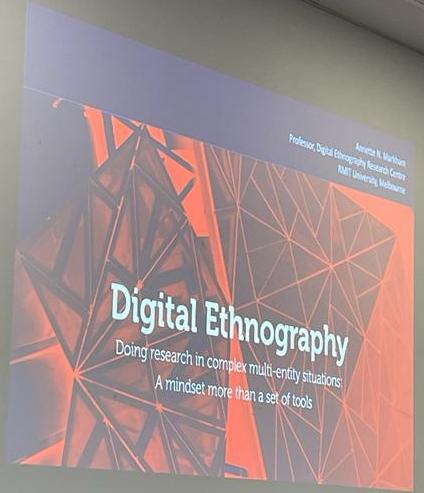
One example is the summer school led by the Digital Ethnography Research Centre (DERC) [https://digital-ethnography.com] here at RMIT Melbourne which I attended at the end of February. During the summer school Early Career Researchers (mostly PhDs) from all over the world got together to learn from Annette Markham and Larissa Hjorth about “Digital Ethnography Fieldwork and Analysis: Studying hybrid contexts of human+ non-human+ more-than-human entanglements”.
What is Digital Ethnography?
Slide from the summer school (Source: picture taken by C. Leeb).
Digital ethnography encompasses a lot of things. In general, it means investigating how digital technology impacts humans and society by using ethnographic tools. For example, how people use and interact in the digital space (e.g., on social media platforms like Instagram or Twitter, online forums, games, etc.) and trying to understand how this impacts the end-user. Just like the EINST4INE researchers, digital ethnographers investigate digital transformation. They are taking a very human-centred approach to this and are interested in the lived experience and feelings of the people using digital tools. I was lucky enough to be able to participate in this summer school, and I can only say: What an amazing summer school and what a great fit to my research!
The Summer School
The summer school lasted a week, plus an extra day for PhDs to present their work.
We heard lectures on various topics, such as how to do ethical research or on important themes in fieldwork (e.g., immersion, continuous documentation, using “what’s at hand” to generate material). Further, a penal discussion of former PhD students doing Digital Ethnography gave us insights about the possibilities in this research area. We heard from Marissa Willcox (University of Amsterdam), Zöe Glatt (London School of Economics), Kelly Chan (RMIT University) and Jess Hardley (RMIT University). We also had workshops in which we did our first ethnographic fieldwork, we learned how to write field notes and how to use video and photos to document our experiences.
Halfway through the summer school, we did one day of fieldwork out in the public space. We were divided into 6 groups. Half of the groups observed the interactions inside the Australian Centre for the Moving Image (ACMI) and the other half on Federation Square in Melbourne. But – this was not all!
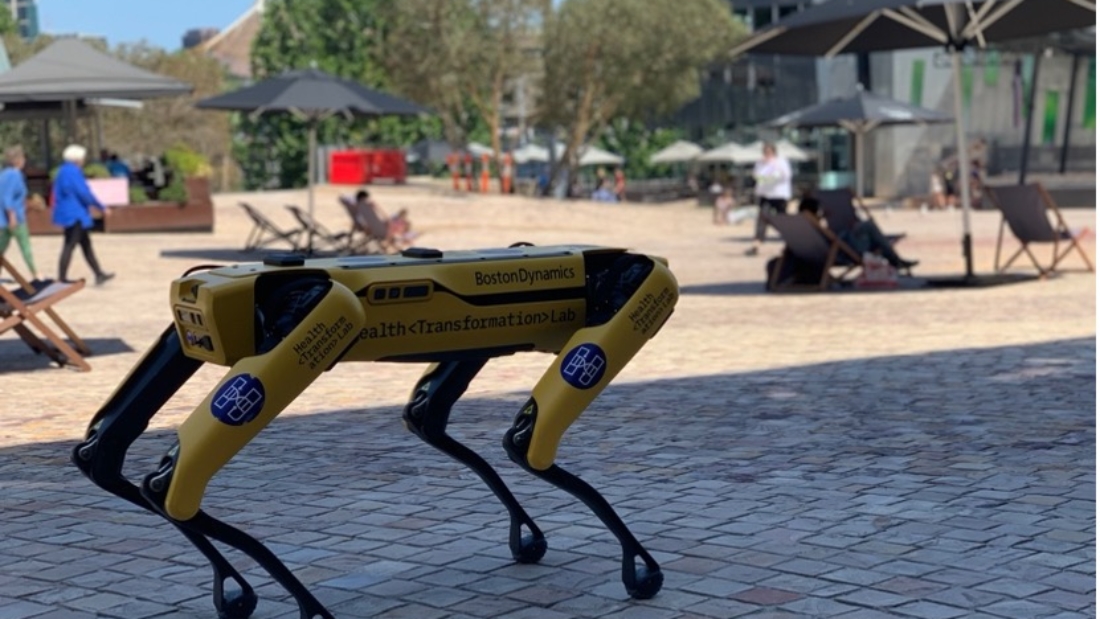
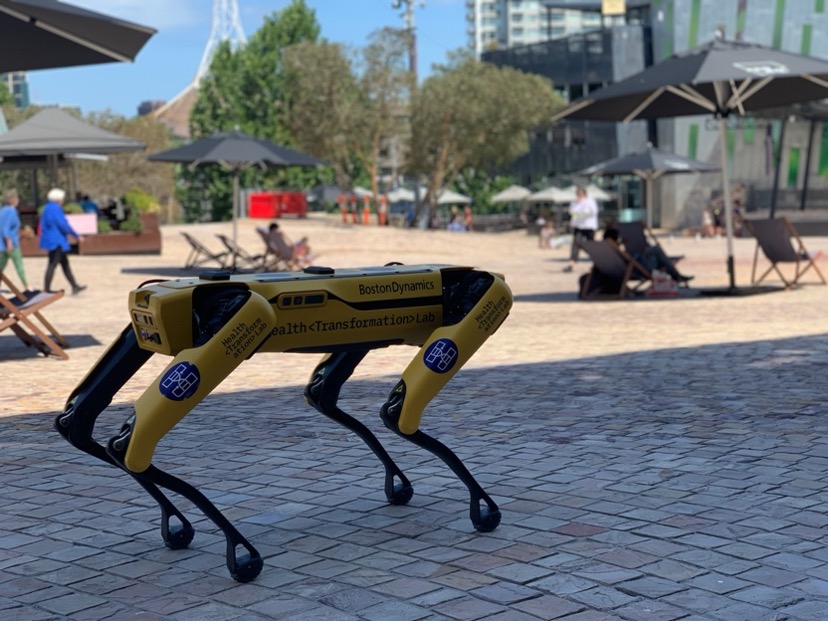
We actually observed something very specific, as we had another participant joining us: Boston Dynamic’s robot Spot!
Spot on Federation Square (Source: picture credits to Alison Starr).
The focus of our observation and field day was to see how people of the public react and interact with Spot. This day was very insightful and lots of fun!
After that, we started reflecting on our experiences as a group and heard lectures on some useful tools for the analytical processing of the data, namely on Situational Mapping and Critical Making techniques. Then, each group put together two presentations to share with the other participants: one on our initial reflections of the field day and one on initial findings from the first attempts of analysing some data.
Personal key take-aways
I will very shortly touch upon 3 key take-aways from this summer school:
Ethical considerations: Before, during, and after doing research.
It was great to discuss this central topic in research again: how important it is for a researcher to constantly reflect on ethical considerations.
Before the research this seems obvious to most: often simply because you need to obtain ethical approval to do your study. But it doesn’t end there, continuously throughout your data collection time – you need to be aware of your positionality (am I an outsider, an insider?), what effect your research or your presence in the field could have on others, and that you will always bring in subjectivity when entering a field. The more you reflect on these things, the better and the more you can ensure that your research will be ethical. Ethics is not simply an approval to obtain – it is there to support you to do the right thing. It helps you to reflect on possible issues that might arise and to plan ahead on how you will react to them.
Looking at the data in a group: Surprises can emerge.
During the analysis stage, we had access to the data we collected ourselves and the data from all other researchers. A key take-away for me here is that looking at data in a group can lead to many different insights and surprising themes! It enriches the analysis process greatly as every member brings a unique point of view into the discussion.
It was exciting to see all the interesting themes that emerged during the analysis process with my group. We talked about the agency of oneself and how we ascribe agency to others (e.g., Spot). While I wasn’t too surprised that participants seemed to struggle to categorize Spot (Is it a dog? A horse? A spider?), I was intrigued by the fact that most people really wanted to categorize it. They either asked a lot of questions or started treating it in a certain way (e.g., petting it etc). Other interesting topics that emerged were control (people started giving Spot commands) and embodiment (participants reflected on their feelings in a bodily sensation).
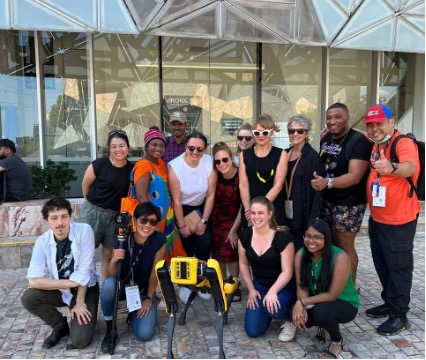
About half of the participants of the summer school + Spot at Federation Square. (Picture credits to Haryo Jiwandono).
Not just valuable learnings: Good company & good food.
The last key take-away is clearly that I learned a lot and enjoyed the summer school greatly. I met fascinating people from all (literally every continent except Antarctica was represented) over the world from various disciplines (architecture, urban studies, anthropology, design, journalism, organisational studies…). Actually – one of them, Kateryna Kryzhanivska, who is also a visiting PhD researcher at RMIT, and she is from LUT University, Business School! (which shows again that the world can be really small as well).
Who knows – maybe some of these connections will last and result in future collaborations!
Further, good food is a great plus in any event.
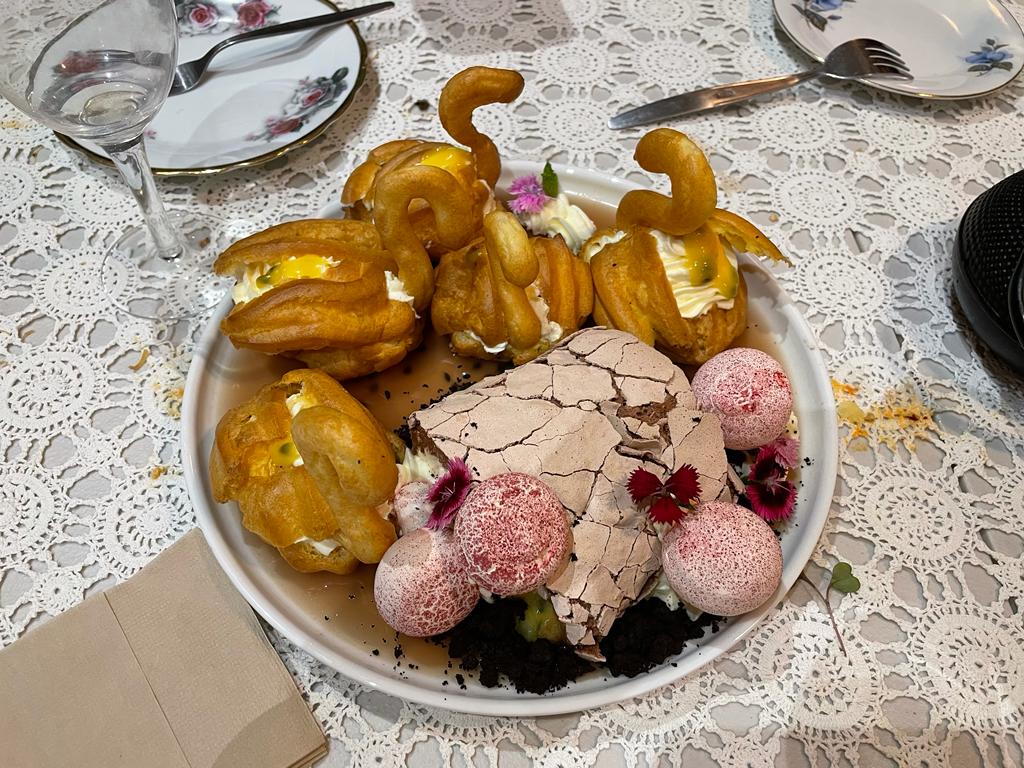
The desert at the Welcome Dinner provided by “Piecurious” run by Helen Addison-Smith (picture taken by Constanze Leeb).
All in all I can say:
It was intense, insightful and amazing – a week well spent!
Shopping Basket
This website collects cookies to enable the proper functioning and security of the website, and help us offer you a better browsing experience. By using our website you agree we can place functional and analytical cookies on your device. Find out more about cookies and how to manage them by visiting the RMIT Privacy Statement link in the website footer. If you're happy to continue, please press accept. You can opt-out if you wish but this may affect how the website functions. Cookie settingsACCEPT
Privacy and Cookies Policy
Privacy Overview
This website uses cookies to improve your experience while you navigate through the website. Out of these cookies, the cookies that are categorized as necessary are stored on your browser as they are essential for the working of basic functionalities of the website. We also use third-party cookies that help us analyze and understand how you use this website. These cookies will be stored in your browser only with your consent. You also have the option to opt-out of these cookies. But opting out of some of these cookies may have an effect on your browsing experience.
Necessary cookies are absolutely essential for the website to function properly. This category only includes cookies that ensures basic functionalities and security features of the website. These cookies do not store any personal information.
Any cookies that may not be particularly necessary for the website to function and is used specifically to collect user personal data via analytics, ads, other embedded contents are termed as non-necessary cookies. It is mandatory to procure user consent prior to running these cookies on your website.