Screenshot 2024-03-05 at 14.32.13

Tackling the Internal Transition to Scale of Digital Innovations

Aiming at being more effective and efficient in exploring digital innovations and new digital business ideas, incumbent firms have adopted separated structures such as innovation units, new business units, internal incubators and accelerators, digital labs, etc. While these structures have been successful in spurring new initiatives, they have not as effective in bringing these to scale. Part of the challenge is the need to transfer the new digital offerings, processes and models to core business and technology structures suitable for operationalising and/or commercialising these at scale – in other words, activities to explore new ideas in separated structures need to transition to become exploitative activities in core business and technology structures. This process, however, is far from simple as core business and technology structures are not naturally equipped with the needed capabilities and resources and its structures practices are often compatible with new digital solutions. 

In a recent publication, I aimed at tackling this challenge by embarking on a journey to dissect the transition to scale of eight digital service innovations developed in a large Asian incumbent bank. This exploration, detailed in the International Journal of Innovation Management, pivots around the intricate dance of transitioning digital innovations from their development in the Bank’s innovation unit to full-scale operationalisation and/or commercialisation in core business structures, with a focus on understanding the practices and challenges of enabling an aligned business-technology transition of digital innovations.  

Here, I present the essence of our findings and their implications for both academic research and industry practice: 

Key Highlights: 

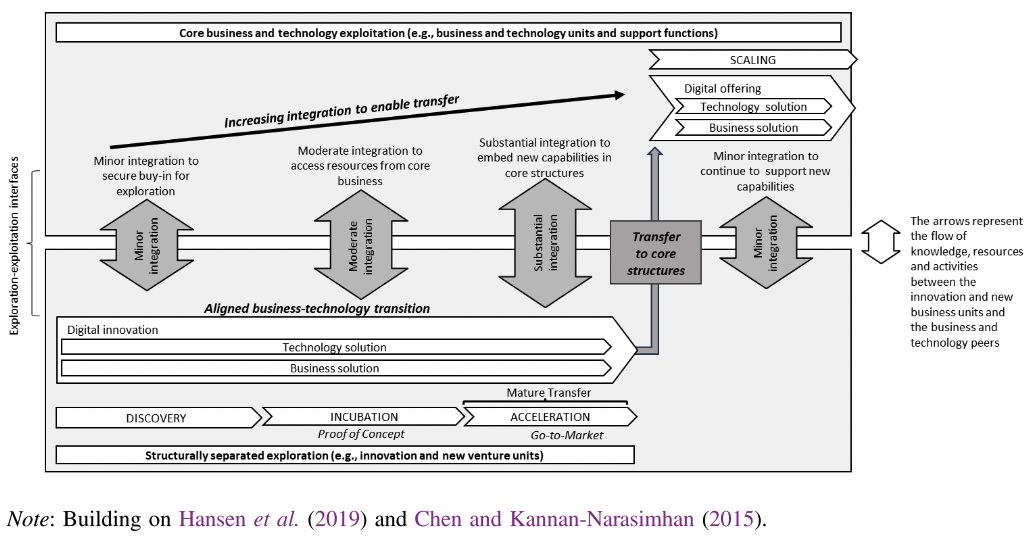
  • Introduction of a Dual Transition-to-Scale Model: We describe a nuanced framework that delineates the variegated intensities of integration, characterised by the flow of knowledge and resources between exploration and exploitation structures, required for digital innovations to seamlessly transition into scalable solutions. This model, described by innovation managers, focusses on manipulating the degree of integration to secure buy-in for the innovation, access core assets from business and technology peers, and embed new capabilities and resources in core structures to able the transfer of innovations to core business and technology actors.  

Aligned business-technology transition of DI with integration and transfer.Illustration 1. Aligned business-technology transition of DI with integration and transfer 

  • Diverse Project Scaling Trajectories: We outline three distinct scenarios of project scaling journeys, offering a granular view into the strategic integration and transition tactics pivotal for digital innovation scalability. In this, we describe how innovation managers deviate from the model that they describe by taking actions to cope with the challenges of pursuing digital innovation in an organisation still undergoing digital transformation. These coping actions, although aimed at creating the enabling conditions for innovations to transition, also created a disconnect between the business and technology transition of digital transformation, creating transition challenges at a later stage.  

Contributions to Academic Research: 

Our study enriches the academic investigation by presenting a model of how innovation managers expect to enable an aligned business-technology transition to scale and showing that integration and transfer decisions along the innovation process significantly impact the business-technology transition of digital innovations and, thus, need to be carefully managed to avoid misalignment.  

Contributions to Practice: 

For practitioners, this study offers actionable insights to orchestrate the scaling process effectively, ensuring that digital innovations are not only developed but also successfully operationalised and/or commercialised to achieve their full market potential. Innovation managers should be aware of their role in transition and of how their decisions around integration could affect transfer in the later stages. They should be careful not to create a disconnect between business and technology transition, which could have consequences not only for the scaling of the digital innovation but also for exploitation in the organisation. 

With this study, we aimed at expanding the scientific investigation into exploration-exploitation of digital innovations in the context of digital transformation. Yet, much remains to be understood and explored. In particular, how the orchestration of internal transition to scale might be effectively and efficiently aligned with go-to-market offers a promising area of investigation as innovation managers face the significant challenge of pursuing commercial success while needed to navigate the complex corporate environment. In short, companies need to be better in enabling internal transition and research has much to contribute.  

Photo by "My Life Through A Lens" on Unsplash.

Reflecting on the Power of Platforms: Bridging the Industry-Academia Gap During My PhD Journey 

During my academic journey as a PhD student, I’ve come to recognise the crucial role of platforms that facilitate interaction between academia and industry. For students like me, these spaces are not just areas of collaboration—they are realms of revelation. They have been pivotal in shaping my research, thinking, and understanding of how innovation and digital transformation play out in the real world. 

Real-World Context to Theoretical Studies 

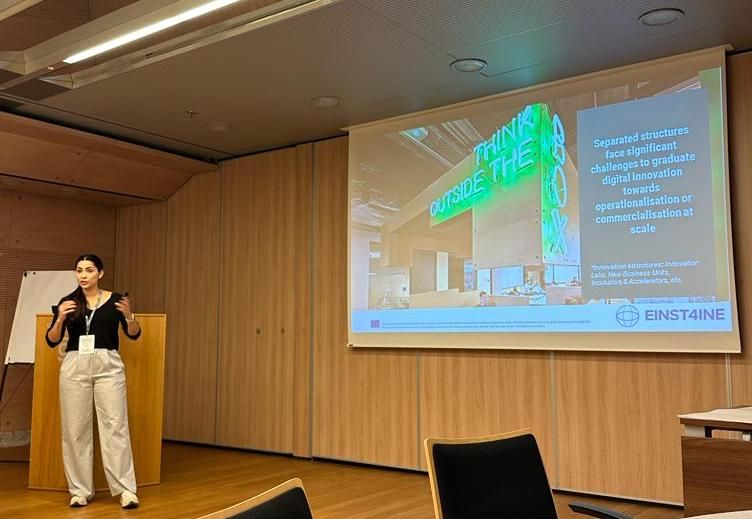
Source: own photo.

The world of academia often revolves around theories, models, and conceptual discussions. While this is essential for foundational knowledge, there’s a palpable gap when it comes to understanding how these theories apply to real-world scenarios. This is where industry-academia collaboration platforms come in. They provide PhD students like me with the real-world context, helping us align our research with genuine industrial needs and challenges. 

For instance, at the recent EINST4INE summer school at the Institute for Manufacturing (IfM) I had the incredible opportunity to engage with leading professionals from various sectors. These interactions brought home the stark realities and specific challenges they face; insights that can’t be gleaned from a textbook or a lecture. 

Enabling Impactful Research 

One of the essential goals of any research, especially at the PhD level, is to have a genuine impact. The industry offers a testing ground for our theoretical frameworks and models. By understanding the problems industry actors face, we can tailor our research to propose effective solutions. 

During my interactions at the summer school, discussions on innovation ecosystems and roadmaps as technology strategy tools were incredibly enlightening. This exchange allowed me to consider the application of theoretical constructs in diverse industrial settings, pushing me to think of research areas that truly matter. 

At the recent EINST4INE summer school, I also had the opportunity to discuss some of my research findings with industry experts and gather feedback on managerial tools that translate my research into practical applications. This opportunity is invaluable for PhD students who often lack the ability to directly engage with industry leaders.  

Preparing for a Seamless Transition 

Beyond research, these collaborative spaces prepare us for the eventual transition to the industry (if we choose that path). By understanding industry dynamics first-hand, we are better positioned to add value from day one. For someone like me, keen on ensuring that my research contributes to real-world impact, these platforms have been instrumental in aligning my studies with industry requirements. 

In Conclusion 

In the evolving landscape of innovation and digital transformation, the need for collaboration between academia and industry has never been more critical. Platforms and spaces that foster such collaboration are the bridges that connect theoretical knowledge with practical applications. As a PhD student, I can attest to the immense value they bring—not just in enriching our research but in moulding us to be better contributors to the world of industry and innovation. 


kvalifik-5Q07sS54D0Q-unsplash

Insights on the Role of Innovation Managers in the Transition to Scale of Digital Innovations

My quest to better understand the scaling challenge in digital transformation led to focus my research on the challenge of transitioning – the very needed – digital innovations (DIs), including processes, products, services and models, to operationalisation or commercialisation at scale in incumbent firms.  

According to recent industry estimates, around 75% of DIs still stall before reaching the desired scale (Martin 2018). This is a big issue; if companies continue to struggle to reap the benefits of their investment, we will have an endless cycle of search and failure.  

One of my areas of interest is the role of innovation managers in the transition to scale of digital innovations, especially when these innovations are developed in separated in dedicated structures (e.g., Digital Innovation Units, Innovation Labs, New Venture Units).  

Recently, I had the change to attend  ISPIM – International Society for Professional Innovation Management conference 2023, held in beautiful Ljubljana, and present some of my research. I was very happy to learn that my paper “Digital Innovation: Exploring Integration and Transition Modes in Scaling Success” was one of the three nominees for the Alex Goffman Award for the best student paper. 

Source: own photo.
Conference paper presented at XXIV ISPIM Innovation Conference and published in conference proceedings.


The Role of Innovation Managers in the Transition to Scale of Digital Innovations: Key Takeaways 

The rise of digital technology is reshaping the landscape of businesses globally. In a comprehensive study, we delved into the critical role innovation managers play within large incumbent firms during their digital transformation journeys. Here’s what we found: 

  1. The Orchestrating Role of Innovation Managers: Innovation managers are not just pioneers of innovative ideas. They are the very bridges that connect novel digital solutions to traditional business operations. They facilitate communication, handle resources, and manage complex interdependencies to ensure that innovations don’t just remain ideas but become scalable solutions. In this, innovation managers are the key enablers of the transition to scale of digital innovations by orchestrating the integration of new digital solutions and offerings with core business, ensuring these find a suitable home in the core of the organisation and managing the process through which these digital innovations migrate to the core structures of the organisation. 
  2. The Standard Transition Model: Innovation managers have in mind a standard transition model for digital innovations. It’s thought that innovations will smoothly integrate with core business, become self-sufficient in the core of the organisation, and then scale. However, the reality of such transitions can be vastly different. 
  3. Challenges in Digital Innovation: The process of transitioning digital innovations is riddled with challenges. From resource allocation hurdles to cumbersome task allocation in core businesses, innovation managers frequently face obstacles in turning a digital idea into a successful operation. 
  4. Adapting to Challenges: One size does not fit all. Depending on the challenges faced, innovation managers might deviate from the standard transition model. These deviations are essential to ensure that digital innovations can continue to progress towards becoming scaled solutions, but they also come with important trade-offs.  

In conclusion, as the digital landscape rapidly evolves, the role of innovation managers becomes ever more pivotal. They stand at the crossroads of traditional business operations and groundbreaking digital solutions, ensuring not just the birth of innovative ideas but their successful journey to large-scale operations. 

Despite their crucial role, research has only recently started to investigate the actions of innovation managers beyond overseeing the innovation process. We need more research that brings insights into the role of innovation managers in the implementation of digital innovations, so that we can better understand how transition to scale challenges emerge, what strategies, actions or mechanics are used to cope with these challenges and how, in turn, these affect scaling.  

Robot handshake human background, futuristic digital age

How can AI technologies such as ChatGPT help us in our PhD journey?

Completing a PhD is an intensive and demanding task. As a PhD student, we spend countless hours scouring through academic literature, collecting data, analysing information, etc.. The good news is that advanced technologies, such as ChatGPT, can help make this process much easier.

ChatGPT is an artificial intelligence (AI) chatbot developed by OpenAI designed to understand and generate human-like language. The advantage of ChatGPT is that it can help make the process of searching and analysing online information much faster.

Here are some ways ChatGPT can help PhD students do research:

Finding relevant literature

One of the most time-consuming tasks for PhD students is finding relevant literature for their research. ChatGPT can help by providing instant access to a vast collection of academic literature. With the help of natural language processing (NLP), ChatGPT can quickly search and retrieve relevant papers, books, and other academic sources, saving you valuable time and effort.

Generating research questions

ChatGPT can also help PhD students brainstorm research questions. By inputting keywords or phrases related to your research topic, ChatGPT can generate a list of potential research questions. This can be especially helpful when you’re stuck and need some inspiration to jump-start your research.

Data analysis

Data analysis is an essential aspect of many research projects. ChatGPT can be used to help with this by assisting in the analysis of complex data sets. With its NLP capabilities, ChatGPT can quickly identify patterns, trends, and correlations in data, providing valuable insights that can help support your research conclusions.

Writing assistance

Another critical aspect of the research process is writing. ChatGPT can help PhD students with their writing by providing suggestions for grammar, style, and tone. It can also generate summaries, abstracts, and even full paragraphs, which can be useful when you’re struggling to articulate your ideas.

Literature reviews

ChatGPT can be used to assist with writing literature reviews. It can help to summarize key findings and highlight important points from multiple sources, making the process of synthesizing and analysing academic literature much more manageable.

Of course, ChatGPT does not work miracles and should also not be trusted blindly. PhD students need to be attentive to potential biases, as an example. They will also need to make sure that the answers provided by ChatGPT are used as a brainstorming or supporting tool, and not as something that limits their thinking. Yet, as we move to a world increasingly dominated by advanced technologies such as AI, we would benefit from thinking about how we can use it to advance our work, making us more efficient and effective researchers.

In short, ChatGPT can be an incredibly valuable tool for PhD students, helping to streamline the research process and save time and effort.

Photo by Michael Dziedzic on Unsplash

Digital Transformation Success and Failure – Part II Insights from the Academic Literature

Digital Transformation Success and Failure – Part II Insights from Academic Literature 

In my previous blog post – check it out if you have not seen it yet – I explored the industry and grey literature to find out what is known about the high failure rate of digital transformation initiatives, especially regarding the human and organisational factors that might contribute to the issue. 

This time, I am delving into the academic literature. Quick disclaimer, this is by no means a literature review. I have no intention of summarising the whole literature on the topic. Rather, you might approach this blog post as “scraping the surface” to get an initial general idea of what is said. 

Defining Success or Failure 

When looking at what defined success or failure in digital transformation, and how to measure it, I am sad to conclude that academic literature did not have great new insights. In general, my thoughts remain the same; more consensus is clearly needed on how to define and measure success and failure of digital transformation.  

That said, there are some interesting discussions regarding what it means to “digitally transform”. While in the industry literature there was little, if any, discussions regarding what defines digital transformation in the first place, the academic literature is very concerned with this matter.  

What is digital transformation?  

There are numerous definitions of digital transformation (DT) in the literature, but in general, DT is seen as process through which organizations leverage information, computing, communication, and connectivity technologies to trigger significant changes to its properties. Some authors see DT as a stage of transformation that follows the IT enabled transformation phenomenon in organisations and is particularly differentiated from digitalisation and digitisation for its transformation or redefinition of value creation paths. In general, academic literature points out to the disruptions and opportunities that digital technologies bring for business model transformation and the strategic renewal of firms.  

Along these lines, the understanding of success and failure in DT should be concerned with extent to which organisations are able to leverage digital technologies to redefine how the create and deliver value to customers.  

Challenges and Barriers in Digital Transformation 

Research and practice show that the pursuit of DT, and the related business model redefinition and transformation, is far from a simple and straightforward endeavour. In fact, the process is plagued by significant challenges and barriers.  

DT scholars have repeatedly stated that digital transformation is a huge and extremely difficult endeavour and that organisations attempting to digitally transform face significant challenges in making the change. 

First, at the organisational level, digital transformation scholars have paid particular attention to the issues of rigidity, change resistance and inertia. Further, they highlight that digital transformation requires organizational processes, structures, and capabilities that firms often lack. 

Firms also face the challenge of balancing the successful management of a healthy core businesses with the diverse development of multiple innovation efforts and the overall transformation process that entails substantial changes at all levels of the organisation. This is far from simple. In fact, trying to balance these efforts often lead to managerial paradoxes and tensions that are difficult, if not impossible to solve. 

Is leadership that important? 

Yes, but not alone. Aligned to the huge attention given to leadership in the grey literature, numerous digital transformations analysed the role of top management involvement and leadership in solving the challenges of innovation and transformation. In this regard, the literature agrees that yes, leadership is very important. However, studies also found that leadership involvement alone is not sufficient to solve the challenges of DT, with organisational design and competencies, being of key importance. 

Is scaling really a big issue? 

Yes, but it is seems like it still not as well understood as we would have expected. The academic literature seems to agree that firms often fail to bring DT initiatives to grow into a stage where they have transformational power. However, the academic literature tends to do the same as the grey literature; it focusses on the success factors as to demonstrate “how they succeed”, instead of “why they fail so much”.  

That said, so interesting insights do exist in the DT and aligned literature. Mostly, the academic literature highlights the same challenges as the grey literature but goes further in explaining why these challenges exist. 

Key Failure Factors 

In the scaling phase, projects face several uncertainties: 

  • Technical uncertainties related to the underlying scientific knowledge, including technical feasibility, manufacturing, and maintainability.  
  • Market uncertainties comprise to what extent customer needs are understood, transformed into products, and superior customer value is generated compared to competition.  
  • Organizational uncertainties address the organizational and managerial conflict of fostering innovation while pursuing operational activities.  
  • Resource uncertainties embrace all difficulties of internally and externally acquiring needed resources for innovation.  

Additionally, the academic literature points out that, especially regarding the new business models that are expected to come from digital transformation, the economic logic makes it hard for leaders and managers to prioritise these projects. That is to say, before scale, new business initiatives will never be as economically viable as the core businesses. Investing in the scale of these initiatives only makes sense if a future lens is applied. Because of these many uncertainties, innovation and transformation activities often get neglected in favour of day-to-day business needs.  

Further, multiple actors in the organisation will have different perspectives on the economic value of such new business and just the decision to scale is far from sufficient to guarantee scaling.  In fact, the academic literature highlights that scaling initiatives require significant changes for the core business units of the organisation. For digital transformation to succeed, the core of the organisation needs to migrate towards operating digital businesses.  

Thus, in additional to managing the successful scaling in the commercialisation of new digital businesses initiatives, companies need to manage the successful scaling in the transformational effect of these. Double the effort, double the trouble… 

What is next? 

Well, I just started to scrape the surface of the literature in digital transformation, so more insights will come soon. I will keep updating on the interesting discussions I find in the literature. Also, please do contribute! Any interesting insights into why digital transformation is so hard to scale? 


REFERENCES 

Appio, F. P., Frattini, F., Petruzzelli, A. M., & Neirotti, P. (2021). Digital Transformation and Innovation Management: A Synthesis of Existing Research and an Agenda for Future Studies. In Journal of Product Innovation Management (Vol. 38, Issue 1, pp. 4–20). Blackwell Publishing Ltd. https://doi.org/10.1111/jpim.12562 

Baculard, L.-P., Colombani, L., Flam, V., Lancry, O., & Spaulding, E. (2017). Orchestrating a Successful Digital Transformation. 

Bosler, M., Burr, W., & Ihring, L. (2021). Digital Innovation in Incumbent Firms: An Exploratory Analysis of Value Creation. International Journal of Innovation and Technology Management, 18(2). https://doi.org/10.1142/S0219877020400039 

Burgers, J. H., Jansen, J. J., van den Bosch, F. A., & Volberda, H. W. (2009). Structural Differentiation and Corporate Venturing: The Moderating Role of Formal and Informal Integration Mechanisms. Journal of Business Venturing,24(3), 206–220. 

Campbell, A., & Park, R. (2005). The Growth Gamble: When Leaders Should Bet Big on New Business and How They Can Avoid Expensive Failures. Nicholas Brealey International. 

Colarelli, O’Connor G., & Demartino, R. (2006). Organizing for Radical Innovation: An Exploratory Study of the Structural Aspects of RI Management Systems in Large Established Firms. Journal of Product Innovation Managemement , 23, 475–497. 

Correani, A., de Massis, A., Frattini, F., Petruzzelli, A. M., & Natalicchio, A. (2020). Implementing a Digital Strategy: Learning from the Experience of Three Digital Transformation Projects. California Management Review, 62(4), 37–56. https://doi.org/10.1177/0008125620934864 

Cozzolino, A., Verona, G., & Rothaermel, F. T. (2018). Unpacking the Disruption Process: New Technology, Business Models, and Incumbent Adaptation. Journal of Management Studies, 55(7), 1166–1202. https://doi.org/10.1111/joms.12352 

Gassmann, O., Widenmayer, B., & Zeschky, M. (2012). Implementing radical innovation in the business: the role of transition modes in large firms. 

Hanelt, A., Bohnsack, R., Marz, D., & Antunes Marante, C. (2021). A Systematic Review of the Literature on Digital Transformation: Insights and Implications for Strategy and Organizational Change. Journal of Management Studies, 58(5), 1159–1197. https://doi.org/10.1111/joms.12639 

Hill, S. A., & Georgoulas, S. (2016). Internal Corporate Venturing: A Review of (Al-most) Five Decades of Literature. In S. A. Zahra, J. Hayton, & D. O. Neubaum(Eds.),Handbook of corporate entrepreneurship(pp. 13–63). Cheltenham, UK:Edward Elgar. 

Hoonsopon, D., & Ruenrom, G. (2012). The Impact of Organizational Capabilities on the Development of Radical and Incremental Product Innovation and Product Innovation Performance. In Journal Of Managerial Issues: Vol. XXIV. 

Lanzolla, G., Lorenz, A., Miron-Spektor, E., Schilling, M., Solinas, G., & Tucci, C. L. (2020). Digital transformation: What is new if anything? Emerging patterns and management research. Academy of Management Discoveries , 341–350.  

Menz, M., Kunisch, S., Birkinshaw, J., Collis, D. J., Foss, N. J., Hoskisson, R. E., & Prescott, J. E. (2021). Corporate Strategy and the Theory of the Firm in the Digital Age. Journal of Management Studies, 58(7), 1695–1720. https://doi.org/10.1111/joms.12760 

Nadkarni, S., & Prügl, R. (2021). Digital transformation: a review, synthesis and opportunities for future research. Management Review Quarterly, 71(2), 233–341. https://doi.org/10.1007/s11301-020-00185-7 

Nambisan, S., Lyytinen, K., Majchrzak, A., & Song, M. (2017). Digital Innovation Management: Reinventing Innovation Management. Research in a Digital World. MIS Quarterly, 41(1), 223–238. https://doi.org/10.25300/MISQ/2017/41:1.03 

Raisch, S., & Tushman, M. L. (2016). Growing New Corporate Businesses: From Initiation to Graduation. Organization Science, 27 (5), 1237–1257 

Schneckenberg, D., Matzler, K., & Spieth, P. (2021). Theorizing business model innovation: an organizing framework of research dimensions and future perspectives. R&D Management, 2021, 10(13). 

Siachou, Evangelina, Vontris, Demetris and Trichina, Eleni, 2021. Can traditional organizations be digitally transformed by themselves? The moderating role of absorptive capacity and strategic interdependence.  Journal of Business Research, 124, pp. 408-421.  

Slater, S. F., Mohr, J. J., & Sengupta, S. (2014). Radical product innovation capability: Literature review, synthesis, and illustrative research propositions. Journal of Product Innovation Management, 31(3), 552–566. https://doi.org/10.1111/jpim.12113 

Smith, P., & Beretta, M. (2021). The Gordian Knot of Practicing Digital Transformation: Coping with Emergent Paradoxes in Ambidextrous Organizing Structures*. Journal of Product Innovation Management, 38(1), 166–191. https://doi.org/10.1111/jpim.12548  

Vial, G. (2019). Understanding digital transformation: A review and a research agenda. In Journal of Strategic Information Systems (Vol. 28, Issue 2, pp. 118–144). Elsevier B.V. https://doi.org/10.1016/j.jsis.2019.01.003 

Wessel, L., Baiyere, A., Ologeanu-Taddei, R., Cha, J., & Jensen, T. B. (2021). Unpacking the difference between digital transformation and IT-enabled organizational transformation. Journal of the Association for Information Systems, 22(1), 102–129. https://doi.org/10.17705/1jais.00655 

Zott, C., Amit, R., & Massa, L. (2011). The business model: Recent developments and future research. In Journal of Management (Vol. 37, Issue 4, pp. 1019–1042). https://doi.org/10.1177/0149206311406265 

Zott, C., & Amit, R. (2015). Business model innovation: Toward a process perspective. In C. Shalley, M. A. Hitt, & J. Zhou (Eds.), The Oxford Handbook of Creativity, Innovation and Entrepreneurship(pp. 1–14). Oxford: Oxford University Press 

 

Digital Transformation Success and Failure – Part I Insights from Industry and Grey Literature

Digital Transformation Success and Failure – Part I Insights from Industry and Grey Literature

The ability to leverage digital technologies is a business imperative. In pursuit of digital business, companies across the globe have dedicated significant resources to pursuing digital innovation and new digital business creation. Yet, industry and academic research consistently report a high failure rate.

Intrigued, I decided to explore what is known about the high failure rates of digital transformation initiatives, especially regarding the human and organisational factors that might contribute to the issue.

Given the attention the topic has received in the business and management media, on this post, I investigate what the industry literature has to say about the topic (on my next post, I will look at what academia has to say. So come back if you want to get hear from the other side).

For this investigation, I focussed on the outlets with most influence. Thus, I selected reports of research conducted by leading global consulting firms. Reports and articles on the topic were found for Bain & Company, Boston Consulting Group, and McKinsey & Company. In addition, a sample of articles were sourced from three actors with significant influence among practitioners: Forbes, MIT Sloan Management Review and Harvard Business Review.

Defining Success or Failure

According to the articles and reports analysed, success range from 5 to 30 percent. Flipping the coin, that means a 95 to 70 percent failure rate. However, the way success and failure is defined vary greatly from one source to the other. I found that while some focus on the success of the overall digital transformation over time, others counted each individual project developed as part of a digital transformation journey. In both cases, however, industry actors asked executives and senior managers to report to what extent their initiatives had succeeded.

My own thoughts were that more consensus is clearly needed on how to define and measure success and failure. Let´s hope that we can get more insights on this from the academic literature.

Table 1. Reported success and failure rates: Sample Bain & Company, BCG and McKinsey & Company

Source What is measured Achieved or Succeeded Partial Results Failed
Bain & Company
(2017)
Success of digital transformation initiatives 5% Achieved or exceeded expectations 75% Settled for dilution of value and mediocre performance 20% Failed to deliver, producing less than 50% of the expected results
BCG (2020) Success of digital transformation projects 30% met or succeeded their targets and resulted in sustainable change 44% created some value but did not meet their targets and resulted in only limited long-term change 26% created limited value (less than 50% of the target), producing no sustainable change
McKinsey & Company (2018) Success of overall digital transformation 16 % have successfully improved performance and also equipped them to sustain changes in the long term. 7 % performance improved but improvements were not sustained. 77% performance did not improve*


* Implied, but not stated

Key Success Factors

Although the industry literature all start by highlighting the high failure rate, the bulk of the attention has been on the key success factors based on what leading organisations have done right. The most systematic or semi-scientific industry research has been along these lines. So, what do they say?

First, my assumption was right, industry literature state that people and organisational factors are much more determinant to success than technological elements (Baculard et al., 2017; BCG, 2020; McKinsey, 2018). Successful companies tend to focus on and invest heavily in the fundamental changes to their ways-of-working and culture that enable them to develop digital innovation initiatives rapidly and execute them at scale. That means that companies that succeed focus on developing human and organisational elements along with investing in technology.

Next, there are numerous commonalities regarding the factors cited as key for success in digital transformation. In general, these are:

  • Clear digital transformation vision, strategy and roadmap, with aligned goals, metrics and monitoring tools
  • Strong engagement of leadership and middle-management, with aligned ownership and accountability
  • Development of talent within the organisation and engagement of key employees in developing and executing digital transformation
  • Adoption of new ways of work, especially lean and agile, and enabling innovation
  • Building foundational digital technologies guided by business needs

Interestingly (but not surprisingly given that the targeted audience tends to be executives), industry literature LOVES to talk about top leadership. The key success factors related to leadership tend to focus on strong involvement in design and implementation, alignment among leadership groups, encouraging and empowering employees to adopt new ways of work and innovate, communicating effectively and creating a sense of urgency, effectively monitoring initiatives, and having incentives attached to digital transformation. So, nothing new here…

Looking at the reasons why digital transformation fails, however, these success-focussed industry literature tends to equate the cause of failure to organisations not doing what successful organisations have done, or not doing it sufficiently (BCG, 2020) – that is to say, if organisations had done exactly what successful organisations did, they most likely would have succeeded.

In my view, however, this is overly simplistic as it does not investigate the specificities for why organisations have not succeeded in doing what others have done. It might often be the case that they have, indeed, tried to do exactly the same – it might not be a case of not knowing what should be done. In these cases, saying they have not done what others have done equate to saying “they failed because they could not succeed.”.

Key Failure Factors

While there are a few industry studies systematically listing the success factors of digital transformation, industry literature truly discussing failure factors tend to be more dispersed across multiple news articles, reports and case studies.

A common practice is to list reasons why companies fail based on personal experiences, anecdotical information or “previous studies” and tend to focus on well-known challenges and barriers to digital transformation.

These include:

  • Not understanding digital transformation
    • Placing technology at the centre of digital transformation, instead of approaching it as a business transformation
    • Mistaking digitization, converting digital products or processes to a digital form, for digitalization, making the most out of opportunities of digital products and processes
  • Miscalculating efforts
    • Overestimating benefits and underestimating costs, especially by senior management
    • Underestimating the amount of legacy applications that need to be digitally transformed
    • Lack of understanding that “it is going to be hard” and commitment despite the challenges
  • Not doing implementation well
    • Working with poor onboarding and implementation processes for digital transformation projects and initiatives
    • Misaligned goals and stakeholders (across levels, teams, business units, partners, etc.) and lack of coordination
  • Issues at the project level
    • Poor user-market-solution fit of digital innovations, low focus on customer value, or lack of alignment to company’s strategy and strengths
    • Miss-alignment between digital capabilities supporting pilot and capabilities for supporting scale
  • Issues with employees
    • Employees’ resistance to change and fear of losing their jobs
    • Not having the proper skills, technical, business and innovation
  • Issues with culture
    • Fear of failure
    • Not being willing to spend time changing behaviours and how people make decisions (culture change).

Worth highlighting…

Digital Transformation is crazy hard

Digital transformation is significantly harder than conventional transformation (Baculard et al. 2017, p.1) and thus traditional change management best practices might not be sufficient or adequate to deal with the challenges at hand.

Part of the challenge is the need to manage an increasingly multi-faceted and diffused set of organisational transformations, while trying to create new digital businesses aligned to the needs of customers and the readiness of markets, and while also maintaining a healthy high-performing core business.

Another part of this challenge would be a consequence of digital technologies. Even if traditional companies are used to innovating in the product development realm, few are adept in deploying digital technologies to solve problems and boost performance across the organisation (Baculard et al. 2017, p.2).

Initiatives do happen, they just don’t scale

The image shows human figures climbing a bridge ladder. The ladder ends abruptly and human figures cannot move further. It demonstrates projects that cannot move beyond pilot phase.
Most of digital transformation initiatives stall at scaling phase. Image source: Radix Blog

Another element worth highlighting is that companies embarking on digital transformation tend to struggle to translate prototypes or pilots into products and capabilities that can have a meaningful impact on the company’s performance (Sutcliff, 2018).

While there is a proliferation of initiatives, they tend to plateau somewhere short of broad organizational impact. Indeed, a recent McKinsey & Company survey found that most (38%) of digital transformation initiatives stall at scaling phase (McKinsey, 2020). This has given placed to the expression “stalled in pilot purgatory” (Denning, 2021).

Most common indicated reasons for this include resourcing issues, misaligned culture and ways of working, lack of skills and competencies to bring these initiatives further (Sutcliff, 2018), lack of internal alignment and commitment, and lack of a well-integrated and communicated strategy and aligned initiatives (McKinsey, 2020). Also, noteworthy, the disconnect between those in charge of pilot initiatives and those in charge of operations (and thus potential scaling) has also been highlighted by industry literature (McKinsey, 2020). This happens even in the case of organisations that have built internal digital innovation units to pursue ambidexterity (Baculard et al., 2017), but without a clear indication of how to best concretely build this integration. This ends up creating “two-speed” organizations that are responsive in limited respects but still held back by legacy systems (Baculard et al. 2017, p.2).

The hidden leadership issues

Interestingly, some articles have started scraping the surface of potentially hidden leadership elements that might play an important role in digital transformation implementation. For instance, Baculard et al. (2017), writing for Bain & Company, hints to scepticism of managers as an element, suggesting that despite survey data reporting that digital investment is a top priority of management, anecdotal evidence suggests that many executives are sceptical that they can translate the buzz around digital into meaningful improvements in performance. This scepticism, in turn, could lead them to make day-to-day decisions that, paradoxically, deprioritises digital innovation and digital transformation.

As another example, Bughin et al. (2018),  writing for McKinsey & Company, hint towards the misalignment between management’s “intuition” – developed though years of formal education and practical experience based on traditional economic, strategic and operating models – and the new logic of a reality shaped by digital technologies. Denning, S. (2021) also talks about an “efficiency-driven” (decrease costs and maximize profits) mindset that does not fit the need for constant investment in skills and innovation of the digital reality. Managers have built their career on top of such intuition and are likely to make day-to-day decisions accordingly – even subconsciously and while understanding well the so called imperatives of successful digital transformation. Furthermore, this traditional intuition might clash with the requirements of digital transformation and digital innovation, leading to the emergence or exacerbation of tensions and paradoxes and the aggravation of challenges and complexities.

On the other hand, Sutcliff et al. (2018), in an article published by the Harvard Business Review, talk about the allure of a new exciting digital business model causing executives to not pay enough attention to the issues of the core business, especially when things are not going well for the existing business lines. In short, the illusion that a new tech-based digital business will solve all the companies problems without the need to deal with the rest.

So, what next?

In general, industry research indicates a clear need for academic investigation of digital transformation to gain a deeper understating of the challenges and potentially hidden complexities of digital transformation, including by moving beyond the focus on top leadership teams.

In particular, understanding of the challenges and complexities that drive failure in digital transformation is anecdotal at best. This is very little regarding the concreate challenges and complexities that managers can expect to experience on a daily-basis. In this regard, as Denning S. (2021) puts in a recent Forbes article, senior executives are frustrated by the slow pace and limited return on investment of their digital transformations, and are (still) unsure what is holding them back.

So next, let´s see how much better academic research is…

______________________________________________________________________________


References

Baculard, L.-P., Colombani, L., Flam, V., Lancry, O., & Spaulding, E. (2017). Orchestrating a Successful Digital Transformation. Bain & Company, November 2017. Available at: https://www.bain.com/contentassets/dd440ca288d34c16ba8cd3ab6ef69a04/bain_brief_orchestrating_a_successful_digital_transformation.pdf

Bock, R., Iansiti, M., & Lakhani, K. R. (2017). What the Companies on the Right Side of the Digital Business Divide Have in Common. Harvard Business Review. Available at: https://hbr.org/2017/01/what-the-companies-on-the-right-side-of-the-digital-business-divide-have-in-common

Boston Consulting Group (BCG). Flipping the Odds of Digital Transformation Success. October 2020. Available at: https://web-assets.bcg.com/c7/20/907821344bbb8ade98cbe10fc2b8/bcg-flipping-the-odds-of-digital-transformation-success-oct-2020.pdf

Bughin, J., Catlin, T., Hirt, M., & Willmott, P. (n.d.). Why digital strategies fail. McKinsey & Company, January 2018. Available at: https://www.mckinsey.com/business-functions/mckinsey-digital/our-insights/why-digital-strategies-fail

Bughin, J., Deakin, J., O’beirne, B., Manyika, J., & Catlin, T. (2019). Digital transformation: Improving the odds of success. Available at: https://www.mckinsey.com/business-functions/mckinsey-digital/our-insights/digital-transformation-improving-the-odds-of-success

Davenportand, T. H., & Westerman, G. (2018). Why So Many High-Profile Digital Transformations Fail. Harvard Business Review. https://hbr.org/2018/03/why-so-many-high-profile-digital-transformations-fail

Denning, S.. Why Digital Transformations Are Failing The Meager Returns From “Digital Transformations. Forbes, June 2021. Available at: https://www.forbes.com/sites/stevedenning/2021/05/23/why-digital-transformations-are-failing/?sh=6184178e7617

Deloitte. (2021). A new language for digitaltransformation. https://www2.deloitte.com/us/en/insights/topics/digital-transformation/digital-transformation-approach.html?id=us:2em:3na:4diUS164855:5awa::MMDDYY::author&pkid=1008296

Forbes Technology Council – Expert Panel. 13 Industry Experts Share Reasons Companies Fail At Digital Transformation. Forbes, June 2021. Available at: https://www.forbes.com/sites/forbestechcouncil/2021/06/15/13-industry-experts-share-reasons-companies-fail-at-digital-transformation/?sh=1a544ce47a3f

McKinsey & Company (McKinsey). How to restart your stalled digital transformation. (2020). March 2020. Available at: https://www.mckinsey.com/~/media/mckinsey/business%20functions/mckinsey%20digital/our%20insights/how%20to%20restart%20your%20stalled%20digital%20transformation/how-to-restart-your-stalled-digital-transformation.pdf?shouldIndex=false

McKinsey & Company (McKinsey).Why do most transformations fail? A conversation with Harry Robinson. July 2019. Available at: https://www.mckinsey.com/business-functions/transformation/our-insights/why-do-most-transformations-fail-a-conversation-with-harry-robinson

McKinsey & Company (McKinsey). Unlocking success in digital transformations. October 2018. Available at: https://www.mckinsey.com/~/media/mckinsey/business%20functions/people%20and%20organizational%20performance/our%20insights/unlocking%20success%20in%20digital%20transformations/unlocking-success-in-digital-transformations.pdf?shouldIndex=false

Mike Sutcliff, Raghav Narsalay, & Aarohi Sen. (n.d.). The Two Big Reasons That Digital Transformations Fail. Harvard Business Review. Retrieved March 21, 2022, from https://hbr.org/2019/10/the-two-big-reasons-that-digital-transformations-fail

Rogers, B. (2016). Why 84% Of Companies Fail At Digital Transformation. Available at: https://www.forbes.com/sites/brucerogers/2016/01/07/why-84-of-companies-fail-at-digital-transformation/?sh=d987290397bd

Sutcliff M., Narsalay R., & Sen A. (2018). The Two Big Reasons That Digital Transformations Fail. Harvard Business Review, October 2018. Available at: https://hbr.org/2019/10/the-two-big-reasons-that-digital-transformations-fail

stephan-valentin-W6ukZyCANG0-unsplash

What does this mean for the people? Looking at the Human Side of Digital Transformation

As I start my PhD journey, it becomes ever more clear just how important it is to exchange with and learn from other dedicated to topics similar to mine. That is, the human side of digital transformation and innovation.

I have been told that PhD journeys can be quite lonely at times, so I hope that this blog will help me get a bit closer to the research and practice community and maybe we can have some fun, interesting and potentially very geeky discussions along the way.

For this first post, we were asked to reflect a bit on why we chose this PhD. Well, what a great task given that I love to reminisce! I hope you bear with me as I delve into times past and, in the process, I hope I get to tell you a little bit about the focus on my research.

When I was a young professional in the United Nation, I had the amazing opportunity to be part of a very small team that was put in charge of creating and leading an internal Innovation Lab. Since those early days, I was already mostly concerned with what it would take from the people point of view to bring innovation into our organisation. This was such a concern that the mission of our Innovation Lab was defined as “to unleash the creative and innovative potential of our people.”

It was a conscious decision not to worry about the technology or the ROI, and instead to focus on supporting people to innovate in whatever it was that they were doing.

As I reflect on the path I that have followed previously to joining the EINST4INE program, I come to realize that it was probably these experiences that prompted me to focus on the human element of digital transformation for my PhD.

Over the years as a practitioner, I had the opportunity to approach innovation and digital transformation from different and diverse angles, levels, perspectives, etc. Nevertheless, I always end up asking myself “what does this mean for the people?”.

I strongly believe that there is no innovation or digital transformation without people. It is the humans – that go to work every day with their fears, needs, desires, troubles, happiness, sadness, etc. – that innovate. They are the ones that transform. It is through the aggregation of their daily actions and behaviours that things change.

Yet, I was always intrigued by the relatively little attention that is given to them in academia.

I have wondered whether it is because it is challenging to understand humans – maybe because we enter the realm of vulnerability and, as Brené Brown[1] has so well highlighted, we tend to hide from vulnerability as hard as we can?

If that is the case, it might be even more important to focus on the people in the context of innovation and digital transformation. As Brené Brown also reminded us, it is in the realm of vulnerability that the magic happens.

Thus, my PhD focus: understanding how intrinsically human factors affect efforts by traditional companies to achieve digital transformation.

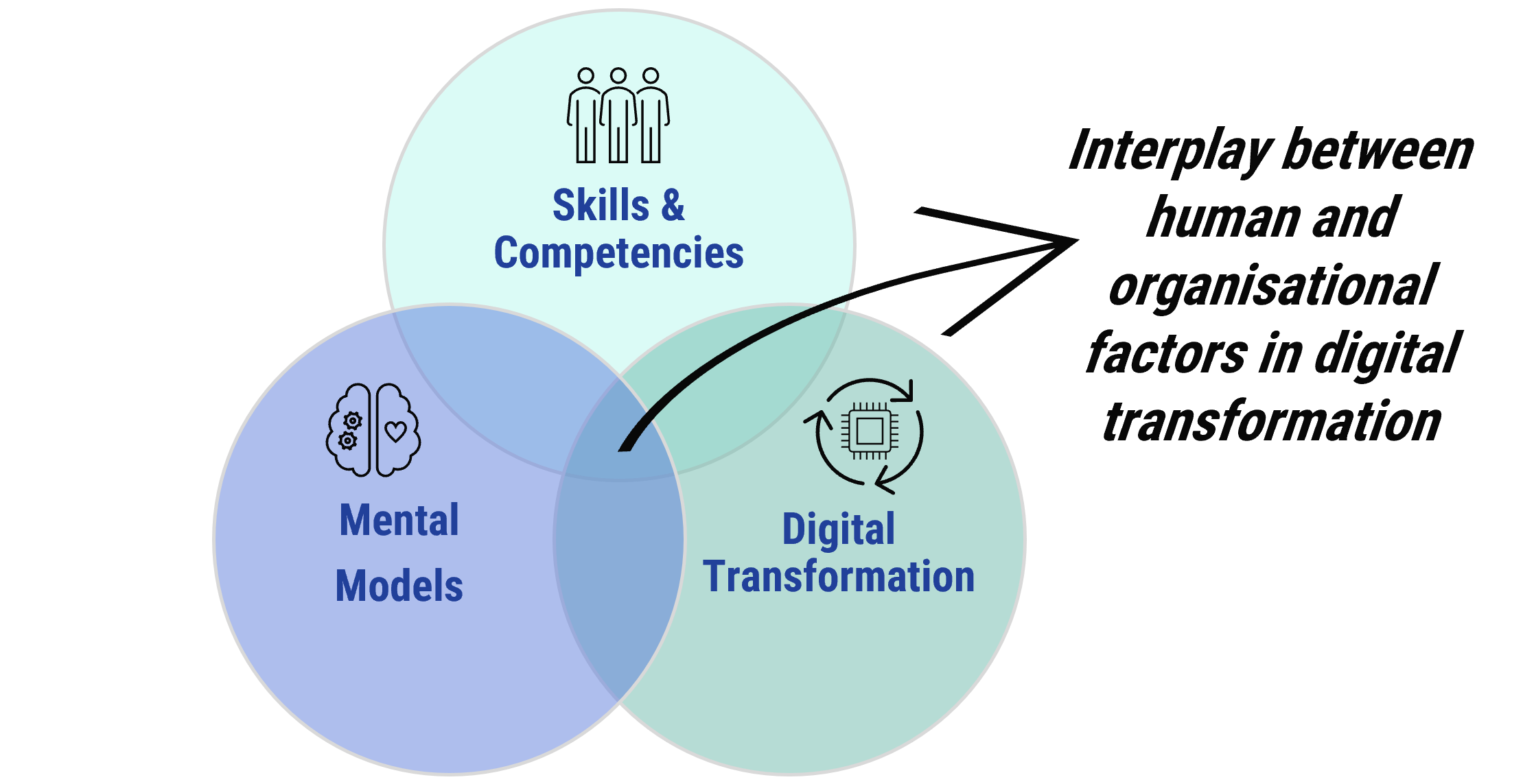
I believe that by developing a better understanding of how people’s skills, competencies, beliefs, behaviours, etc. interact with organizational factors such as strategies, projects, resources, processes, structure, etc. in the context of digital transformation we can get much deeper insights into what goes right and what goes wrong.

I do not mean to be negative, but as we know up to 80% of digital transformation efforts fail. Can we pause a minute to imagine just how much time, resources, blood, sweat and tears go into these 80%?

When I look at this number, I cannot stop myself from thinking that maybe we are missing something important. I hope that this research will contribute at least a little to solving some of the problem. Perhaps by finding new and better ways to design and implement digital transformation and innovation?

As this blog post goes live, I am on my third week of my PhD journey. So far, I have been enjoying reading what all the great authors have been investigating and saying about the topic.

I have a very long and arduous road ahead, but I could not be more excited to be a part of this EINST4INE cohort. I chose to apply to EINSTAINE because of its strong industry connections and diverse and top-notch team of scholars. Having had the chance to interact with my pears and some of the great researchers that are part of this programme, I certainly have high hopes for the future.

Now that I have taken you through a bit of a personal journey, I am wondering, how about you? Do you think any of this makes any sense? Or do you think this topic is a total waste of time? What would you suggest me to look into? And if you had a wish list of things you would love to know about the human side of innovation and digital transformation, what would be in it?

I look forward to the interactions we will have as I move forward! And I hope you will find in this blog an enriching and safe space to exchange thoughts and ideas on helping humans innovate and transform their organisations.

[1]  Brené Brown is an American research professor, lecturer, author, and podcast host. Brown is known in particular for her research on shame, vulnerability, and leadership.