In the world of academic research, it’s common to embark on a journey with a specific destination in mind (at least that was my path). Guided by established theories and prior studies, we often believe we know where our research will take us. My recent experience with a case study on innovation ecosystems, particularly focusing on environmental sustainability, was a humbling reminder of the unpredictable nature of inquiry.
As is the beauty—and sometimes, the frustration—of qualitative research (though it’s worth noting that surprises aren’t exclusive to this methodology), I was in for some revelations, when taking a closer look at how companies carry out projects…
… As I was delving into the practices of companies engaged in green transition projects, I encountered a case that exemplifies this perfectly: the renowned CopenHill facility in Copenhagen.
CopenHill is an example of a new breed of sustainability projects that are simultaneously functional and hedonistic. With its waste-to-energy plant, ski slope, and restaurant, CopenHill epitomizes the concept of “hedonistic sustainability”, a term brought to life by Bjarke Ingels, the architect behind the facility (Estika et al., 2020). Aimed at merging environmental responsibility with pleasure and aesthetic appeal, many of these new facilities stand as a testament to the interconnectedness of green projects with the social, cultural, and environmental fabric of their communities. They are “history-dependent and organizationally-embedded units of analysis” (Engwall, 2003), each following a unique trajectory influenced by a variety of factors.
Thus, the creation of such multifaceted projects involves a collaborative effort extending beyond the realms of engineering or business. To assess their success or failure, there is an increasing need to adopt inter- or multi-disciplinary approaches, as their implementation and development cannot be fully understood or effectively managed through a single field of knowledge. Instead, it requires the collaboration and integration of diverse disciplines, as I have come to realize. For this reason, the current findings of my case study research are steering me in a more sociological direction, to better understand the complexities of the green transition. In pursuit of this, I have enrolled in an immersive three-day course at Aarhus University, where I’ll delve into various sociological theories, including Actor-Network Theory and Transition Theory, to name a few. My aim is to enrich my comprehension of the historical and environmental contexts that surround my case study.
Of course, I’m eager to share my discoveries along the way, so stay tuned for more updates and revelations!
References:
Engwall, M. (2003). No project is an island: Linking projects to history and context. Research Policy, 32(5), 789–808. https://doi.org/10.1016/S0048-7333(02)00088-4
Estika, N. D., Kusuma, Y., Prameswari, D. R., & Sudradjat, I. (2020). The hedonistic sustainability concept in the works of Bjarke Ingels. ARTEKS : Jurnal Teknik Arsitektur, 5(3), 339–346. https://doi.org/10.30822/arteks.v5i3.487
Attending a Doctoral Colloquium can be an exciting and valuable experience for doctoral students at all stages in their journey. I was lucky enough to be accepted to this year’s R&D Management conference and Doctoral Colloquium, held in the beautiful (and very hot) Sevilla. This was my first time attending a colloquium so I thought I would share my experiences to help other first-time goers or those that are simply interested to learn more about the experience.
The colloquium typically provides a platform for doctoral candidates to present themselves and their ongoing research work, receive feedback, and interact with experienced researchers and scholars in our field. Here are my key takeaways:
Research is MEsearch:
Alberto Di Minin (Co-Editor in Chief of R&D Management Journal) energetically opened the colloquium with a ‘Start with Why’ exercise (if you are familiar with Simon Sinek’s work). As an icebreaker and to introduce ourselves, we all shared the ‘why’ of our research, before explaining the ‘what’ and the ‘how’. This was a meaningful reminder of how research is really MEsearch which we don’t often acknowledge – you are the one invested in your topic, you are carrying out the research, you are producing the results. It is important we remind ourselves why we are doing this and continue to engage with that in order to power on and in creating connections with others.
Presentation of Research:
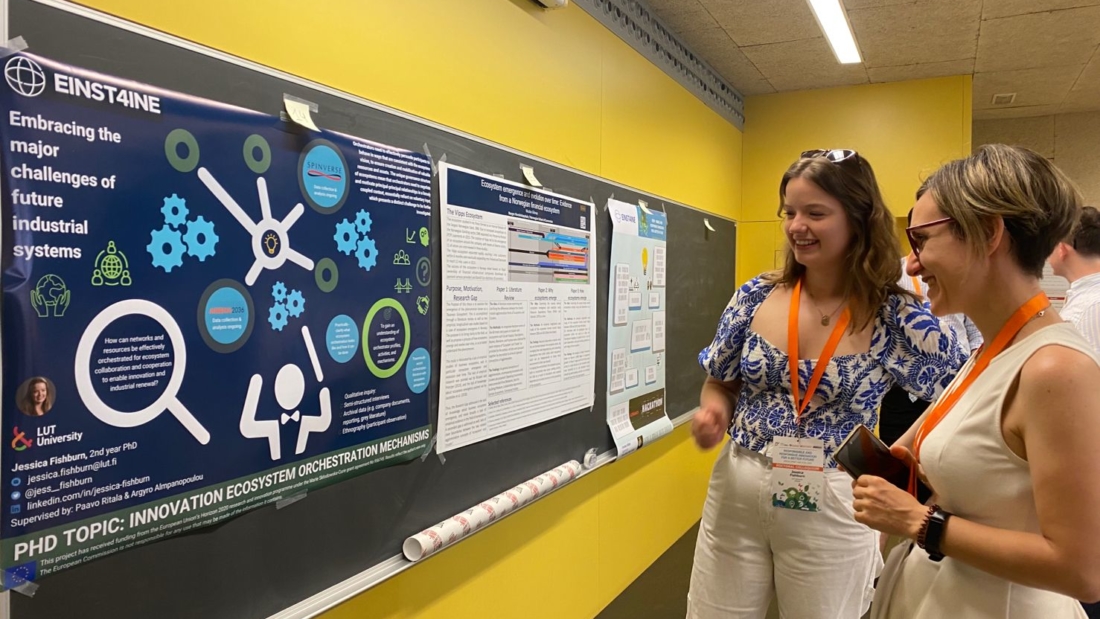
As a participant, we had the opportunity to present our doctoral research projects in the form of a poster presentation. It was interesting to see the range of posters presented, from the traditional academic poster format to more visual and creative ones. Honestly, I felt a little self-conscious displaying my work on a giant A0 sheet for everyone to poke at, but this became a very fruitful exercise both for myself and I hope for those interested in my work. In the preparations I stressed over what and how I should present, but in the end I learnt it is most important to understand what YOU would like to get from the interaction and let your poster follow that principle, no matter how others have approached the task.
Networking Opportunities:
The colloquium allows you to connect with other doctoral students and researchers who share similar interests in R&D management and wider management topics. Networking is an essential aspect of academic conferences, as it opens doors for potential collaborations and research partnerships in the future. However, what is perhaps some unspoken law about conferences that is maybe unknown to new PhD students (at least it was to me) is how social these events are. The majority of networking, and deeper connections, happen outside of the conference centre and instead in the bars, tours, dinners, etc. Having these bonding moments and community building activities are essential, so while these are very long and tiring days, I would urge all students to make the most of these additional activities where possible and be open to getting involved.
We can often get stuck in our narrow little holes as PhD students focussing hard on our topics. While sometimes I find it overwhelming to become distracted by so many new ideas and inputs, you never know when a piece of advice, literature suggestion, new connection, etc. may become fundamental to your work. Since R&D Management conference attracts the leading experts and top students in the field, the colloquium can expose you to the latest trends and emerging areas of interest in R&D management.
Practice in Academic Communication:
Presenting at the colloquium allows you to refine your academic communication skills, including attempting to deliver clear research ideas, responding to questions, and engaging with an audience. When working with experts who have 10s of years experience in these fields, I often still feel that I know nothing about my topic. Having to communicate my research, respond to questions, and share the observations I am making surprisingly gave me some ‘uh-huh’ moments where I realised, perhaps sometimes I do know what I am talking about. Similarly, being asked questions opened up new avenues even in my own mind about what should be clarified and what is most interesting to answer – which is key to making impact with your work!
Community Building:
As mentioned above regarding networking, one of the biggest takeaways was the social aspect that I did not expect. Being able to connect with other doctoral students in your field and share some of the trials and tribulations of this journey with them is a very cathartic and underrated activity. Particularly since this is a small and select group (approx. 40 students accepted) means that you do have the opportunity to get to know most of the students over the 2 days and, even better, you then have some familiar faces to say hello to during the conference. Of course, I hope that all doctoral students also have a great community at their home institution, but having this community extended across borders is all the more valuable. For future collaboration, or future complaining, as you wish!
Overall, remember to come prepared with energy and intention and don’t be shy to receiving constructive criticism. This is an excellent chance to gain valuable insights into your work and build connections within the academic community, so don’t forget to follow-up afterwards too. Enjoy the experience and make the most out of this unique opportunity!
Pitfalls and Blessings: A 21st century Research Journey
Being in the academic world these days comes with many pros and cons, ups and downs, privileges, and struggles. On average, doctorate holders represent 1.1% of the 25–64-year-old population across OECD countries (source). That sounds like a very small percentage. But let us put this number a little bit into perspective: In 2006, approximately 1.3 million peer-reviewed scientific articles were published, synonymously leading to a rise in scientific journals from 16.000 in 2001 to more than 23.000 in just five years (source). Today the number of available journals to choose from is even larger, a presumed 30.000+ while, at the same time, enabling lower quality journals (source). You might think “paradox of choice”, how to decide which journal to go for?
Unsplash picture by Claudio Schwarz
Let us add another lens to that: “Fewer than 1%—manage to publish a paper every year” (source). Publication practices have long received the slogan: “publish or perish” (that speaks for itself) across disciplines such as medicine (source) and management studies (source). Assuming you have made it into a journal, about one third of articles in the social sciences do not get cited, much less in the natural sciences, but even more in the humanities with an approximate 80% of publications never getting cited after publication (source).
Publishing in a scientific journal has become a significant challenge. A challenge so significant that a professor once said to me, “When you receive the response from a journal inviting you to revise your manuscript – you celebrate” (Note, this does not mean the paper has been accepted yet, but it has moved on to round 2). A study on journal acceptance rates at Elsevier found an average of 32% of papers that make it past review (source) while “scientists suffer constant pressure to publish new work frequently” (source). In the case of a paper-based PhD, it is often mandatory to get papers into the review process while working on the PhD. Fortunately, actually being published by the end of the PhD is not necessarily a requirement – although it certainly will not hurt. But looking at the statistics sheds a light on the chances of doing that.
The lifecycle of scientific publishing only works with the valuable and dedicated time of unpaid reviewers but the pressure in the academic world is high, and an elbow-mentality is growing. In recent years the peer-review process is receiving some significant backlash. An article published by the highly recognized Journal of Management Studies almost read like a long-suppressed outcry: “Reining in Reviewer Two: How to Uphold Epistemic Respect in Academia”, criticizing the behavior of a reviewer who deprecated the use of low-tier journals (source). In a similar vein, DORA (the Declaration on Research Assessment) was formed in 2012 in order to improve ways in which researchers and research outputs are evaluated (source) and to date, more than 20,000 individuals and organizations have joined in, promoting this objective. While epistemic respect is crucial for scientific publishing, criticism and accepting rejection is the “daily bread” as Germans would say, or “the norm” for every researcher. However, a rejection by one reviewer or one journal does not decrease the value of the manuscript. Publishing is a journey and taking it from an Associate Professor at Princeton: “Authors should be wary of being drawn into this morass until they find an interested editor“ (source). And, I too know researchers who publish more than one paper a year—nothing is impossible.
Unsplash picture by Nathan Dumlao
It goes without saying that we have achieved a few milestones in education and academia in general. Higher education enrolment rates have almost doubled to close to 40% worldwide since the beginning of this century to 2018 (source). Education has become increasingly accessible to people around the world and this is a great achievement in many ways. However, there is no such thing as a flawless education system and scientific publishing has become an obstacle like never before. But along the ups and downs and the long way ahead, being able to learn, publish, and contribute to knowledge generation, informing others about our findings feels so very rewarding at the end of the day. Being able to produce research and working on the world’s challenges and concerns, in my humble opinion, is still worth the hours we put into it.
“Any fool can know. The point is to understand.”
― Albert Einstein
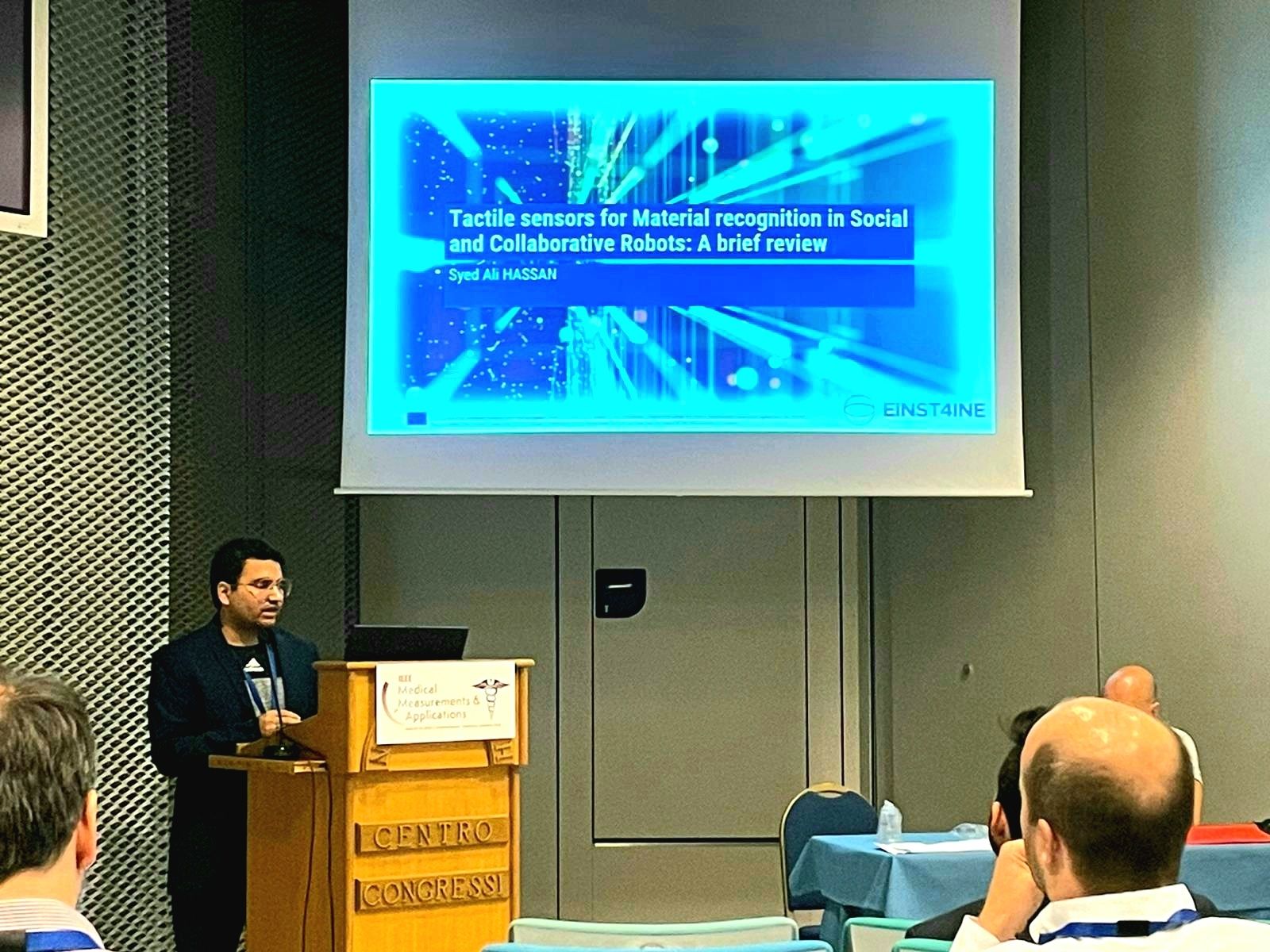
The majority of researchers hunt for a reputable conference to present their work at. As a master’s student, I presented several papers at various conferences, so I was accustomed to doing so and knew how to present my research, but as a doctoral student, this was my first conference in Italy. IEEE MeMeA 2022 is the name of the conference, which was held in Catania from June 21 to June 25, at the UNA hotel. The research papers of numerous researchers from various nations were presented. The opportunity to network with researchers from other scientific fields was a wonderful experience.
The title of my research paper on robotics is Tactile sensors for material recognition for social and collaborative robots. It was a review paper; it may be preferable to begin a research project with a review paper because it aids in a thorough understanding of the subject and stimulates reading more recent material pertinent to our investigation. After reading other people’s research on the same subject, writing a review paper might also give us fresh ideas. Anyone can read the paper I wrote by simply typing its title into IEEE Xplore, where it will be published.
The points I’m sharing for a good conference presentation are listed below:
Practice several times in front of a mirror.
Discuss your paper with your supervisor.
Be confident when presenting the paper.
Always put your presentation earlier in the conference room computer and check all slides one time to make sure all slides are working.
Don’t use new fonts in the presentation that are not supported in old versions of PowerPoint.
Use pptx or pdf format, take both formats with you.
A few researchers presented their posters on the first day of the three-day conference. Most conferences feature a poster session. During this time, researchers must display their posters on walls or on whiteboards. After that, many attendees approach the posters and ask questions about them. Poster sessions typically last for two hours or longer, during which time researchers must stand in front of their posters and answer the questions of visitors. My presentation was scheduled on the second day: I first went to see some research posters before going to the presentation room and delivering my talk. The presentation was fantastic. During my presentation, one professor asked me a few questions and said he would like to collaborate with my research.
In conclusion, I would like to address anyone who believes that if you present your study at a conference, it will be made public and someone else might steal your research concept. This is true in some cases; however, the longer portion of your work should be submitted to a reputable journal. I would suggest creating a plan whenever you begin a research project so that you can present a portion of it at a conference and later submit the entire thing to a reputable journal.
You are probably wondering why a first-year PhD student is already talking about how to get published. Even though my natural thought has always been to think about publishing after actually having written something, I have attended a course on How To Get Published taught by Prof. Dries Faems which has shown me otherwise.
As PhD students, and Early-Stage Researchers at EINST4INE, we should be able to recognize and apply the basic structure of an academic text, which includes an abstract, an introduction, a literature review, a method section, and a conclusion (at the least). This might differ according to the nature of our research, different journals might have different requirements – but the truth is that the academic world is competitive, so you might as well start now.
First, before you fit your paper into a specific journal, ask yourself these questions:
What is your research question?
How is your research question related to the current literature?
How will you use your data to answer your research question?
These are questions that both, author and reader need to be able to answer.
The next step would be to choose a journal.
After having established what kind of paper you are planning to write (conceptual, quantitative/qualitative, positivistic/interpretative), you will probably recognize the community of scholars who are working and have published in your line of study, and thus you can identify which people should read your work, and where they have published.
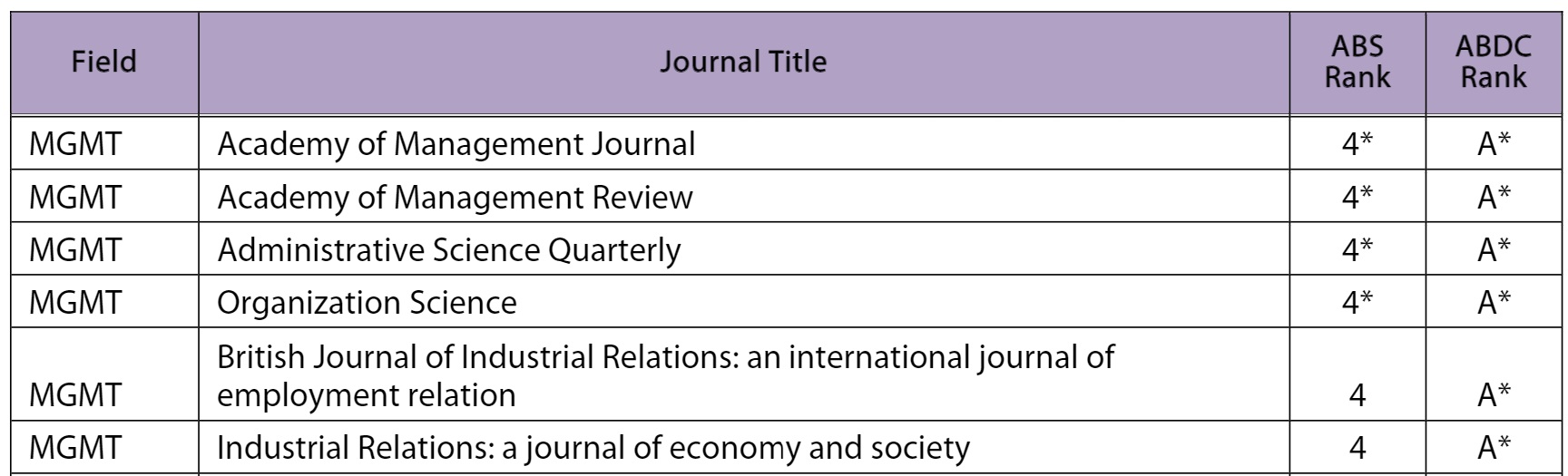
There are a number of websites and services which publish journal rankings according to their impact factor. Here, the impact factor represents the frequency with which an average article in a journal within a given year has been cited. Counting the number of times its articles are mentioned, determines the standing or prominence of a journal.
Example of the ABS ranking for Management (MGMT) journals [Image source: ABS (Association of Business Schools) and ABDC (Australian Business Deans Council)].Being a Management scholar myself, I look at the yearly published ABS list, however other websites might publish similar information, and universities usually also offer guidance on the rank, reputation, and purpose of journals.
Then, another useful step would be to get to know the editors of the journals as well as assess the reputation of these journals in terms of processing time/quality of the feedback that they give (don’t forget to check the Open Access criteria/options). This can be done by contacting people that have had experience with the journal. You might also find that you want to target other journals which are not included in the big journal list but are still very relevant to your field of study. For instance, as a Management scholar, I might focus on the Academy of Management Journal (impact factor 10.2). But with a specialization in ecosystem research, the R&D Management (impact factor 4.3) Journal might also be a great fit.
Once you have made your selection of qualified journals, start writing your paper with the criteria of the journal in mind. This has definitely helped me not only to narrow down the most crucial sources of information for my research but also helped me find a research focus.
… So how do you write a paper that might get accepted?
According to Prof. Faems, there are a number of reasons a paper might get rejected, one of them simply being the reason that the paper does not fit the personality of the journal, emphasizing the need to work towards that target journal. Some other reasons include an absence of a clear theoretical contribution, a lack of novelty, and methodological issues.
Unfortunately, I don’t think there is a specific recipe that mixes a set of ingredients for success. But there are still some basic ingredients that might help:
Clearly position your project against existing research and theories
Formulate a good theoretical contribution
Good data and methodology won’t hurt
The best way to understand how you can embed your project in existing research is to visualize it:
Imagine you are entering a house and you have to choose to enter a room, which goes in line with your research. So, you enter the room of Management research. You try to find a table of people who you understand and where you feel comfortable enough to contribute to the conversation. So, you go sit at the table that talks about, let’s say Open Innovation. So, you’ve already positioned yourself in the Management field, focusing on Open Innovation. At the Open Innovation table, you are trying to recognize the recurrent themes and findings that are being reported and you identify the most important people at this table.
Once you have done that, you might be able to recognize missing links in the current research or you might make new links that you wish to develop in your research.
One challenge that many scholars and reviewers report is the clear positioning in one specific area of research. For instance, while I can identify a particular gap in the Open Innovation literature, I realize that I can address this gap with findings from the Ecosystem literature (for instance), which puts me at two different tables in my Management room. In this case, making links between two literature streams is good, if I make it clear. However, the more links I have, the more delicate it becomes and can confuse some people at my main table.
In terms of the novelty of the paper, reviewers are often looking for interesting ideas that have the potential to impact future research, i.e. a strong contribution. This process seems tricky, as novelty does not necessarily mean interesting. Imagine you have found a research gap in your given field… This doesn’t imply that it’s a novel idea, it might well be an idea that has already been thought of but is not worth researching further. Thus, an editor might reject your paper on the basis of lacking a novel and relevant contribution. This is the reason why having good data doesn’t hurt. While your theoretical part might lack some grounding and novelty (which, for the record, it shouldn’t), having a unique and well-developed dataset that is difficult to access, can become an advantage during the review process.
The theoretical grounding, novelty, and contribution of your research, along with your data (depending on the nature of your research) are the main selling points of your research, which should be communicated at the beginning.
And the best way to communicate it is through the introduction, which is the gateway to a good paper. Indeed, apart from the abstract which swiftly summarizes your research, the introduction is one of the most important written parts of your research. In fact, editors make a first judgment based on the quality of the introduction which should include:
The community you want to talk to
Your research gap
How you address the research gap
Your main findings and contributions
Of course, this does not mean that one should disregard other sections like the discussion section, where you can go more in-depth into discussing the implications of your findings and iterate on the practical and theoretical contribution you wish to make.
Finally submitting it…
Once you think you have managed to position your research in a clear and concise manner, the last step is to get some friendly reviewers (such as fellow researchers, supervisors, etc.) to look over your work before submitting it to your journal of choice.
And then you wait…
You will most probably receive feedback from the editor with reviews from researchers in the same or related field (some that might even be cited in your paper!) who will either have immediately rejected it or might have accepted it with some changes. This return can provide you with a relevant critique on how to improve your paper, and (hopefully) arm you with the tools necessary to survive the next round of reviews and get you published.
I hope I was able to provide a little insight into what I have learned about publishing and how I aim to tackle my research. Of course, there are different ways to conduct research and get published. I have certainly started following my own advice from this post, which was mostly inspired by what I have learned following Prof. Faems’ How to Get Published course.
And who knows, this might even be helpful for becoming a good reviewer or even editor at some point…
Shopping Basket
This website collects cookies to enable the proper functioning and security of the website, and help us offer you a better browsing experience. By using our website you agree we can place functional and analytical cookies on your device. Find out more about cookies and how to manage them by visiting the RMIT Privacy Statement link in the website footer. If you're happy to continue, please press accept. You can opt-out if you wish but this may affect how the website functions. Cookie settingsACCEPT
Privacy and Cookies Policy
Privacy Overview
This website uses cookies to improve your experience while you navigate through the website. Out of these cookies, the cookies that are categorized as necessary are stored on your browser as they are essential for the working of basic functionalities of the website. We also use third-party cookies that help us analyze and understand how you use this website. These cookies will be stored in your browser only with your consent. You also have the option to opt-out of these cookies. But opting out of some of these cookies may have an effect on your browsing experience.
Necessary cookies are absolutely essential for the website to function properly. This category only includes cookies that ensures basic functionalities and security features of the website. These cookies do not store any personal information.
Any cookies that may not be particularly necessary for the website to function and is used specifically to collect user personal data via analytics, ads, other embedded contents are termed as non-necessary cookies. It is mandatory to procure user consent prior to running these cookies on your website.