The automotive sector has undergone a significant transformation with the advent of electromobility. This revolutionary shift is reshaping the way vehicles are powered, manufactured, and utilized, with profound implications for the industry, the environment, and society as a whole.
Electromobility refers to the use of electric propulsion systems, primarily batteries or fuel cells, to power vehicles instead of traditional internal combustion engines. This transition is driven by various factors, including concerns about climate change, air pollution, and the finite nature of fossil fuels. As a result, automakers are increasingly investing in electric vehicles (EVs) and developing advanced technologies to improve their performance, range, and affordability.
Tesla has played a pivotal role in driving the adoption of electromobility and reshaping the automotive industry. However, Tesla’s success has also posed a significant challenge for traditional automakers, many of whom have struggled to catch up in the rapidly evolving electric vehicle market. Despite their substantial resources and manufacturing capabilities, legacy automakers have faced obstacles in developing competitive electric vehicles that can match Tesla’s performance, range, and brand appeal. Additionally, the transition to electromobility requires significant investment in research and development which can be daunting for established automakers.
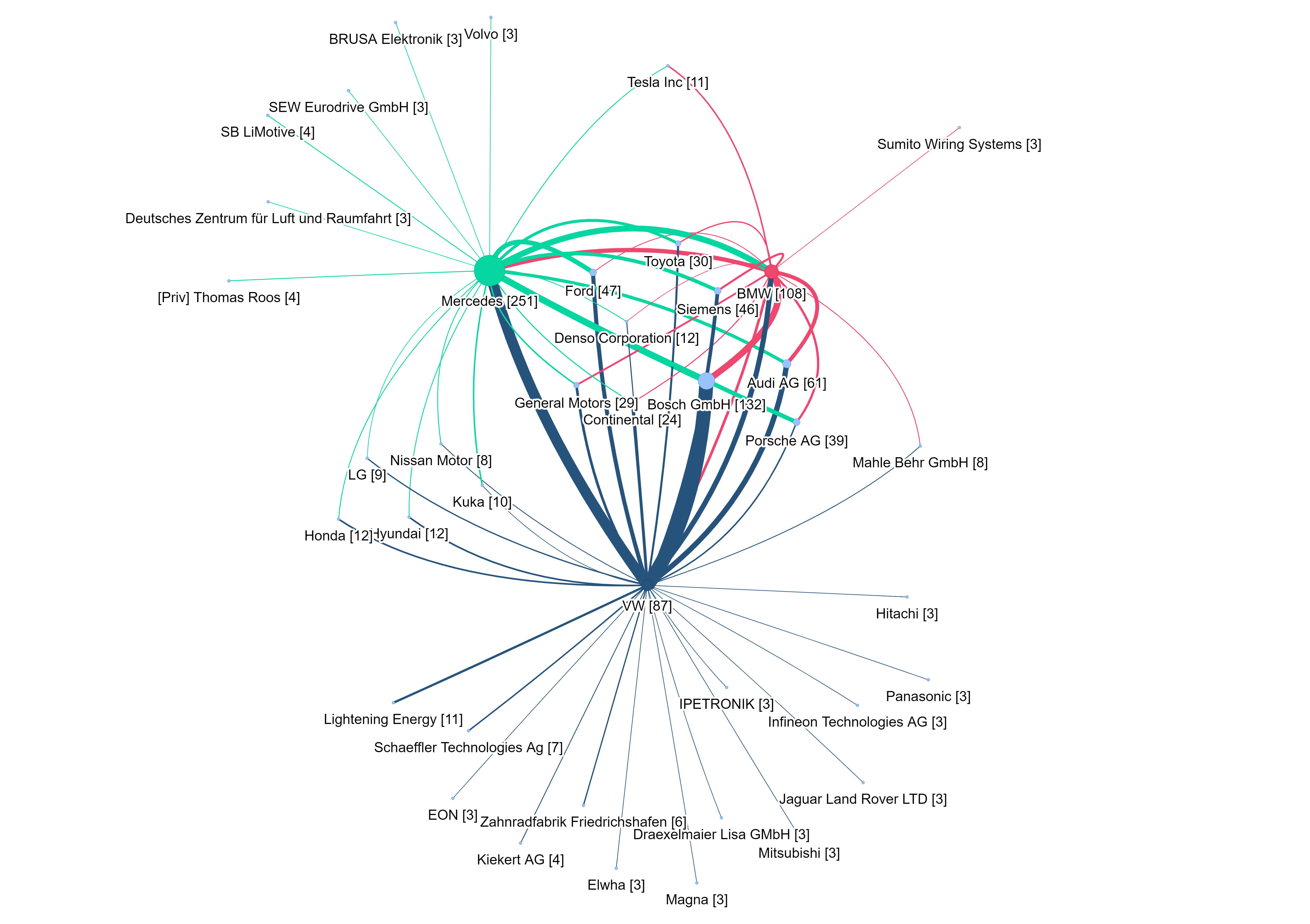
Nevertheless, traditional car manufacturers had plenty of time and resources to search for and integrate external knowledge and identify the market changes. We investigated how the German car manufacturing sector prepared and responded to electromobility in our latest paper. What we find is that they delayed their response significantly and heavily relied on local knowledge – rather than sourcing missing knowledge early and integrating it. Using patent data, we mapped the knowledge flows for the three major players in the German car manufacturing sector and visualized the network.
Our most important finding is, that someone else in the innovation ecosystem managed to step up when the car manufacturers were not. Bosch became essential for all three car manufacturers and shows that it is essential to scan the peripheral of the industry. Otherwise you risk your position in the market and empower potential competitors to take your spot during the industry evolution.
Knowledge flows at the later stages of the industry evolution. Bosch managed to become a central source for knowledge, granting them the power to control knowledge in the new ecosystem.
In the world of academic research, it’s common to embark on a journey with a specific destination in mind (at least that was my path). Guided by established theories and prior studies, we often believe we know where our research will take us. My recent experience with a case study on innovation ecosystems, particularly focusing on environmental sustainability, was a humbling reminder of the unpredictable nature of inquiry.
As is the beauty—and sometimes, the frustration—of qualitative research (though it’s worth noting that surprises aren’t exclusive to this methodology), I was in for some revelations, when taking a closer look at how companies carry out projects…
… As I was delving into the practices of companies engaged in green transition projects, I encountered a case that exemplifies this perfectly: the renowned CopenHill facility in Copenhagen.
CopenHill is an example of a new breed of sustainability projects that are simultaneously functional and hedonistic. With its waste-to-energy plant, ski slope, and restaurant, CopenHill epitomizes the concept of “hedonistic sustainability”, a term brought to life by Bjarke Ingels, the architect behind the facility (Estika et al., 2020). Aimed at merging environmental responsibility with pleasure and aesthetic appeal, many of these new facilities stand as a testament to the interconnectedness of green projects with the social, cultural, and environmental fabric of their communities. They are “history-dependent and organizationally-embedded units of analysis” (Engwall, 2003), each following a unique trajectory influenced by a variety of factors.
Thus, the creation of such multifaceted projects involves a collaborative effort extending beyond the realms of engineering or business. To assess their success or failure, there is an increasing need to adopt inter- or multi-disciplinary approaches, as their implementation and development cannot be fully understood or effectively managed through a single field of knowledge. Instead, it requires the collaboration and integration of diverse disciplines, as I have come to realize. For this reason, the current findings of my case study research are steering me in a more sociological direction, to better understand the complexities of the green transition. In pursuit of this, I have enrolled in an immersive three-day course at Aarhus University, where I’ll delve into various sociological theories, including Actor-Network Theory and Transition Theory, to name a few. My aim is to enrich my comprehension of the historical and environmental contexts that surround my case study.
Of course, I’m eager to share my discoveries along the way, so stay tuned for more updates and revelations!
References:
Engwall, M. (2003). No project is an island: Linking projects to history and context. Research Policy, 32(5), 789–808. https://doi.org/10.1016/S0048-7333(02)00088-4
Estika, N. D., Kusuma, Y., Prameswari, D. R., & Sudradjat, I. (2020). The hedonistic sustainability concept in the works of Bjarke Ingels. ARTEKS : Jurnal Teknik Arsitektur, 5(3), 339–346. https://doi.org/10.30822/arteks.v5i3.487
As the four main pillars that constitute my research topic at EINST4INE relate to ecosystem research, digital transformation, environmental sustainability, and Open Innovation, I would like to tell you a little about what I have learned in the intersection between technology and ecosystems. While some of my fellow EINST4INERs have similar research interests in ecosystem research, I hope to complement their thoughts on what ecosystems actually are and how they form.
Many paradigms nowadays emphasize the need for companies to adopt novel and disruptive technologies to stay afloat. Through such paradigms, like Open Innovation, business executives in today’s digital age have access to hundreds of new technologies that may revolutionize their operations and the quality of service they provide to customers, as collaborations and other types of connections enable companies to leverage the force of digital technologies, without having to create them in-house.
However, adopting cutting-edge technology isn’t enough to achieve these objectives; companies also need to know how to put such tools to good use for their operations and their consumers. This requires resources like time, funds, and expertise, which may be in short supply.
As such, how can businesses use the benefits of cutting-edge innovation and speed up the delivery of value to their customers?
Curating ecosystems is one solution: businesses should collaborate with one another, aligning talents and pool resources to develop ground-breaking new goods and services and shorten the time it takes to get them to market. And this is precisely what many businesses are doing.
As Gianlorenzo has given an overview of the different types of existing ecosystems, I felt the need to set the prerequisite of what ecosystems are not (based on Adner, 2017):
Business models based on ecosystems are not the same as supply chains. Tiers of suppliers in a supply chain feed into an ultimate point of value creation, but the suppliers themselves are neither part of the brand promise nor material to the value generated, although top suppliers may be quite important.
Then, platforms per se, are not ecosystems. While every platform has an ecosystem and is often the keystone actor (an ecosystem actor with a strong influence despite being relatively few in number. The term comes from the biological term of keystone species), there is a narrow focus on technology and transactions. Indeed, while platforms are concerned with interface governance, ecosystems are concerned with structures of interdependence.
Older terms and arrangements like Networks and Alliances have a similar connection as in ecosystems, however, these mostly focus on patterns of connectivity. In this sense, for Networks and Alliances, the focus lies more on actor ties rather than the value proposition, and just like for platforms, there is not enough focus on the structure of interdependence.
Open Innovation (OI) has also been related to ecosystem research. One could argue that OI provides a rather micro-perspective, taking into account the firm strategies. However, ecosystem literature applies a rather macro-vision, which helps us gain insights into the multilateral coordination between ecosystem partners in their quest to align their strategies to provide value.
Adner (2017) finds other similar structures which can be distinguished from ecosystems.
But, if we take a glance around, we can see that businesses of all stripes are attempting to implement ecosystem business models and, in many instances, even orchestrating their own ecosystems in an effort to generate profits. In Jessica’s post, ecosystem orchestration is defined as “hub players” taking the lead, where she clearly defined what an orchestrator is.
Of course, for companies, occupying the orchestrator or “hub actor” position can be beneficial for several reasons such as having a more centralized knowledge about the ecosystem, compared to other actors. However, orchestration is not necessarily easy:
The present academic literature tends to focus on successful long-standing ecosystems, which greatly looks at the organizational capabilities of firms, related to the success of their overall ecosystem. However, some scholars have extended this notion to the capabilities of the environment in which an orchestrator thrives, meaning that the success of the hub actor and the ecosystem depend on the architecture of the network, and how the network interacts with its environment.
From this, two streams of literature have emerged:
First, we can consider intentionally created ecosystems, departing from the definition of the overall value proposition that the ecosystem is supposed to achieve, and assembling actors that can contribute to the value creation and transfer in the ecosystem.
Second, we can consider the assemblage of different actors, who create and co-evolve a common value proposition together.
There are certainly differences in terms of processes and mechanisms of orchestration between the two approaches, however, some universal challenges that can impact orchestration overall can be distinguished (among others):
Leadership: some researchers argue for the importance of a hub actor who should facilitate the interaction between actors. However, not every firm has the capabilities to become an orchestrator and gather the efforts of all actors that ultimately define the success of the ecosystem.
Platforms: most platforms offer a space for orchestration as they, in some way, build the base for the ecosystem. Here the platform orchestrators can leverage several benefits such as Network Effects (when the value or utility of a service or product is defined by the number of users). Platforms and their surrounding ecosystem represent the most successful businesses nowadays as they achieve economies of scale very rapidly. That does not mean, however, that being successful is given… first, because network effects can also backfire (e.g. see Network Effects Aren’t Enough) and second, because what makes your platform successful can also make another platform successful!
Actor role & position:one of the dangers of maintaining good relationships with actors is the way an orchestrator treats its connections. When shifting from a traditional business model, some focal firms tend to see actors as suppliers rather than a relationships. This implies a shift or adaptation of business models to current ecosystem standards.
Finding the right business model: Ecosystem relationships imply a different strategic model that needs to contemplate the management of inter-and intra-actor relationships as well as the governance and coordination between multiple parties
External factors:As trust is crucial for successful collaborations, hub actors need to depart from their self-interest view and focus on shared efforts, which is necessary for the long-term success of an ecosystem. This can be understood as gaining legitimacy, not only within a given ecosystem but also gaining acceptance from the environment and society, and other institutions as a whole. Other external factors can also comprise the competition: an ecosystem formation can improve the current market conditions for the players, but also for the competition. Thus, orchestration necessitates a lot of coordination, management, and governance efforts to not be overthrown by competing ecosystems and their value propositions.
Although there are other factors that play a role in ecosystem orchestration (e.g. capabilities, modularity, complementarity, bottlenecks, etc.) for the sake of brevity and comprehension I have limited these to the challenges mentioned above.
What amounts to all of this is that the current literature provides examples of how ecosystems can be orchestrated, but there is still a lot to learn from failed ecosystems. Successes can give a lot of insights into “good practice” strategies, but these are not said to work for every ecosystem, precisely because of the heterogeneous nature of participating actors, and their environments.
Thus, while some research has looked at the “dark side of ecosystem orchestration” (Oliveira & Lumineau, 2019), which can impact a firm and impede the capacity of complementors and consumers to innovate, more insights from failures cases could tell us a lot more about what can go wrong during the orchestration process, as well as insights into ecosystem governance mechanisms and even organizational capabilities needed to support ecosystem orchestration.
While we will see or recognize more such failures in the future, I am sure that their lost efforts will have an ultimate purpose, which is the benefit for academia to study why some ecosystems fail and others thrive and thus, creating several implications for businesses.
References
Adner, R. (2017) Ecosystem as Structure: An Actionable Construct for Strategy. Journal of Management, 34: 39-58.
Oliveira, N., & Lumineau, F. 2019. The dark side of interorganizational relationships: An integrative review and research agenda. Journal of Management, 45(1): 231-261.
Don’t ecosystems belong in nature? Isn’t orchestration to do with music? Yes and yes, but also, no ? as you will (hopefully) find out, these metaphors effectively provide meaning to practical and theoretical management concepts.
You might realize that academics like to use big words because of the need to convey complicated things in simple ways. Likewise, businesses like to use buzzwords to stay up-to-date with the latest talk and trends. Often, this results in terms being adopted and interpreted in many different ways where they risk losing meaning and understanding. While it is not necessarily wrong for terms to be applied in different ways, and there is beauty in this creativity, it is useful if there is an agreed consensus on what is meant.
Almost a year into my PhD on innovation ecosystem orchestration mechanisms, I still wonder myself what exactly that means. So, let’s go back to basics and unpack this. Please note: this is my perspective and developed understanding so far – subject to change and interpretation!
Starting with innovation, this essentially refers to the creation of change. The scale of this change can vary from incremental improvements to completely disrupting markets, as well as radical breakthrough change or more architectural improvements to a product/service. But, creating change for what? Innovation and innovative thinking span many contexts and provide tools suited to address challenges across the board including business, social, and environmental.
For innovation to materialise, there are clever strategies that bring together diverse set of actors (private companies, startups, government, etc.) to work together towards an aligned goal in which they can co-create shared value. This is what we call an ecosystem. This can be challenging as it relies on interdependencies – the dependence of two or more entities on each other – among these actors to make this happen.
A way to approach this is for a ‘hub firm’ to take the lead and orchestrate these activities. The role of an orchestrator is multifaceted whereby they can attract new actors to the ecosystem, facilitate resources and interactions between actors, resolve any tensions that may arise, find alignments across the ecosystem, and so on. What is unique about this management style is that it is intended to be non-hierarchical and instead focused on fostering cultures that create innovative thinking. I like to think of orchestrators as positive encouragers, empowering supporters, and uplifting influencers.
As for mechanisms to do this, I will leave you on a cliffhanger for a future blog post where I can share some results from my findings!
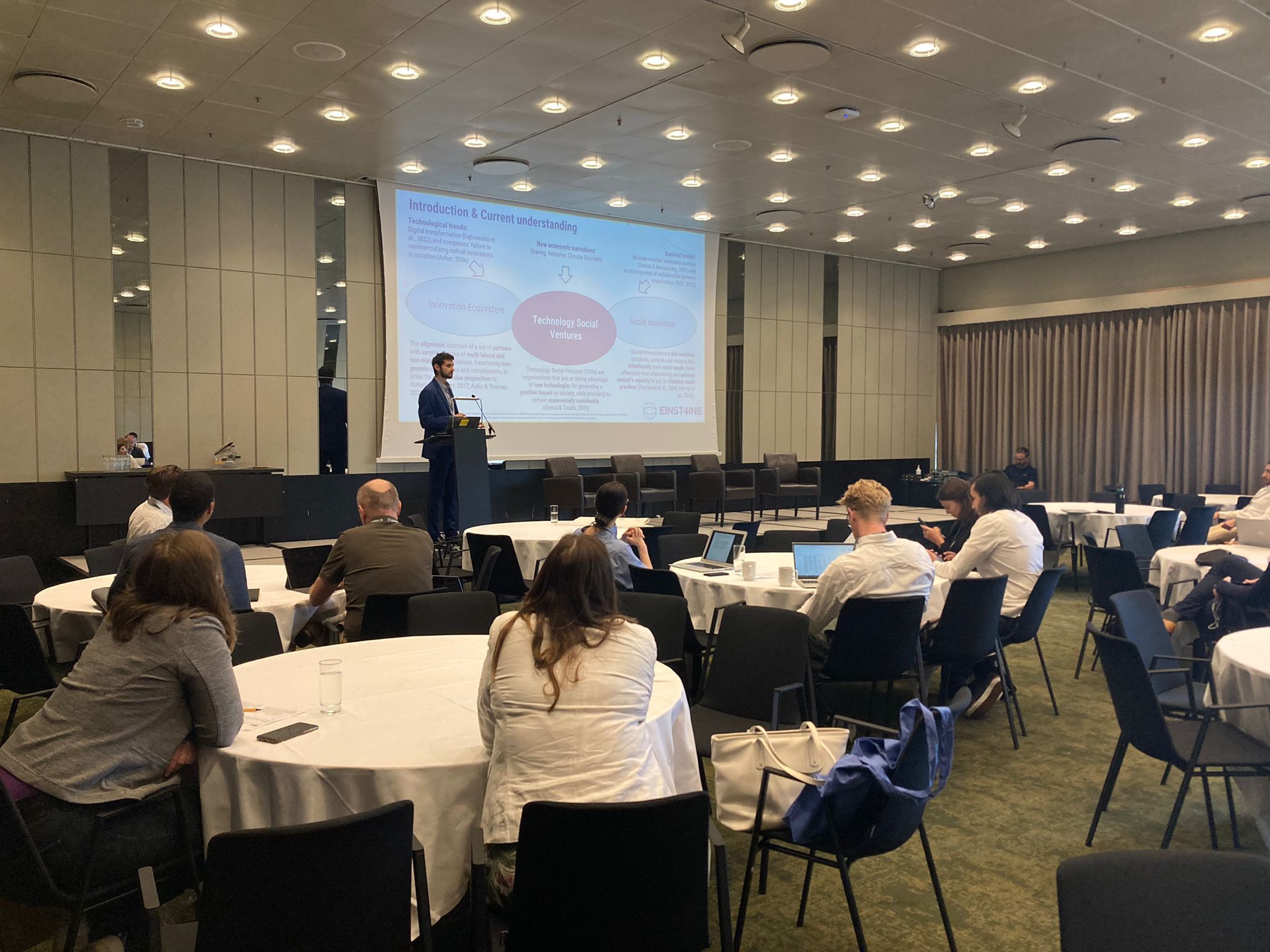
As I wrote in the last post, in June I participated in the first two live conferences of my PhD. At ISPIM, I presented a preliminary study on Technology Social Ventures (TSVs), namely companies with a social mission and a tech-based strategy, taking an ecosystem perspective. Instead, at EURAM, I shared the findings of a work focusing on the entrepreneurial level, to understand how TSVs manage the social and technological component of their strategy.
Photo taken during my presentation at ISPIM 2022, Copenhagen
Based on that, you may have realized that my main research interests lie at the intersection between technological innovation, societal challenges and ecosystems. Today, I would like to talk about this last topic.
Indeed, taking inspiration from the conversations I had at ISPIM conference, I realized:
First, how difficult it is explaining what an “ecosystem” is to someone not working in the field.
Second, scholars apply this concept in different ways and contexts, not always highlighting the differences.
Third, despite its wide adoption in the industry, practitioners usually refer to the classic conceptualization of business ecosystem, neglecting the other definitions identified in the literature.
Therefore, in this blog I would like try to address this mismatch providing a brief overview on what characterizes an ecosystem, according to the literature.
Why
But before that, why are we even talking about ecosystems in the management literature? To answer this question, we should go back to the early 90s, when J.F. Moore adopted a Darwinian perspective to describe market competition’s dynamics. He argued that:
“Successful businesses are those that evolve rapidly and effectively.”
That is, those who are best able to adapt to the environment. Yet innovative businesses can’t evolve in a vacuum.
In fact, drawing from other recent anthropological and biological discoveries, he suggests that a company can be viewed not as a member of a single industry but as part of a business ecosystem that crosses a variety of industries (Moore, 1993).
However, the diffusion of this concept remained latent for almost a decade, until Iansiti and Levien (2004) recalled it in their HBR Article titled “Strategy as Ecology”. Finally, it is a few years later, when Adner (2006) showed how most traditional companies fail to commercialize breakthrough innovations in isolation, that the ecosystem concept definitely took hold.
Most likely, one of the enabling factors of the increasing adoption of this term in the late 2000s is the advent of digital technologies. Accordingly, collaborations between organizations became easier and more frequent, making the proper management of interdependencies crucial, as predicted by Moore three decades ago.
What
That said, what is an ecosystem?
An ecosystem can be defined as “an interdependent network of self-interested actors jointly creating value” (Bogers et al., 2019). In other words, we can see an ecosystem as a set of organizations collaborating to offer a specific product or service, without having formal bonds or hierarchical relations.
However, ecosystems can take several forms, which makes our blog even more interesting (or complex, depending on the perspective 🙂 ). Here, I will briefly present four of them (Scaringella & Radziwon, 2018), starting from the most embedded in the geography literature to the most abstract one:
Entrepreneurial Ecosystem:
“a set of interdependent actors and factors coordinated in such a way that they enable productive entrepreneurship within a specific institutional context” (Stam, 2016);
Example: Typically these studies examine a high-technology cluster or the linkage between universities and local companies, such as Silicon Valley.
Knowledge Ecosystem:
“users and producers of knowledge that are organized around a joint knowledge search, and as such need to be located in close proximity” (Järvi et al., 2018; Van der Borgh et al., 2012).
Example: The High-Tech Campus Eindhoven (HTCE), in the Netherlands, served as the object of the study for Van der Borgh et al. (2012).
Business Ecosystem:
“a system in which companies coevolve capabilities around a new innovation, developed by a focal firm. They work cooperatively and competitively to support new products, satisfy customer needs, and eventually incorporate the next round of innovations” (Jacobides et al., 2018; Moore, 1993).
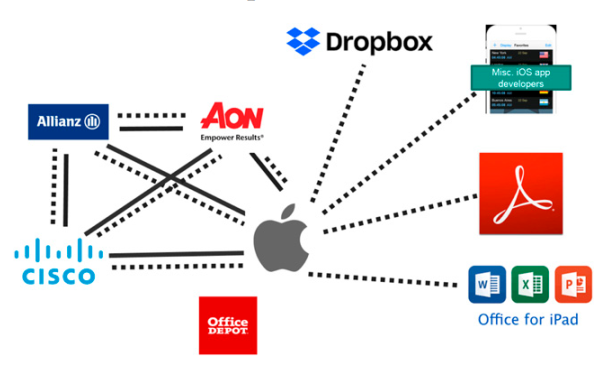
Example: Apple is the leader of an ecosystem that crosses at least four major industries: personal computers, consumer electronics, information, and communications (Moore, 1993).
Innovation Ecosystem:
“the alignment structure of a set of actors with varying degrees of multi-lateral, non-generic complementarities that are not fully hierarchically controlled, providing components and complements, in order for a focal value proposition to materialise” (Adner, 2017; Jacobides et al., 2018)
Example: Digital platforms such as the Apple Store can be described as innovation ecosystems. Instead, the Michelin’s PAX run-flat tire system presented by Adner (2017), represents an example of a non-platform based ecosystem, requiring an alignment between the actors to let the innovation materialize.
Description of the Apple Store ecosystem, taken from Shipilov and Gawer (2020).
How
After having seen the definition, now I will report some of the main elements that help to identify an ecosystem from other concepts.
Among the most relevant factors, we can mention:
Complementarities
Three types of complementarities exist.
Unique: The first one means that A wouldn’t function without B (and, in case of co-specialization, viceversa), requiring coordination among the actors to achieve success.
Supermodular or “Edgeworth”: complementarities describe a relation between two objects, which can be two different products, assets, or activities, where more of A makes B more valuable.
Generic: even though a particular good or service may be needed for the production of a complex value proposition or innovation, that good or service may be generic (i.e., standardized) enough for firms to draw on it with little concern for governance structure or risks of misappropriation.
Ecosystems must be identified just with the first two typologies (Jacobides et al., 2018).
Interdependencies
While complementarities represent an economic relationship in terms of the potential for value creation, interdependencies represent a structural relationship between offers, in terms of how they are connected for the value to be created (Kapoor, 2018).
In a nutshell, this means that they are even more complex to manage, because they are not directly related to an economic exchange.
To be clearer, I will report an example related to Tesla, drawn from Kapoor (2018):
The structure of interdependencies between car producer and cell producer is distinct from the structure of interdependencies between car producer and charging infrastructure provider:
The first one has a direct relation;
The second one has a indirect relation, mediated by the user;
Moreover there are other interdependencies between cell producer and charging infrastructure provider or even between charging infrastructure and the electricity grid.
Therefore, the core concern for research grounded in an ecosystem perspective is to explain firms’ strategies and outcomes through the lens of such complementarities and interdependencies.
It follows that the co-evolution of actor’s strategies represents another key element, given the kind of relationships that exist between them (Ritala & Almpanopoulou, 2017), as well as the existance of a system-level outcome (Autio & Thomas, 2021).
Finally, we should highlight that these relations between different parties are usually multi-lateral and not hierarchically or formally controlled, compared to the dyadic relations that can be found in other structures, such as supply chains, markets and networks (Adner, 2017; Shipilov and & Gawer, 2020).
As you can see, talking about ecosystem means looking beyond the strict boundaries of an organization, something that now is more needed than never, given the complex societal challenges we are facing. And this is what I like the most about this concept, as it is an example of how and why managers should adopt wider lenses to define their strategies (Adner, 2012), aligning them with all the relevant stakeholders.
I hope that this post helped to clarify (even though in a non-exhaustive way) the ongoing conversation about ecosystems.
Now, it’s time for the second episode of my column!
Surfin’ Internet
Video:
If you haven’t had enough on ecosystems yet, this Debate from DRUID Conference 2019 won’t let you down.
Academic article
In this recent article introduced by Denny Gioia, Gabriela Rivera displays all the contradictions and mixed messages PhD Students have to deal with, while embarking in the first year of their Doctoral Program.
Tweet
Unless you have a natural talent, writing is never easy. And writing with an academic style can be even more painful. Here you can find a nice tip to improve your writing style.
Adner, R. (2006). Match your innovation strategy to your innovation ecosystem. Harvard business review, 84(4), 98.
Adner, R. (2012). The wide lens: A new strategy for innovation (Vol. 34, No. 9). Penguin Uk.
Adner, R. (2017). Ecosystem as structure: An actionable construct for strategy. Journal of management, 43(1), 39-58.
Autio, E., & Thomas, L. D. (2021). Researching ecosystems in innovation contexts. Innovation & Management Review.
Bogers, M., Sims, J., & West, J. (2019). What is an ecosystem? Incorporating 25 years of ecosystem research. Proceedings.https://doi.org/10.5465/AMBPP.2019.11080abstract
Iansiti, M., & Levien, R. (2004). The keystone advantage: what the new dynamics of business ecosystems mean for strategy, innovation, and sustainability. Harvard Business Press.
Jacobides, M. G., Cennamo, C., & Gawer, A. (2018). Towards a theory of ecosystems. Strategic management journal, 39(8), 2255-2276.
Järvi, K., Almpanopoulou, A., & Ritala, P. (2018). Organization of knowledge ecosystems: Prefigurative and partial forms. Research Policy, 47(8), 1523-1537.
Kapoor, R. (2018). Ecosystems: broadening the locus of value creation. Journal of Organization Design, 7(1), 1-16.
Moore, J. F. (1993). Predators and prey: a new ecology of competition. Harvard business review, 71(3), 75-86.
Ritala, P., & Almpanopoulou, A. (2017). In defense of ‘eco’in innovation ecosystem. Technovation, 60, 39-42.
Scaringella, L., & Radziwon, A. (2018). Innovation, entrepreneurial, knowledge, and business ecosystems: Old wine in new bottles?. Technological Forecasting and Social Change, 136, 59-87.
Shipilov, A., & Gawer, A. (2020). Integrating research on interorganizational networks and ecosystems. Academy of Management Annals, 14(1), 92-121.
Stam, F. C., & Spigel, B. (2016). Entrepreneurial ecosystems. USE Discussion paper series, 16(13).
Van der Borgh, M., Cloodt, M., & Romme, A. G. L. (2012). Value creation by knowledge‐based ecosystems: evidence from a field study. R&D Management, 42(2), 150-169.
A genuine question I received when explaining my new project and role (yes, EINST4INE is intended to be pronounced Einstein). I simply laughed and dismissed the comment.. of course I am not the next Einstein.
But, it did make me think.
Collectively, our projects will embrace the major challenges of future industrial systems. That’s pretty big. While this is certainly a daunting prospect as the imposter syndrome starts to creep in, I remind myself that I was selected to embark on this journey alongside other brilliant young researchers, so why shouldn’t we aim for such an impact with our research projects?
Impact really drives me. Graduating only in 2020 and 2021, I completed both my Bachelors in Business and Master of Research in Sustainable Futures at the University of Exeter, Cornwall. During my studies, I interned for a social enterprise that trains and supports entrepreneurs to innovate social and environmental challenges through purpose-led businesses, as well as co-founding and leading my own venture of a ‘Women in Business’ society to empower young women to pursue their dream careers. Further to this, I have worked on several projects providing consultancy and freelance support to start-ups and research projects addressing various business and sustainability challenges.
Despite a rather naïve and potentially even immodest notion to believe that a group of PhDs will contribute groundbreaking science, I also believe that if you are not striving for something you will never come close to achieving it. So, we must dream big.
The main expectations I have for my EINST4INE journey is to make connections and build my network, receive high-level research training with great support from colleagues, and be exposed to a number of multicultural and practical experiences which all help deliver impact and enhance employability. At current, my research topic is broadly focussed on orchestrating innovation ecosystems. I’m really interested in investigating how things work, what challenges are being faced, and how they can be improved or resolved. As a result, I hope that my research will explore and develop mechanisms to successfully orchestrate ecosystems and the challenges they face. From an industrial perspective, I would like to explore ecosystems applied in circular innovation as I find it very applicable and an area that faces its own unique challenges. Above this, digital transformation has created opportunity to accelerate both the emergence and management of innovation ecosystems and the sustainable transition to a Circular Economy, areas that need development of understanding and best practices. And of course, being part of Gen Z, life before technology is pretty incomprehensible to me so curiosity into the digital phenomenon is almost second nature.
With these big dreams, how did I end up here in the first place? And another funny remark I have received…why Finland?!
Well, I am extremely pleased that LUT University is my host institution. It was my hope to pursue a career in research, and with a strong academic background, I was seeking opportunities that would give me international and industrial experience whilst still gaining PhD research training. The Marie Skłodowska-Curie Action presented the perfect opportunity to enable this. I am still in disbelief to be in such a fortunate position and am extremely honoured. I feel very grateful that I get to be located in such a beautiful place with such high quality of life and connected to incredible expertise through the institution and EINST4INE; I believe these factors will make all the difference on this learning and development journey.
Our view from the office. Source: Jessica Fishburn.
I feel I align quite well with Finnish culture and ways of conducting business; quiet, relaxed, resilient, and respectful. While this has helped me settle here, it also excites me for working with our industry partners here with whom I have begun exciting conversations about orchestrating innovation ecosystems addressing sustainability challenges. Beyond this, I cannot wait to learn and explore other cultures as part of my EINST4INE journey and the amazing research opportunities we have!
Looking forward to seeing what the future holds and I hope others will be inspired to follow along the way ?
Shopping Basket
This website collects cookies to enable the proper functioning and security of the website, and help us offer you a better browsing experience. By using our website you agree we can place functional and analytical cookies on your device. Find out more about cookies and how to manage them by visiting the RMIT Privacy Statement link in the website footer. If you're happy to continue, please press accept. You can opt-out if you wish but this may affect how the website functions. Cookie settingsACCEPT
Privacy and Cookies Policy
Privacy Overview
This website uses cookies to improve your experience while you navigate through the website. Out of these cookies, the cookies that are categorized as necessary are stored on your browser as they are essential for the working of basic functionalities of the website. We also use third-party cookies that help us analyze and understand how you use this website. These cookies will be stored in your browser only with your consent. You also have the option to opt-out of these cookies. But opting out of some of these cookies may have an effect on your browsing experience.
Necessary cookies are absolutely essential for the website to function properly. This category only includes cookies that ensures basic functionalities and security features of the website. These cookies do not store any personal information.
Any cookies that may not be particularly necessary for the website to function and is used specifically to collect user personal data via analytics, ads, other embedded contents are termed as non-necessary cookies. It is mandatory to procure user consent prior to running these cookies on your website.