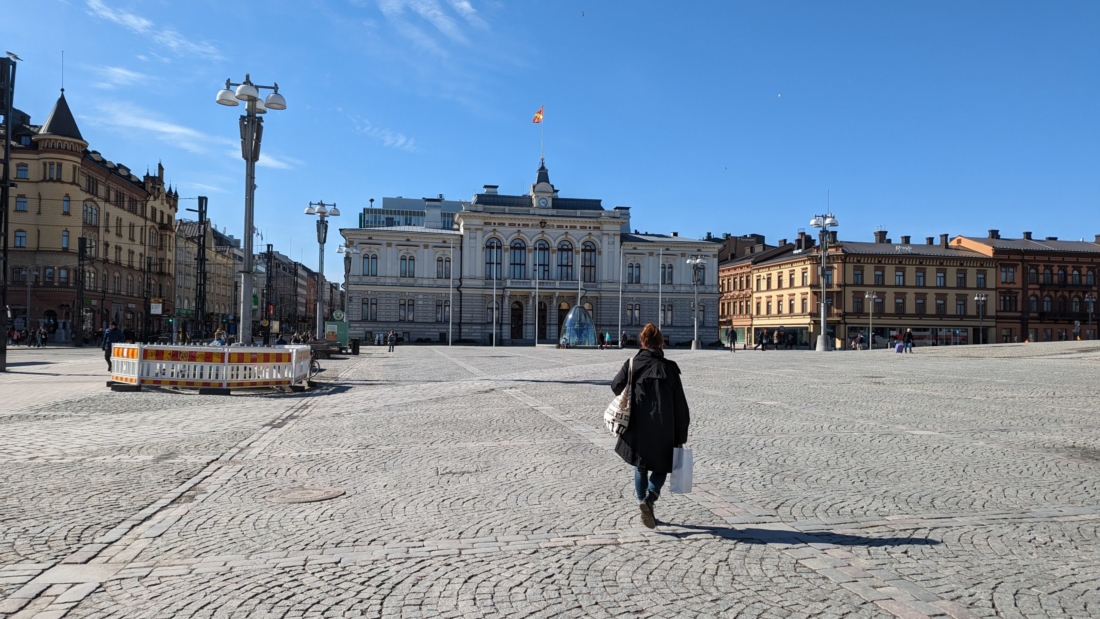
As part of the program I have the opportunity to go to Finland and visit both my industry partner Jakamo, as well as the LUT university. Now the time has finally come and I have arrived in the lovely city of Tampere, where I will be staying for my first two months. I was lucky to be met not only by great weather, but also the amazing team of Jakamo. During my stay I will conduct research in the field of ecosystem legitimacy, using Jakamo as a case study. At the same time, I will gain important industry insights and can engage with the team here so that we can learn from each other. For now I will focus on settling in, which does not seem too hard with such great company showing me the sights of Tampere 😉
I am thankful for this opportunity and am excited to see where my journey here takes me. While working with Jakamo, I will also post on their blog on supplier experience, so stay tuned for more to come!
Approaching Tampere. Picture by Finn TryggvasonTampere Town Square. Picture by Finn Tryggvason
After work sunbathing with the team. Picture by Timo Rossi
During my current academic placement with RMIT in Melbourne, Australia I have the chance to network with colleagues from the School of Business, attend talks and seminars and collaborate with other departments and researchers from different fields!
One example is the summer school led by the Digital Ethnography Research Centre (DERC) [https://digital-ethnography.com] here at RMIT Melbourne which I attended at the end of February. During the summer school Early Career Researchers (mostly PhDs) from all over the world got together to learn from Annette Markham and Larissa Hjorth about “Digital Ethnography Fieldwork and Analysis: Studying hybrid contexts of human+ non-human+ more-than-human entanglements”.
What is Digital Ethnography?
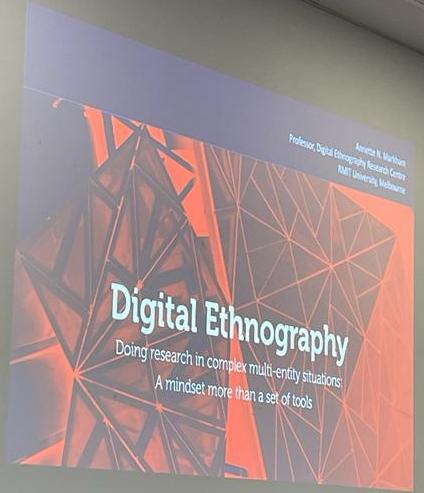
Slide from the summer school (Source: picture taken by C. Leeb).
Digital ethnography encompasses a lot of things. In general, it means investigating how digital technology impacts humans and society by using ethnographic tools. For example, how people use and interact in the digital space (e.g., on social media platforms like Instagram or Twitter, online forums, games, etc.) and trying to understand how this impacts the end-user. Just like the EINST4INE researchers, digital ethnographers investigate digital transformation. They are taking a very human-centred approach to this and are interested in the lived experience and feelings of the people using digital tools. I was lucky enough to be able to participate in this summer school, and I can only say: What an amazing summer school and what a great fit to my research!
The Summer School
The summer school lasted a week, plus an extra day for PhDs to present their work.
We heard lectures on various topics, such as how to do ethical research or on important themes in fieldwork (e.g., immersion, continuous documentation, using “what’s at hand” to generate material). Further, a penal discussion of former PhD students doing Digital Ethnography gave us insights about the possibilities in this research area. We heard from Marissa Willcox (University of Amsterdam), Zöe Glatt (London School of Economics), Kelly Chan (RMIT University) and Jess Hardley (RMIT University). We also had workshops in which we did our first ethnographic fieldwork, we learned how to write field notes and how to use video and photos to document our experiences.
Halfway through the summer school, we did one day of fieldwork out in the public space. We were divided into 6 groups. Half of the groups observed the interactions inside the Australian Centre for the Moving Image (ACMI) and the other half on Federation Square in Melbourne. But – this was not all!
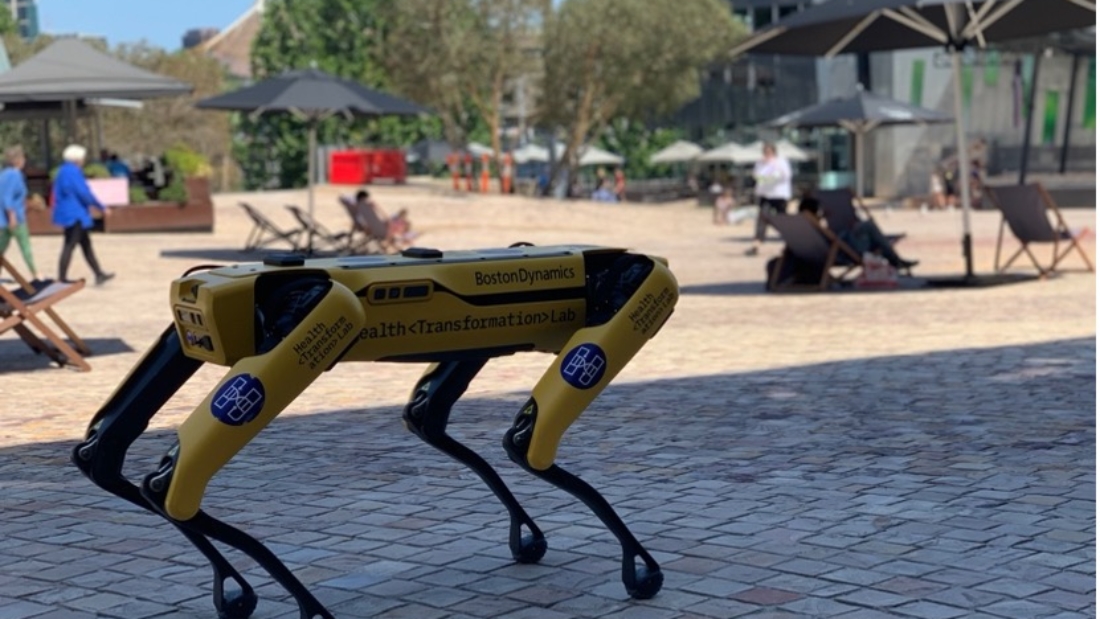
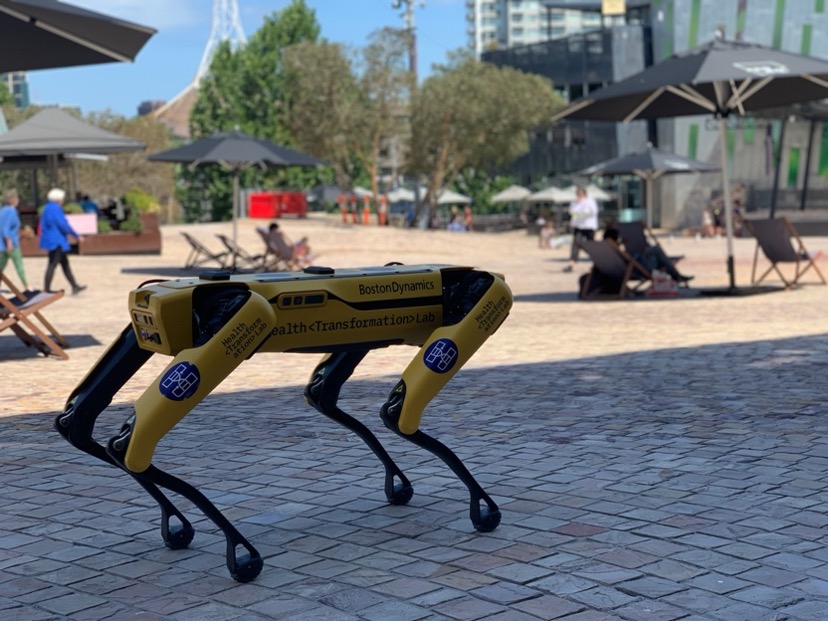
We actually observed something very specific, as we had another participant joining us: Boston Dynamic’s robot Spot!
Spot on Federation Square (Source: picture credits to Alison Starr).
The focus of our observation and field day was to see how people of the public react and interact with Spot. This day was very insightful and lots of fun!
After that, we started reflecting on our experiences as a group and heard lectures on some useful tools for the analytical processing of the data, namely on Situational Mapping and Critical Making techniques. Then, each group put together two presentations to share with the other participants: one on our initial reflections of the field day and one on initial findings from the first attempts of analysing some data.
Personal key take-aways
I will very shortly touch upon 3 key take-aways from this summer school:
Ethical considerations: Before, during, and after doing research.
It was great to discuss this central topic in research again: how important it is for a researcher to constantly reflect on ethical considerations.
Before the research this seems obvious to most: often simply because you need to obtain ethical approval to do your study. But it doesn’t end there, continuously throughout your data collection time – you need to be aware of your positionality (am I an outsider, an insider?), what effect your research or your presence in the field could have on others, and that you will always bring in subjectivity when entering a field. The more you reflect on these things, the better and the more you can ensure that your research will be ethical. Ethics is not simply an approval to obtain – it is there to support you to do the right thing. It helps you to reflect on possible issues that might arise and to plan ahead on how you will react to them.
Looking at the data in a group: Surprises can emerge.
During the analysis stage, we had access to the data we collected ourselves and the data from all other researchers. A key take-away for me here is that looking at data in a group can lead to many different insights and surprising themes! It enriches the analysis process greatly as every member brings a unique point of view into the discussion.
It was exciting to see all the interesting themes that emerged during the analysis process with my group. We talked about the agency of oneself and how we ascribe agency to others (e.g., Spot). While I wasn’t too surprised that participants seemed to struggle to categorize Spot (Is it a dog? A horse? A spider?), I was intrigued by the fact that most people really wanted to categorize it. They either asked a lot of questions or started treating it in a certain way (e.g., petting it etc). Other interesting topics that emerged were control (people started giving Spot commands) and embodiment (participants reflected on their feelings in a bodily sensation).
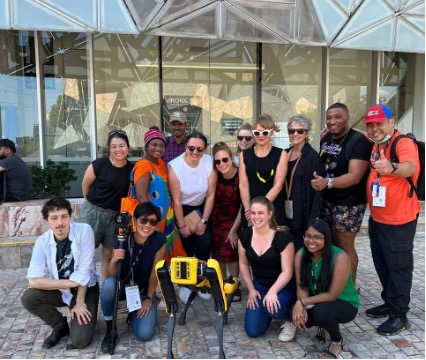
About half of the participants of the summer school + Spot at Federation Square. (Picture credits to Haryo Jiwandono).
Not just valuable learnings: Good company & good food.
The last key take-away is clearly that I learned a lot and enjoyed the summer school greatly. I met fascinating people from all (literally every continent except Antarctica was represented) over the world from various disciplines (architecture, urban studies, anthropology, design, journalism, organisational studies…). Actually – one of them, Kateryna Kryzhanivska, who is also a visiting PhD researcher at RMIT, and she is from LUT University, Business School! (which shows again that the world can be really small as well).
Who knows – maybe some of these connections will last and result in future collaborations!
Further, good food is a great plus in any event.
The desert at the Welcome Dinner provided by “Piecurious” run by Helen Addison-Smith (picture taken by Constanze Leeb).
All in all I can say:
It was intense, insightful and amazing – a week well spent!
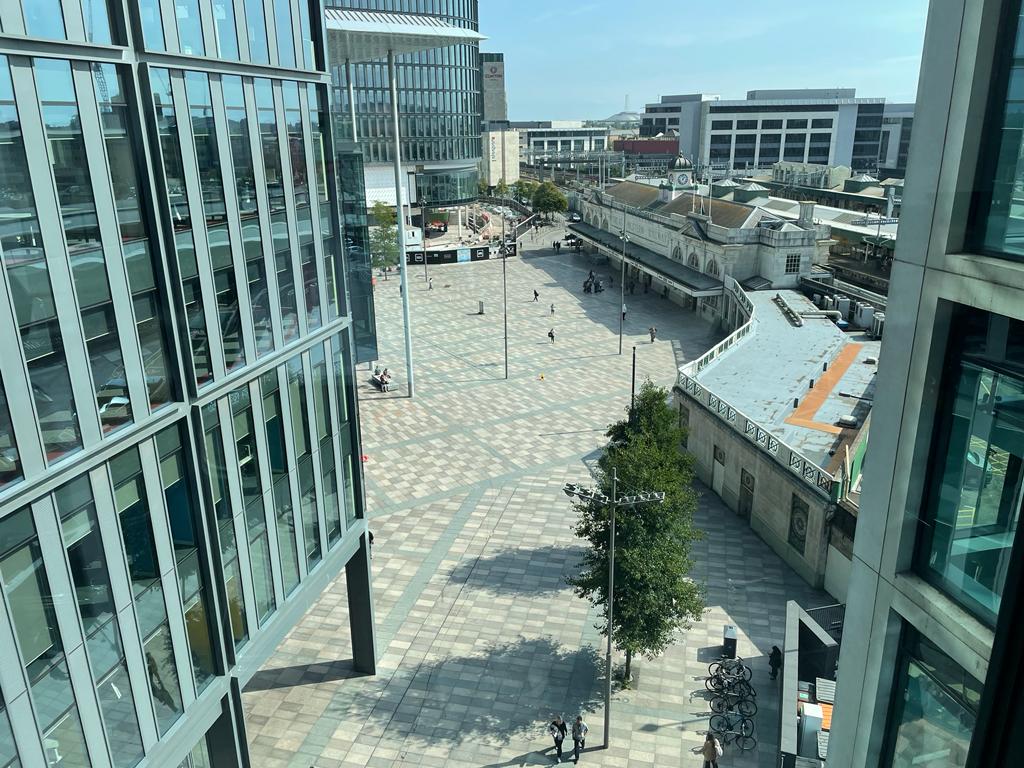
So, one step further in my PhD journey: my first secondment with EINST4INE is in the books. I spenT some time with one of my industry partners: AMPLYFI in Cardiff. Here, I summarise a few useful learnings that might be helpful for your research as well!
AMPLYFI
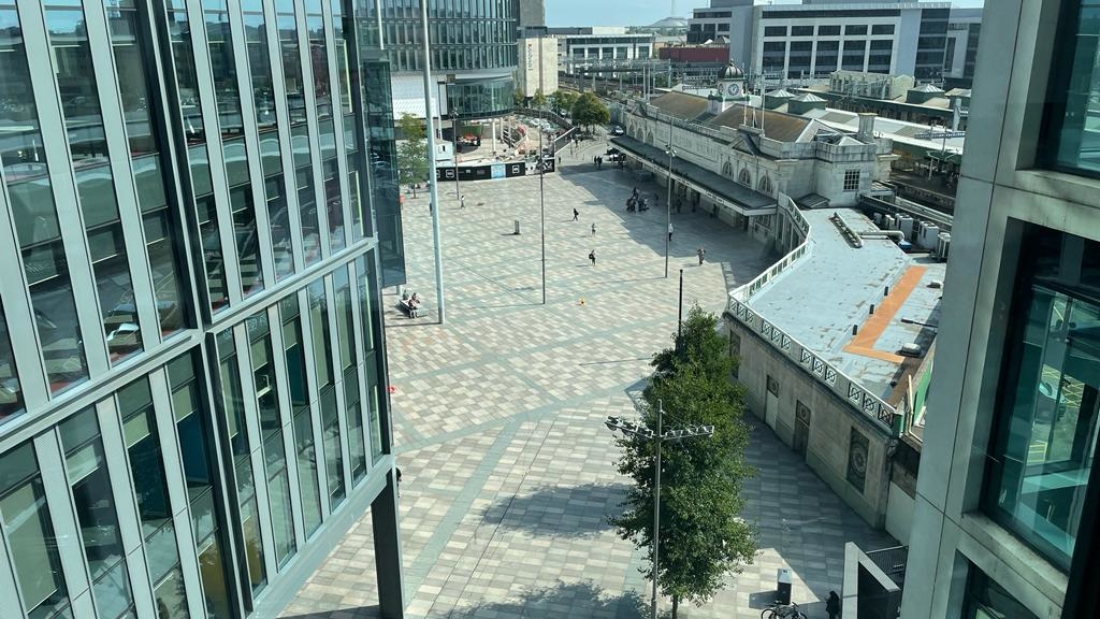
Cardiff Bay (picture taken by Constanze Leeb).
The company I visited during my first secondment is part of the EINST4INE consortium. AMPLYFI is a company providing a research platform which uses AI to analyse content and uncover previously hidden trends and opportunities. For this, I moved to Cardiff, Wales (so once across the U.K. from East to West) where the company is headquartered and spent a few weeks with AMPLYFI. If you have never been – Cardiff is a great city, with an amazing castle, lots of nice arcades and it’s next to the sea (and if you time it right and are lucky, like me – you can maybe see the King)! Hint: bring a waterproof jacket (and backpack) and no umbrella – it can get quite rainy and windy.
Real fieldwork – A typical day at AMPLYFI
My days at AMPLYFI were always interesting and fun. First, the team is really nice and the atmosphere very motivating. Second, I was able to participate in many things during my time there. I had a desk in a shared working space, could come to the office every day, met many of the team, and was able to participate in most things, which enabled me to really experience the company and their activities. I talked to many colleagues, sat-in on meetings and calls, participated in workshops and was able to get hands-on experience with AMPLYFI’s tools.
Industry vs. Academia
You have all heard this before, but it really is true: the pace is very different in the industry. Everything happens faster – especially at a young company like AMPLYFI! A colleague has an idea, a small team gets together to look into it, and a few weeks later you can see the results. It is incredible how quickly AMPLYFI’s tools develop, I am sure there will be something new when I return for my second placement with them!
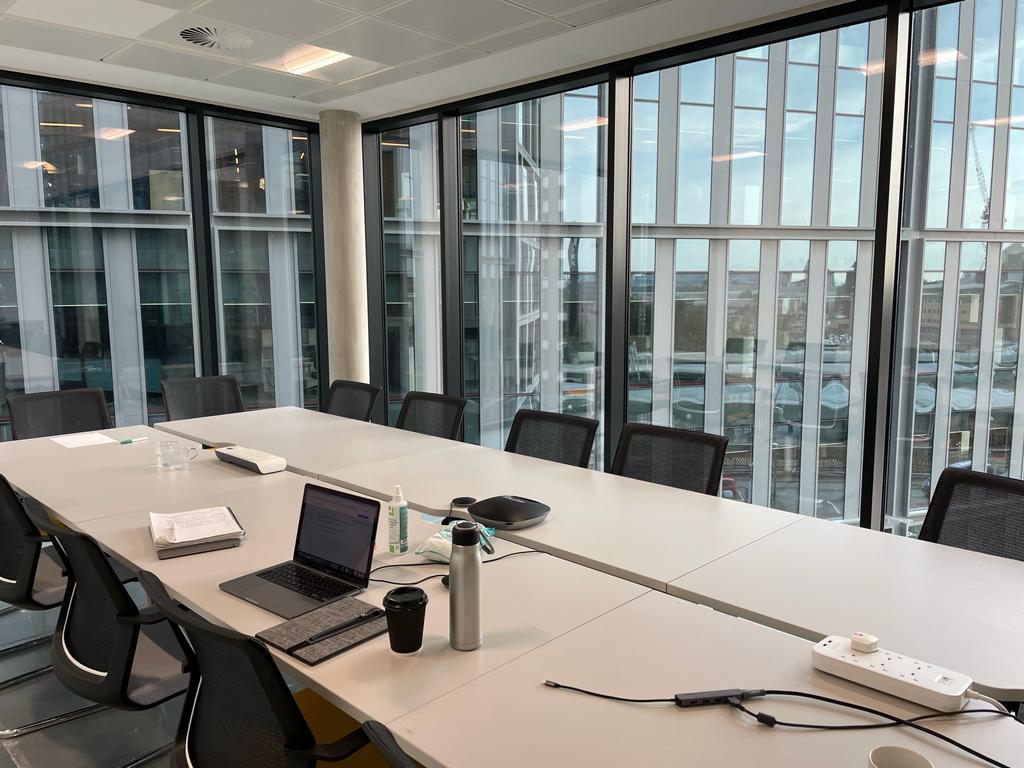
AMPLYFI’s Board Room (picture taken by Constanze Leeb).
What impressed me as well is how well organised AMPLYFI is. They are working closely across teams, keep each other up to date on their work, and have detailed documentation of their tasks performed – something that academia can benefit from as well!
Lastly, I have always studied intelligence work from a distance – reading about it and hearing others talk about it. But I have never had to perform it myself. During my time at AMPLYFI I was able to do a little research project on a topic of my choice using AMPLYFI tools, which was an invaluable practical experience. What I definitely learned from it is that intelligence work is just as hard and complex as I thought it is and my respect for all people performing intelligence work has increased even more.
Learnings for and from fieldwork
My first experience in fieldwork was great, but I did realise that many of the things that made it great came from my Sociology background and me taking time before the secondment to visualise what it would be like. Therefore, I am summarising some of my learnings here:
Be well organised! When you enter the field, it can be overwhelming. So, it is best if you already thought about a few things and prepared them. For example:
Know where you want to take which kind of notes. Especially, if your fieldwork will entail data that is not being recorded on audio or video!
Prepare folders beforehand for your data, e.g.: interviews with employees, interviews with customers, etc.
Think about a naming system for your data. Are you going to number your interview partners? Are you going to name the files after the interview partners, the day of the interview, etc.?
View from AMPLYFI’s Board Room.
Be part of everything you can! Often you learn the most interesting things in situations least expected. So, if you have dedicated time for fieldwork – use it and participate in everything you can.
You will not only learn a lot by participating in meetings, events, social activities etc. – you will also meet people! And this in turn can give you access to new interview partners or new events.
When you hear about an interesting event. – just ask if you can participate. The answer will likely be yes, as you will have some form of NDA/CDA in place anyways. Remember: others don’t know what you need or are specifically interested in! And also: Worst case – the answer is no, but at least you asked!
If you feel like you have no idea of what is happening – just participate anyways, you will figure it out on the way. Or not – and then you can ask about it afterwards.
Just ask! We all know the fear of asking questions from school or university. Of course, also back then the lesson was: just ask! This is also true here, especially as you are entering the field from outside – nobody expects you to know everything!
If you don’t understand something – ask about it. Usually, people are very happy to help and to explain something. Even if it is basic for them, they understand that it isn’t basic for you. Also – this is what research is sometimes about right? Asking the obvious questions to understand deeper underlying concepts.
Ask for access to internal documentation and access to internal communication! This will give you invaluable insights and help you understand your field a lot better! Just ask and explain that it’s insightful for a comprehensive understanding – if they are not happy to share, they will tell you so.
If you are interested to hear more about my time at AMPLYFI: I also wrote a blog post for the AMPLYFI website! You can check it out here, next to other interesting blogs on the AMPLYFI website.
Shopping Basket
This website collects cookies to enable the proper functioning and security of the website, and help us offer you a better browsing experience. By using our website you agree we can place functional and analytical cookies on your device. Find out more about cookies and how to manage them by visiting the RMIT Privacy Statement link in the website footer. If you're happy to continue, please press accept. You can opt-out if you wish but this may affect how the website functions. Cookie settingsACCEPT
Privacy and Cookies Policy
Privacy Overview
This website uses cookies to improve your experience while you navigate through the website. Out of these cookies, the cookies that are categorized as necessary are stored on your browser as they are essential for the working of basic functionalities of the website. We also use third-party cookies that help us analyze and understand how you use this website. These cookies will be stored in your browser only with your consent. You also have the option to opt-out of these cookies. But opting out of some of these cookies may have an effect on your browsing experience.
Necessary cookies are absolutely essential for the website to function properly. This category only includes cookies that ensures basic functionalities and security features of the website. These cookies do not store any personal information.
Any cookies that may not be particularly necessary for the website to function and is used specifically to collect user personal data via analytics, ads, other embedded contents are termed as non-necessary cookies. It is mandatory to procure user consent prior to running these cookies on your website.