The automotive sector has undergone a significant transformation with the advent of electromobility. This revolutionary shift is reshaping the way vehicles are powered, manufactured, and utilized, with profound implications for the industry, the environment, and society as a whole.
Electromobility refers to the use of electric propulsion systems, primarily batteries or fuel cells, to power vehicles instead of traditional internal combustion engines. This transition is driven by various factors, including concerns about climate change, air pollution, and the finite nature of fossil fuels. As a result, automakers are increasingly investing in electric vehicles (EVs) and developing advanced technologies to improve their performance, range, and affordability.
Tesla has played a pivotal role in driving the adoption of electromobility and reshaping the automotive industry. However, Tesla’s success has also posed a significant challenge for traditional automakers, many of whom have struggled to catch up in the rapidly evolving electric vehicle market. Despite their substantial resources and manufacturing capabilities, legacy automakers have faced obstacles in developing competitive electric vehicles that can match Tesla’s performance, range, and brand appeal. Additionally, the transition to electromobility requires significant investment in research and development which can be daunting for established automakers.
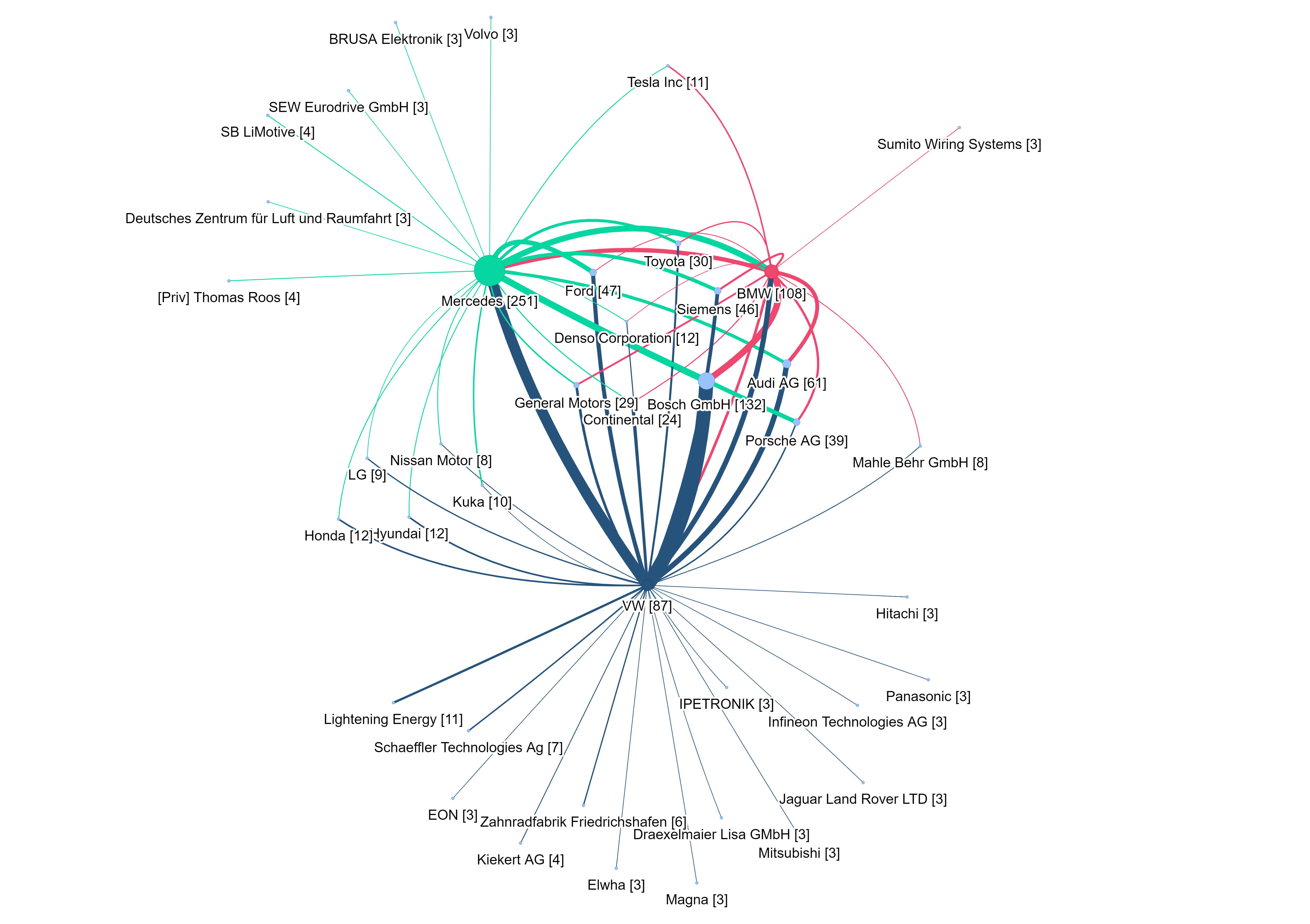
Nevertheless, traditional car manufacturers had plenty of time and resources to search for and integrate external knowledge and identify the market changes. We investigated how the German car manufacturing sector prepared and responded to electromobility in our latest paper. What we find is that they delayed their response significantly and heavily relied on local knowledge – rather than sourcing missing knowledge early and integrating it. Using patent data, we mapped the knowledge flows for the three major players in the German car manufacturing sector and visualized the network.
Our most important finding is, that someone else in the innovation ecosystem managed to step up when the car manufacturers were not. Bosch became essential for all three car manufacturers and shows that it is essential to scan the peripheral of the industry. Otherwise you risk your position in the market and empower potential competitors to take your spot during the industry evolution.
Knowledge flows at the later stages of the industry evolution. Bosch managed to become a central source for knowledge, granting them the power to control knowledge in the new ecosystem.
Data monetization refers to the process of capturing monetary value from data by generating revenue through selling data, data-based products, and data-based services. It involves converting the intangible value of data into tangible financial returns.
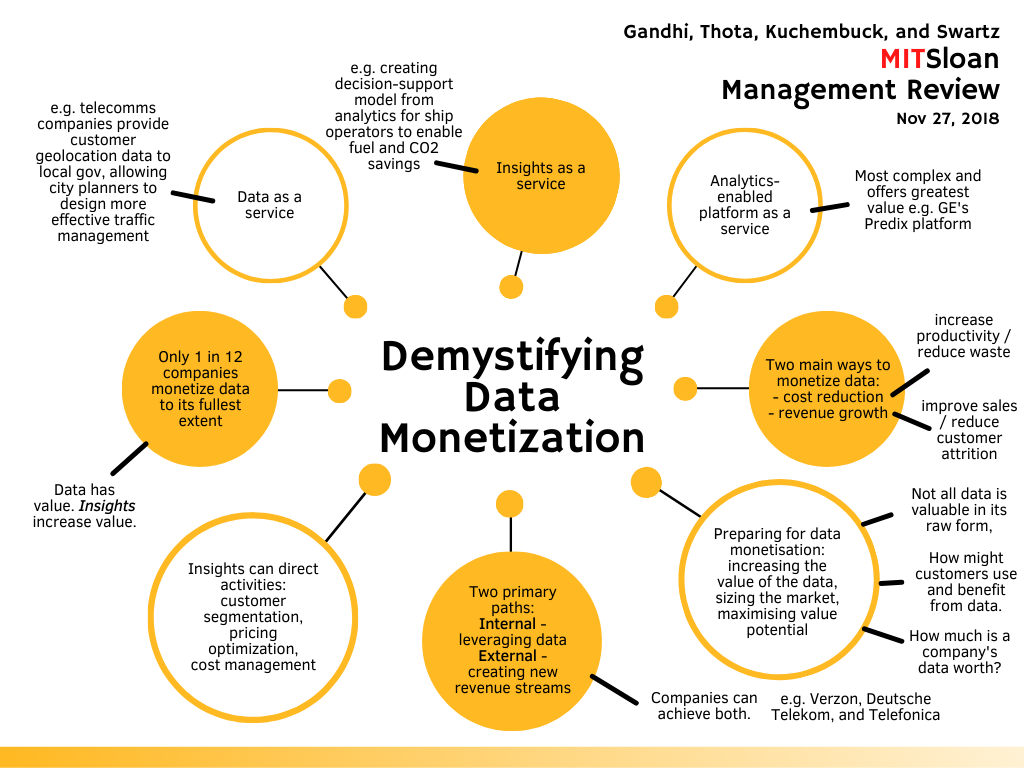
Summary of ‘Demystifying Data Monetization’ (Gandhi et al., 2018). Created by author.
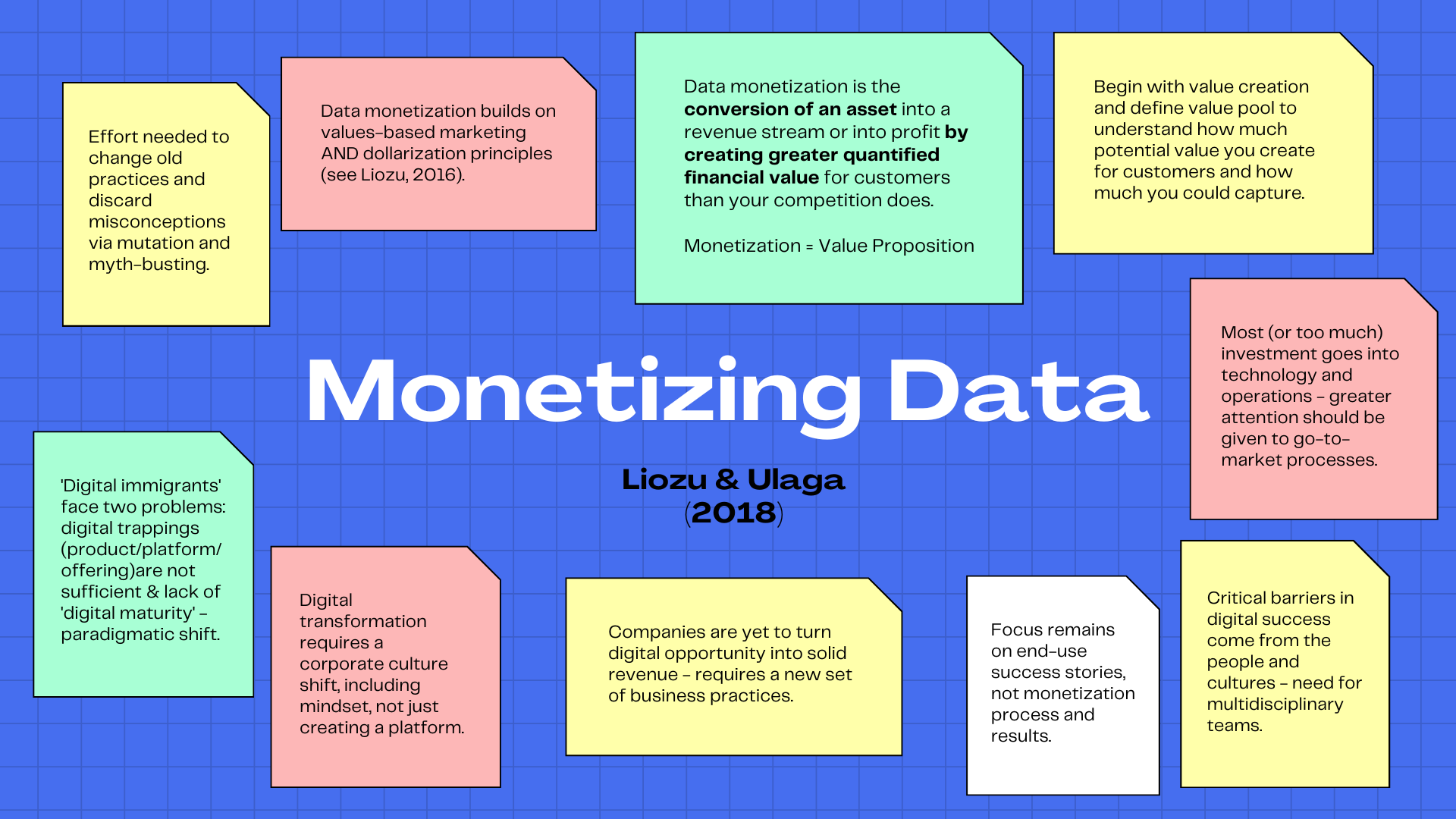
I was actually very new to this topic when I started this project, so as a fun way to get into the literature I generated a few visuals to help concretize the key learnings and takeaway. I share them here (above and below) to help give a snapshot of some of the foundational reading. At this time, I was lucky enough to gain the experienced wisdom from my co-authors, who publish works in this area such as ‘Three Ways to Sell Value in B2B Markets‘ (Keränen et al., 2021) and ‘Growth Reinvented: Turn your data and artificial intelligence into money‘ (Ruokonen, 2020).
Summary of ‘Monetizing Data’ (Liozu & Ulaga, 2018). Created by author.
Data monetization is crucial for organizations as it presents opportunities to create new revenue streams, drive innovation, enhance competitiveness, and unlock the full potential of data assets which can also contribute to environmental and social benefits. Despite the increasing trend towards data-driven offerings, many B2B firms face difficulties in effectively selling and monetizing their data.
How can data be monetized – what did we find?
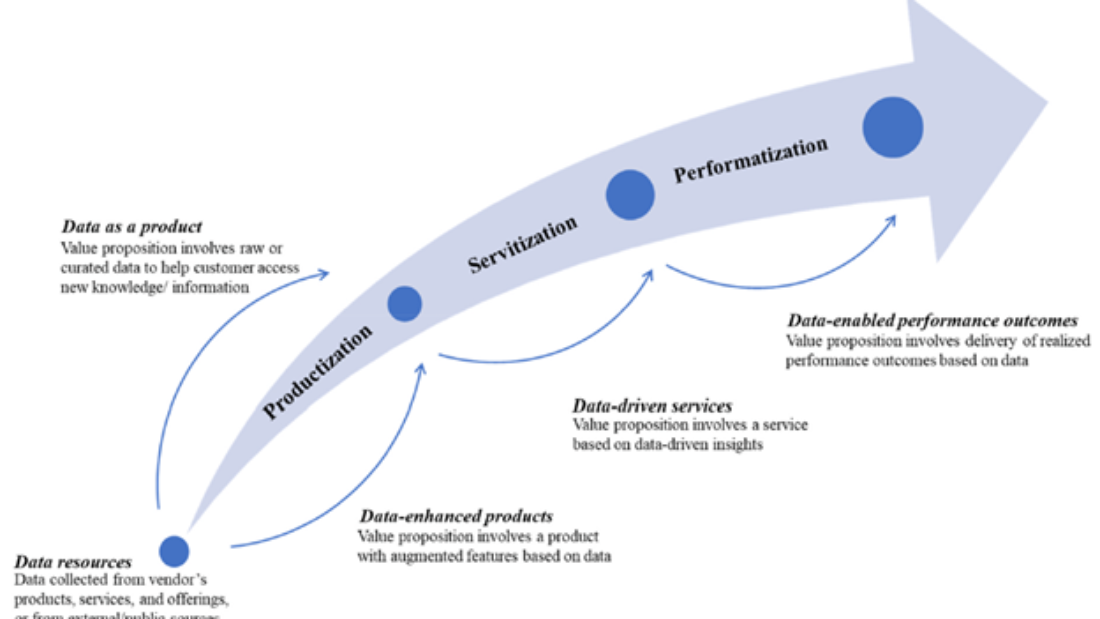
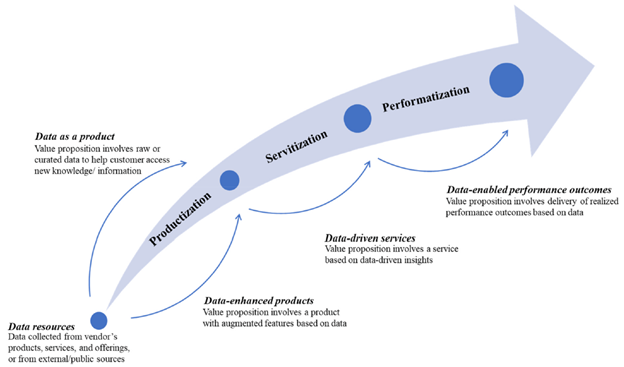
We studied data-driven value propositions by 14 B2B companies, including ABB Group, Hilti Group, Kemira, Eagle Alpha, Kyndryl, Metso Outotec, Jakamo, and many others. Accumulating evidence from some of the authors’ previous work, the literature, and predominantly the interviews we conducted with key informants from our case companies, we were able to identify four different data-driven value propositions that B2B firms can use to sell and monetize data-driven offerings. These are:
Data as a product – where raw or processed data is sold or shared with customers as a stand-alone offering. In this model, vendors typically sell their own data or data collected from public domains or other companies.
Data-enhanced products– where existing product offerings are enhanced with data-driven features and functionalities. In this model, vendors embed for instance smart sensors, software, and IoT applications into physical products to collect, analyze, and monitor data on how customers use their products.
Data-driven services – where vendors use accumulated data to analyze, predict, and optimize customers’ processes. In this model, vendors sell intangible insights and know-how through consulting services.
Data-enabled performance outcomes – where vendors combine data-enhanced products and data-driven services to deliver complete smart solutions that guarantee specific performance outcomes. In this model, vendors take responsibility for specific processes on behalf of their customers and sell measurable and guaranteed performance, capacity, or availability outcomes.
Each of these value propositions has its unique characteristics, capabilities, and challenges, and the study provides insights into how firms can transition between them and develop their data-driven offerings (see Table 2 in the paper).
These four propositions are not a step-by-step progression, as a firm can choose to develop one or more of these propositions and expand in either direction that suits the firm’s capabilities, resources, and goals at any given time. Although, it can be said there is a higher investment of resources and increasing complexity and challenges as you progress from 1 to 4 of the labelled propositions above.
We developed a continuum to visualize how firms often navigate between these different value propositions.
Data-driven value proposition continuum (Source: Ritala et al., 2023)
For example, Telia told us about their data-driven services such as Crowd Insights, where for instance they work with cities to support decision-making and planning for a more efficient and optimized city. Using aggregated mobile data (meaning it is anonymized and cannot be traced to the individual) the city can understand the movements of people to better organise road traffic and general services such as events. This innovation allows Telia to make use of their otherwise untapped data and open additional revenue streams, while creating both social and environmental benefits with better traffic flow and less crowding.
As another example, at Johnson & Johnson MedTech they design healthcare solutions that are smarter, less invasive, and more personalized. They told us about how they monetize data via their smart product and technologies (data-enabled products). Ultimately, the goal is to make surgery safer and to reduce complications. Additionally, with data-enabled performance outcomes such as their Surgical Process Manager, they are able to standardize processes better which reduces errors and thus reduces complications in surgery.
Key implications for managers
We suggest that firms need to carefully develop and pilot new data-driven value propositions with their customers.
During this process, they should engage in organizational up-skilling, especially in terms of acquiring and developing new capabilities related to data collection and analysis, tech architecture, commercialization, sales, and marketing.
While the softer sales and marketing capabilities needed to understand and communicate the value of data-driven value propositions are often possible to learn and (re)train in-house, the more complex technical capabilities related to data collection, analysis, and interpretation usually need to be acquired externally through hiring or partnering with other firms.
It’s also important for firms to consider strategically how and to what extent they can monetize the data they can access and to address challenges with customer or industry maturity in terms of accepting and using novel data-driven solutions, which often require extra effort from suppliers to educate and shape those markets.
Gandhi, S., Thota, B., Kuchembuck, R., Swartz, J., 2018. Demystifying Data Monetization. https://sloanreview.mit.edu/article/demystifying-data-monetization/
Keränen, J., Terho, H. and Saurama, A., 2021. Three ways to sell value in B2B markets. MIT Sloan Management Review, 63(1).
Liozu, S., Ulaga, W., 2018. Monetizing Data: A Practical Roadmap for Framing, Pricing & Selling Your B2B Digital Offers. Value Innoruption Advisors Publishing.
Ritala, P., Keränen, J., Fishburn, J. and Ruokonen, M., 2024. Selling and monetizing data in B2B markets: Four data-driven value propositions. Technovation, 130, p.102935.
Ruokonen, M. 2020. Growth Reinvetned: How to turn your data and artificial intelligence into money. Independently published.
I’m delighted to share our study, “Contamination Detection Using a Deep Convolutional Neural Network with Safe Machine Environment Interaction,” has been accepted for publication in MDPI Electronics Journal. This journey has been an effort of dedication, and I can’t wait to share our groundbreaking findings with you.
Understanding the Problem Contamination detection is an important issue in many industries, including food processing, healthcare, and others. A primary focus is ensuring product quality and safety, and this is where our research comes in. Manual examination gets laborious and may result in contamination occurring along the production line. To solve this issue, a contamination detection system based on an enhanced deep convolutional neural network (CNN) in a human-robot collaboration framework is proposed.
Deep Learning: The Key to Precision In our research, we enhanced Deep Convolutional Neural Networks (CNNs) to detect contaminants in food packages. CNNs are well-known for their ability to extract intricate patterns from complex data, making them perfect for tasks like object detection and analysis.
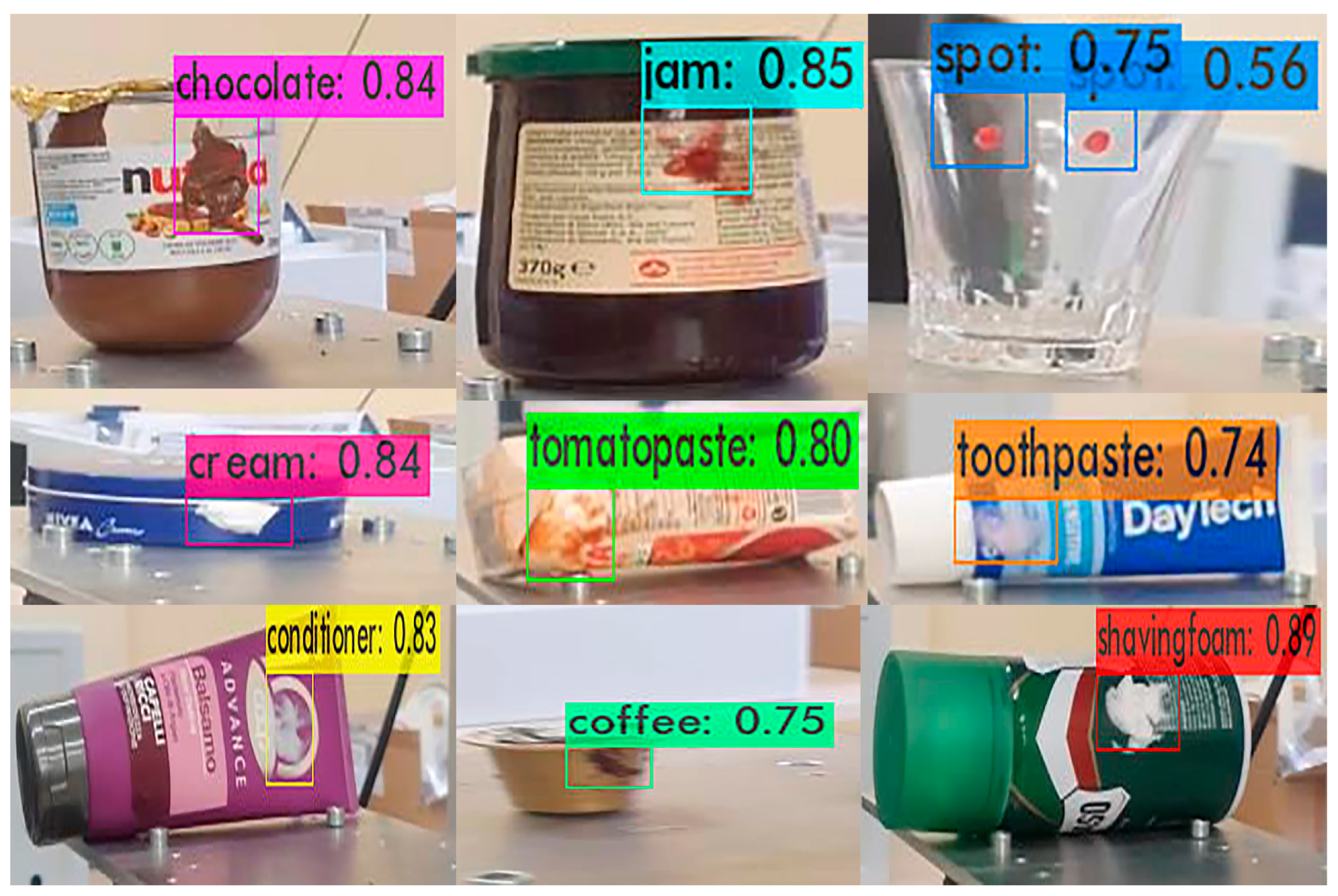
Safe Machine Environment Interaction To improve our system’s performance, we coded the proximity sensor for “Safe Machine Environment Interaction.” A mechatronic platform with a camera for contamination detection and a time-of-flight sensor for safe machine-environment interaction was used for the experiment. The experiment findings show that the reported system can identify contamination with 99.74% mean average precision (mAP). Figure 1 depicts the experimental results, and the publication can be found here [1].
Figure 1. Experimental trials of real-time detection using the reported CNN [1].Future Directions Future work may concentrate on adding more contamination classes in order to create a more thorough and improved contamination detection system. The algorithm might also be applied in a real robot with a conveyor belt to create an industrial quality inspection setup. However, the journey does not finish here. We’re devoted to improving our methodology and investigating new applications. We’re thrilled to be at the forefront of the deep learning revolution.
Acknowledgments I want to express my heartfelt gratitude to my Supervisor, colleagues, and the entire research team who played a pivotal role in this project. Their expertise, dedication, and collaboration made this achievement possible.
Paper Reference
[1] Hassan, Syed Ali, Muhammad Adnan Khalil, Fabrizia Auletta, Mariangela Filosa, Domenico Camboni, Arianna Menciassi, and Calogero Maria Oddo. “Contamination Detection Using a Deep Convolutional Neural Network with Safe Machine—Environment Interaction.” Electronics 12, no. 20 (2023): 4260.
Shopping Basket
This website collects cookies to enable the proper functioning and security of the website, and help us offer you a better browsing experience. By using our website you agree we can place functional and analytical cookies on your device. Find out more about cookies and how to manage them by visiting the RMIT Privacy Statement link in the website footer. If you're happy to continue, please press accept. You can opt-out if you wish but this may affect how the website functions. Cookie settingsACCEPT
Privacy and Cookies Policy
Privacy Overview
This website uses cookies to improve your experience while you navigate through the website. Out of these cookies, the cookies that are categorized as necessary are stored on your browser as they are essential for the working of basic functionalities of the website. We also use third-party cookies that help us analyze and understand how you use this website. These cookies will be stored in your browser only with your consent. You also have the option to opt-out of these cookies. But opting out of some of these cookies may have an effect on your browsing experience.
Necessary cookies are absolutely essential for the website to function properly. This category only includes cookies that ensures basic functionalities and security features of the website. These cookies do not store any personal information.
Any cookies that may not be particularly necessary for the website to function and is used specifically to collect user personal data via analytics, ads, other embedded contents are termed as non-necessary cookies. It is mandatory to procure user consent prior to running these cookies on your website.