Extended Reality

XR – Extended Reality

Immersive experiences are constructed by merging the physical and virtual worlds. Among the technologies that are gaining more popularity are Virtual Reality (VR), Augmented Reality (AR), and Mixed Reality (MR). Recently interest in Extended Reality (XR) has grown rapidly.

Current developments in technology have led to the extension of the terminology used to describe the merging of the physical or real world with a virtual world. All mentioned terms refer to a combination of virtual and physical worlds using various digital media to create new, blended spaces. In recent years, we have heard and read a lot about Virtual Reality and Augmented Reality.

Virtual Reality (VR) is like a new reality that is created. It is a simulation of an environment or a three-dimensional image. People can interact with that virtual environment by using equipment such as headsets, helmets, glasses, or gloves. Increasingly such equipment comes with more sophisticated sensors, enabling more refined experiences. A headset allows the user to be immersed in the VR experience; the user can see a virtual world delivered by computer-simulated images and sounds.

Augmented Reality (AR) is often described as the merging of our normal reality with computer-generated digital graphics. Unlike virtual reality, users do not experience being in a virtual world, but they see the real world with an additional digital layer. Often used by enabling the camera of handheld devices such as mobile phones or tablet computers, AR allows a new kind of display which is usually portable.

Picture: Freepik.com 

Mixed Reality (MR) combines the features of VR and AR. A more recent term, mixed reality is often used in a similar way as augmented reality. MR is used to create three-dimensional images of realistic objects or complex environments where real and virtual worlds are blended. The interaction of digital and physical elements in real-time constructs a new space. MR is defined as a “continuum between the real and the virtual environments” [1].

In addition to the combination of real-world overlaid with a virtual layer as provided by AR, digital environments for mixed reality can use not only portable devices but physical environmental elements such as rooms or buildings. The fact that both sellers and users or buyers can interact with these objects or environments makes MR attractive for application in business. Sellers can provide immersive experiences with MR that help demonstrate how a product will look in a certain space. For instance, fitting furniture into a client´s home or demonstrating how a building looks and how it will fit into an area or neighborhood are useful features for marketing and sales. Other examples include head-up displays as used in the automotive industry. Using MR, clients can interact with the object and experience it in a new way.
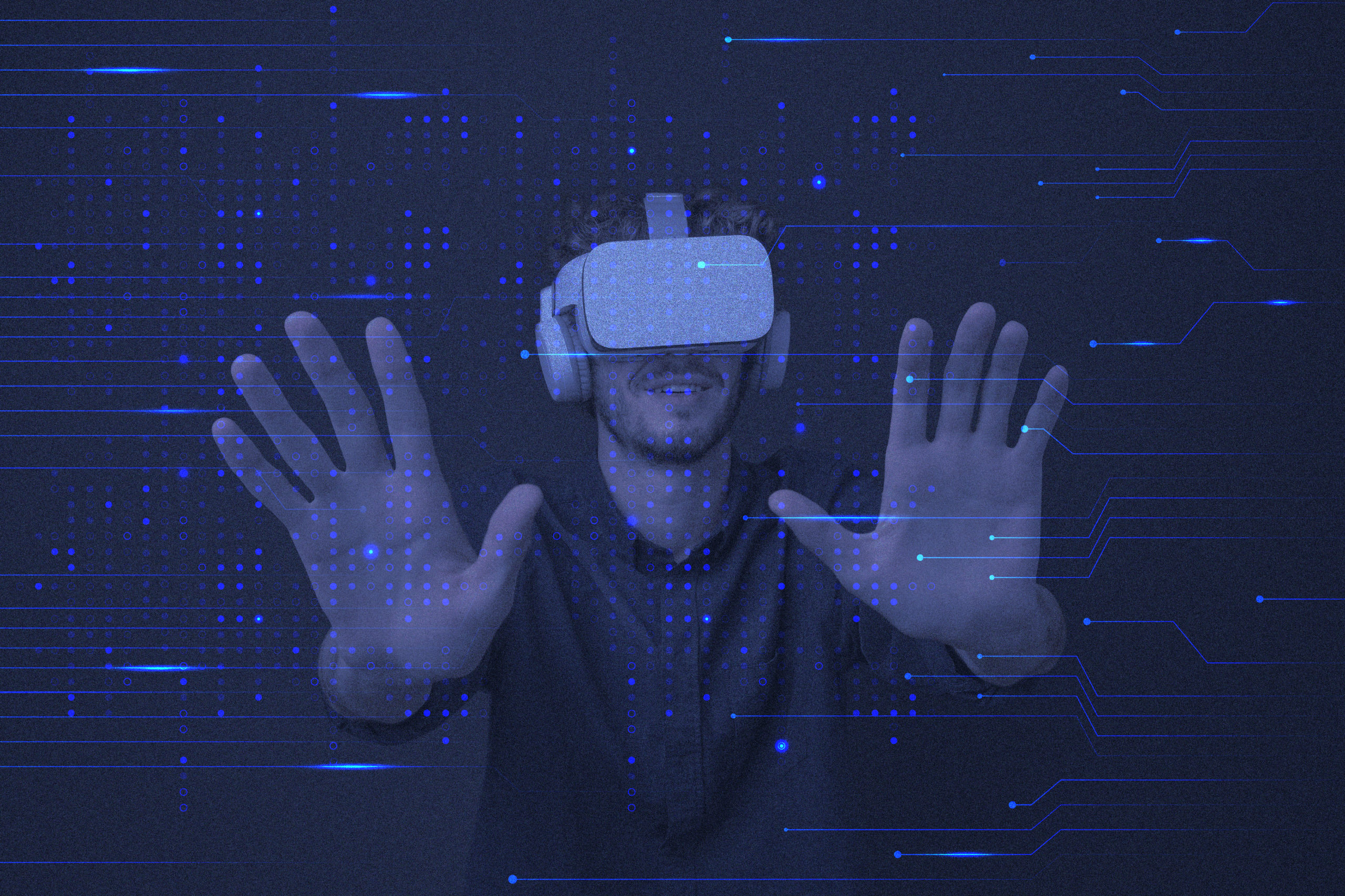
Picture: Freepik.com

So, VR constructs a new reality, AR consists of the physical world that is overlaid with a digital layer, and MR allows new experiences through interaction with an object or a product… what about Extended Reality?

Extended Reality (XR)

Extended Reality or XR is a relatively new expression. It is an emerging umbrella term that includes Virtual Reality (VR), Augmented Reality (AR), and Mixed Reality (MR). The full spectrum of real and virtual environments is covered by XR. [2] It refers to computer-generated environments. By overlaying a virtual layer over the physical reality, XR creates entirely immersive user experiences using computer-generated images and sensors.

In 2019, many stakeholders of XR product companies predicted that XR will become mainstream in the next five years. [3] Industry use cases are predicted to be mainly in the medical and manufacturing industries for business XR, whereas consumer XR will be mainly focused on media and entertainment, movies, television, and the gaming industry.

In education augmented and virtual reality technology offers new training opportunities that cannot be found in traditional classroom settings. XR will allow educators to explore new educational territory. Furthermore, XR helps facilitate new experiences for students, such as observing certain topics at different points in time throughout history or exploring distant places on earth with virtual visits. Students exposed to XR are enabled to experiment and engage in new ways. They may not only learn better but could also improve crucial skills like problem-solving or other abilities that are useful in daily life.

Multisensory Extended Reality is often used together with the term extended reality. In addition to the visual and the auditory senses, which have been mainly highlighted by VR and AR, it refers to immersion into a new reality through additional senses. The human senses are extended with sensory-enabling XR technology. These include the haptic sense, enabling the touch of objects with gloves, the sense of taste, simulated with an electronic tongue, and the sense of smell, simulated through an electronic nose or diffuser technology. [4]

Picture: Freepik.com

Which reality?

The possibilities offered by XR technology are seemingly endless. Businesses have begun to leverage this cutting-edge technology for a variety of purposes such as entertainment, education, or remote tours for remote visits to museums or tourist attractions. Marketing, real estate, the medical industry, media, and entertainment were the first to adopt it, but many more will follow soon. In 2022, the worldwide market for extended reality was valued at $38.3 billion. Predictions for 2030 see the market rise up to $394.8 billion. [5] The European XR industry is fragmented and less well-known than its competitors in Asia or the US. [6]

Industry has discovered what XR technology can do for them and has developed innovative ways to make use of these advanced technologies. As AR and VR are increasingly adopted, a rapidly growing list of sectors invests in the development of new applications.

New technologies are likely to continue the creation of additional new realities. People are given more control over how they interact with their physical or digital environment. Use cases for XR are seen in almost every industry. As potential applications for XR may go far beyond the sectors mentioned, XR is foreseen to revolutionize every industry in the near future.


References

[1] https://xr4all.eu/xr/

[2] XR4ALL is an initiative by the European Commission to strengthen the European XR industry. For more information see https://xr4all.eu/xr/

[3] https://www.visualcapitalist.com/extended-reality-xr/

[4] Santoso, H. B., Wang, J. C., & Windasari, N. A. (2022). Impact of multisensory extended reality on tourism experience journey. Journal of Hospitality and Tourism Technology.

[5] https://www.psmarketresearch.com/market-analysis/extended-reality-xr-market-insights

[6] https://xr4all.eu/about/

Innovation competitions

Innovation competitions

Digital technologies have changed innovation in organizations. Online communities, digital content providers, or online platforms are new formats that make collaboration between many innovators possible. Innovation nowadays can take many different forms; one is hackathons.

Hackathons

Innovation competitions
Hackathon participants at work (picture: Ultrahack).

The fast-paced innovation format is based on the collaboration of a group of people, sometimes friends or colleagues, or strangers, that meet up to find solutions to specific problems.

Hackathons are usually two to three-day events at which many people come together to be creative and develop solutions to challenges. An event commonly lasts for about 48 hours, but the exact duration can vary.

The group of people that cooperate in a hackathon generally consists of around 2-6 individuals. They collaboratively analyze a problem and develop a solution for a challenge. Many hackathon participants regularly compete in hackathons. Participants work on their own laptops and communicate and collaborate in person or online through digital platforms. Inclusion is an important part of hackathons, and including colleagues is key, particularly those participants that have not attended an innovation competition before.

What participants like about hackathons and what makes an event interesting for them are:

  • a positive atmosphere
  • developing or learning new skills
  • collaborating with nice people

Group communication among all hackathon participants and for each team is set up in a way that participants and team members can easily stay in touch with one another. Digital platforms are often used for this purpose, such as Slack, which offers various chat rooms for teams to collaborate.

Hackathon events often include some of the following aspects:

  • Well-defined challenges with clearly identified problems
  • Solvable challenges – the stated challenge(s) can be solved, and coming up with a solution is achievable
  • The challenge can be accomplished in the limited time of the hackathon
  • Registration deadline for participants – the organizer often defines a maximum number of participants that can join a hackathon
  • Various skill levels can be integrated

In a broader sense, hackathons are nowadays also used as a creative format for problem-solving. The format can be centered around technology, but it does not necessarily have to be that way.

The organization of an interesting hackathon event is often built around:

  • A welcoming session with a short welcome to everyone present (online or on-site)
  • An introduction of the organizers
  • Acknowledging the event sponsors
  • Mentioning the hackathon purpose
  • Practicalities such as the schedule of the hackathon, important steps along the way, and information regarding the sessions for workshops, lunches, and dinners
  • Information about some basic rules or a code of conduct, to give a guideline and make the event enjoyable for everyone
  • Information regarding mentoring for participants etc.
  • Encouraging people to share information and communicate about the progress of their projects

At the end of a hackathon, after the award ceremony, applause is given to the winners. Yet the community celebrates not only the winners but all participants for having participated, as participation is seen as an achievement by itself.

Open Innovation journey

Open Innovation journey

Before starting my digital transformation journey and pursuing a PhD, I had developed a strong interest in innovation. For a while, that interest was rather general and did not focus on one specific area. With a background in economic history and teaching, I liked the fact that learning and discovery processes form an important part of innovation.

Open Innovation journey
Sunset at 11pm – Photo: C. Häfliger

Little did I know that a concept called “Open Innovation” existed. Widely known as the father of open innovation, Henry Chesbrough introduced the open innovation concept in the early 2000s. I became very interested in open innovation when I started to read more about innovation and strategy in various specific fields. I was also very fortunate to participate in the first intensive training at Einst4ine project where we dived even deeper into open innovation and the processes it involves.  In the training, we were also introduced to current research in the field.

Open innovation refers to a distributed innovation process and can guide strategic decision making. With its focus on knowledge flows across the boundaries of organizations, it offers it offers a new way of thinking, new forms of idea development. There´s a shift away from insular thinking to seeking internal and external input and the inclusion of broader networks.

As an experienced teaching professional in higher education, I can see similarities of the open innovation concept to educational settings, where students are encouraged to approach learning with an open mindset. Similarly, open innovation requires organizations to change and facilitate the adoption of new skills. With consistent support by the organization, and learning of new skills and training, a new mindset can be developed.

Last week, we were fortunate to be able to attend a lecture by Henry Chesbrough at LUT University, when he was awarded for his outstanding achievements in strategy research. In my discussions with colleagues at university, I realized how much inspiration they drew from Henry’s work with open innovation since the early 2000s when his first book was published.

In his lecture, Henry Chesbrough’s presented some new ideas related to open innovation that I find very interesting and highly relevant for my work. Particularly, he presented an extended framework of open innovation- knowledge flows where two new types of flows were added: inside-in, and outside-out. First, inside-in knowledge flows, even though they are technically not covered by open innovation. They address issues like overcoming of internal siloes and between different groups and business units. Second, Henry Chesbrough discussed the outside-out knowledge flows. There, external knowledge is orchestrated across an ecosystem. How this is done is part of what I am trying to find out.

To sum up, as we are living in a constantly changing world, it is crucial in my opinion to teach and practice open innovation, so that we are able to solve the complex problems ahead of us more effectively.


Source: Christina Häfliger

Digital Innovation Journey

Digital Innovation Journey
(Photo: Christina Häfliger)


Currently I am working on extending my theoretical knowledge on innovation ecosystems. Over the past few years, I have developed a strong research interest in innovation, entrepreneurship, and strategic management. With multilateral sets of partners interacting in ecosystems, legitimacy processes are an important part of successful orchestration. I’m particularly interested in finding out how innovation ecosystems can be initiated and maintained so that they flourish, and how legitimacy is established.

My research at EINST4INE focuses on innovation orchestration. I’m interested in the mechanisms that contribute to prospering ecosystems. The orchestration of ecosystems involves multiple organizations and parties. Innovation ecosystems create new opportunities for diverse stakeholders to collaborate. At the same time, they create challenges for the inclusion of multiple perspectives of various stakeholders.

My expectations for the EINST4INE project are to learn and to build a network of colleagues working in different areas of digital transformation. I intend to contribute with insights through my own research and to profit from excellent research training. Having worked in higher education for the last couple of years, I had wanted to specialize in innovation. As I have been involved in several innovation projects in the past, I was looking for opportunities that would give me international research and training experience.

Research on innovation provides for me the opportunity to delve further into a topic I find fascinating. During the first few months we were able to participate in highly interactive reading and discussion sessions. We learned about various research activities and received a lot of input and tips from experienced researchers and practitioners. It is great to get to know a diverse group of young research colleagues and an extended network of partners in the field of digital business and organization. So far, we had many discussions in our cohort and were able to get to know our EINST4INE colleagues better. One topic that I particularly liked in our discussions was open innovation, as this has been an interest of mine for a while. Different forms of collaboration have fascinated me for a long time. When the Marie Skłodowska-Curie Fellowship presented this excellent opportunity to further develop my skills, I was – and still am – very happy to be able to pursue my new career path in research.