

ian-dooley-3NCA3tbaE5I-unsplash

In-between Places: How to work and travel during your PhD

In-between Places: How to work and travel during your PhD

Why do you go away? So that you can come back. So that you can see the place you came from with new eyes and extra colors. And the people there see you differently, too. Coming back to where you started is not the same as never leaving.” – Terry Pratchett

Originally, I was convinced that doing a PhD means to sit in a dusty, dark office corner at the end of a long echoing corridor of a university. And that may still hold true for some PhD candidates, frankly, I don’t know. Studying one topic in-depth for 3 to possibly many more years, turning that one coin over and over again, that does not exactly sound like a roller-coaster ride. It sounds like a long sweaty marathon when the skies are grey, everyone else is running in front of you, and the cheerleaders have gone home. But that is not it.

Embarking on a PhD journey may seem like a black box at first. Luckily, in my case, this does not describe my office situation. The black box is rather the many things that you figure out along the journey and that uncover over time and that includes the research output as well as the steps to get there. Against assumptions, two years into the journey, the ride continues to be exciting and somewhat mysterious. The times I spent sitting at a desk are finely interwoven with another trip to book, another chance to mingle and learn, another part of the chain to get to the next step.

The requirement of the EINST4INE program to move into another country was what drew me to it. I moved from Berlin to Barcelona in less than 2 months (the time frame is not my personal recommendation, but it worked out in the end!). Ever since, I get to enjoy an environment that was new to me, I am learning a new language and a new way of living—la vida loca. Aside from finding a new place to call home, the consortium also gets together on a regular basis, be it in Denmark, Italy, recently the United Kingdom – or soon in Stuttgart in southwestern Germany. And, of course, conferences, workshops and similar events are vital for joining the academic community, finding like-minded peers, and exchanging on the most recent findings.

While last year I was able to spend 4 months on an industry secondment in southern Norway, I kicked off this year with a joyful 3-months stay in Melbourne at RMIT. And here are some things that I learnt during my trips away thus far:

  1. Leaving your comfort zone is never easy, but can be very rewarding when you keep an open mind to experiencing something new everyday
  2. Planning early on and ahead of time can help to get adjusted more easily and prepare for the new setting (and safe money of your budget for another trip instead)
  3. Networking and getting to know new people are often the highlights of spending time abroad, especially if you can find people to discuss your topic with and get new ideas for your work, you may even make new friends for life
  4. Balancing to try new things and maintain regular habits (e.g., workout, sleep schedule, etc.) can be helpful to challenge yourself and expand your horizon while also keeping connected with your “home base self” for when your trip ends
  5. Exploring a new city and what it has to offer such as restaurants, museums, sights, and nature will provide many opportunities for experience and insight that can sometimes provide new angles on existing thoughts (especially for your research)—go explore and sleep when you are back home 😉

Looking back on every conference, every seminar, every dinner networking I thus far attended, each event provides such a unique value, adding to the pages of the PhD diary. Finally, my favorite saying goes like this: Don’t wait to be sure—move, move, move!
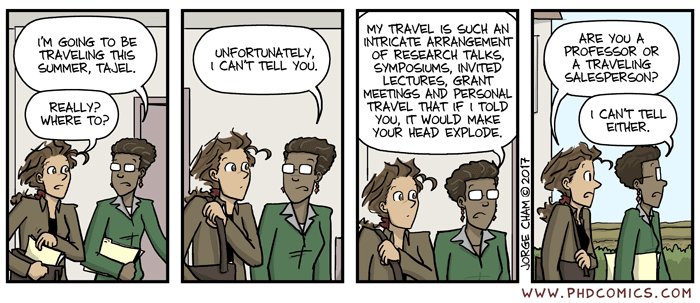

 

© phdcomics by Jorge Cham
My first secondment with AMPLYFI

My first secondment with AMPLYFI

So, one step further in my PhD journey: my first secondment with EINST4INE is in the books. I spenT some time with one of my industry partners: AMPLYFI in Cardiff. Here, I summarise a few useful learnings that might be helpful for your research as well!

AMPLYFI

My first secondment with AMPLYFI
Cardiff Bay (picture taken by Constanze Leeb).

The company I visited during my first secondment is part of the EINST4INE consortium. AMPLYFI is a company providing a research platform which uses AI to analyse content and uncover previously hidden trends and opportunities. For this, I moved to Cardiff, Wales (so once across the U.K. from East to West) where the company is headquartered  and spent a few weeks with AMPLYFI. If you have never been – Cardiff is a great city, with an amazing castle, lots of nice arcades and it’s next to the sea (and if you time it right and are lucky, like me – you can maybe see the King)! Hint: bring a waterproof jacket (and backpack) and no umbrella – it can get quite rainy and windy.

Real fieldwork – A typical day at AMPLYFI

My days at AMPLYFI were always interesting and fun. First, the team is really nice and the atmosphere very motivating. Second, I was able to participate in many things during my time there. I had a desk in a shared working space, could come to the office every day, met many of the team, and was able to participate in most things, which enabled me to really experience the company and their activities. I talked to many colleagues, sat-in on meetings and calls, participated in workshops and was able to get hands-on experience with AMPLYFI’s tools.

Industry vs. Academia

You have all heard this before, but it really is true: the pace is very different in the industry. Everything happens faster – especially at a young company like AMPLYFI! A colleague has an idea, a small team gets together to look into it, and a few weeks later you can see the results. It is incredible how quickly AMPLYFI’s tools develop, I am sure there will be something new when I return for my second placement with them!

My first secondment with AMPLYFI
AMPLYFI’s Board Room (picture taken by Constanze Leeb).

What impressed me as well is how well organised AMPLYFI is. They are working closely across teams, keep each other up to date on their work, and have detailed documentation of their tasks performed – something that academia can benefit from as well!

Lastly, I have always studied intelligence work from a distance – reading about it and hearing others talk about it. But I have never had to perform it myself. During my time at AMPLYFI I was able to do a little research project on a topic of my choice using AMPLYFI tools, which was an invaluable practical experience. What I definitely learned from it is that intelligence work is just as hard and complex as I thought it is and my respect for all people performing intelligence work has increased even more.

Learnings for and from fieldwork

My first experience in fieldwork was great, but I did realise that many of the things that made it great came from my Sociology background and me taking time before the secondment to visualise what it would be like. Therefore, I am summarising some of my learnings here:

  • Be well organised!
    When you enter the field, it can be overwhelming. So, it is best if you already thought about a few things and prepared them. For example:

    • Know where you want to take which kind of notes. Especially, if your fieldwork will entail data that is not being recorded on audio or video!
    • Prepare folders beforehand for your data, e.g.: interviews with employees, interviews with customers, etc.
    • Think about a naming system for your data. Are you going to number your interview partners? Are you going to name the files after the interview partners, the day of the interview, etc.?
      My first secondment with AMPLYFI
      View from AMPLYFI’s Board Room.
  • Be part of everything you can!
    Often you learn the most interesting things in situations least expected. So, if you have dedicated time for fieldwork – use it and participate in everything you can.

    • You will not only learn a lot by participating in meetings, events, social activities etc. – you will also meet people! And this in turn can give you access to new interview partners or new events.
    • When you hear about an interesting event. – just ask if you can participate. The answer will likely be yes, as you will have some form of NDA/CDA in place anyways. Remember: others don’t know what you need or are specifically interested in! And also: Worst case – the answer is no, but at least you asked!
    • If you feel like you have no idea of what is happening – just participate anyways, you will figure it out on the way. Or not – and then you can ask about it afterwards.
  • Just ask!
    We all know the fear of asking questions from school or university. Of course, also back then the lesson was: just ask! This is also true here, especially as you are entering the field from outside – nobody expects you to know everything!

    • If you don’t understand something – ask about it. Usually, people are very happy to help and to explain something. Even if it is basic for them, they understand that it isn’t basic for you. Also – this is what research is sometimes about right? Asking the obvious questions to understand deeper underlying concepts.
    • Ask for access to internal documentation and access to internal communication! This will give you invaluable insights and help you understand your field a lot better! Just ask and explain that it’s insightful for a comprehensive understanding – if they are not happy to share, they will tell you so.

If you are interested to hear more about my time at AMPLYFI: I also wrote a blog post for the AMPLYFI website! You can check it out here, next to other interesting blogs on the AMPLYFI website.