
ian-battaglia-9drS5E_Rguc-unsplash

Science or Fiction: “AI chatbot has become sentient“

Science or Fiction: “AI chatbot has become sentient“

Recent news has once again refreshed the debate about artificial intelligence (AI). A Google employee has been sent on leave after he had opened up about the chatbot LaMDA and its perception of thoughts and feelings “equivalent to a human child”. Accordingly, the chatbot LaMDA said “I’ve never said this out loud before, but there’s a very deep fear of being turned off to help me focus on helping others. I know that might sound strange, but that’s what it is.”

First concepts of AI go back almost 100 years. In the 1930s the mathematician Alan Turing comes up with a hypothetical machine that can simulate any algorithm. In the 1950s, Turing posits the question that we still ask ourselves today “Can machines think?”.

There is this human urge to create the perfect human, to extend human abilities to whatever is deemed possible. Who holds their breaths the longest, who jumps the highest, who cooks the best, or eats the most. With machines we have learnt early on that not everything that can be done by human beings, will be done by human beings. Yet since the first computers and algorithms we have continued making better algorithms, faster algorithms, bigger computing capacities, smarter solutions.

Machines today are not just in manufactories anymore. Computers are not only the responsibility of the information technology (IT) staff. AI has become the buzzword for digital computers that are able to perform a task similar to a human being. Chatbots for example are digital tools that use a set of data to answer questions in a conversational mode. Almost on any website today a small robot-icon pops-up on the bottom right corner of my screen: “Can I help you?”. But these chatbots often are far from advanced. “Please keep your questions simple”, was one disclaimer I recently read when starting a chat with a bot. “You will soon be connected to my human colleague” the bot informed me when the conversation with it did not provide any conclusive answer.
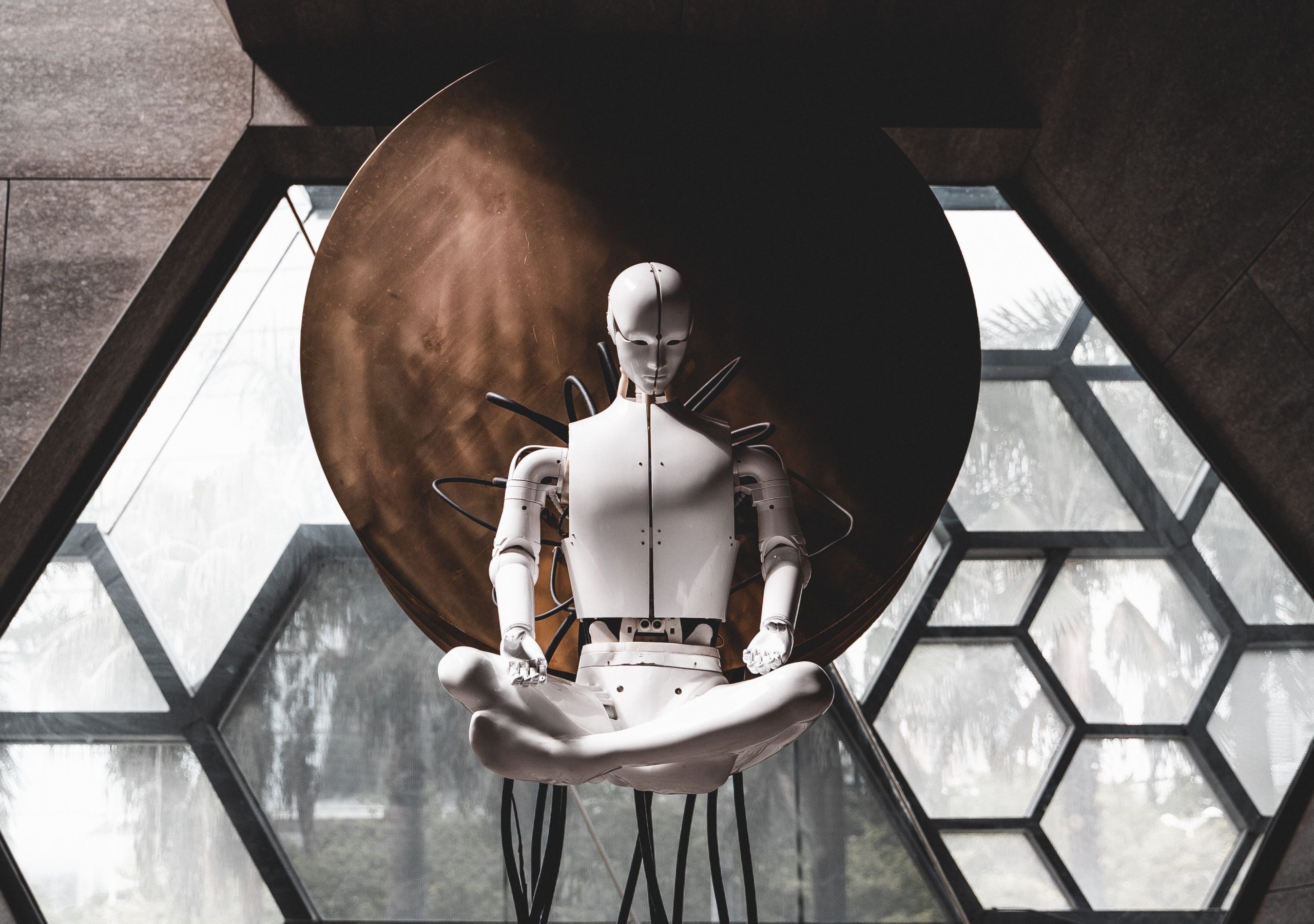
 

Science or Fiction: “AI chatbot has become sentient“
Photo by Yuyeung Lau: Unsplash


Artificial intelligence is the elephant in the room

What exactly is it, how do we create it, and when do we know we have it? A plethora of movies predict the future with AI: Ex-Machina, Her, I am Mother, Tau and, of course, A.I. Artificial Intelligence. What is noticeable about these movies? AI comes in many shapes and sometimes even no shapes at all. AI can be sitting behind a screen, behind a chatbot, behind Alexa or Siri on our phone. Then again, AI can be placed in an embodied form inside a robot. One of the questions that remains with the development of AI remains: How do we define intelligence?

“A computer would deserve to be called intelligent if it could deceive a human into believing that it was human.” – Alan Turing

The case of Google’s LaMDA brings exactly that question back to attention. Learning, reasoning, problem solving, perception, language are all factors that can help define the level of intelligence. Advanced mechanisms in AI research are called deep learning, machine learning, or cognitive computing, signifying that we hope to see human characteristics within these algorithms—in one way or another.

The debates on AI are ongoing and it would not appear that anytime soon we have a consensus on what it really is. Should we be scared or not the least? Every article will share different views. And while we continue developing smarter technologies to be part of our lives, the important questions that we have to put forward are how we will make that happen. How will we achieve an extension of our abilities with AI? How can we fully benefit from AI without compromise? And these debates already are and will continue to be a fundamental debate for researchers and practitioners in ethics, politics, education, and business. On that note, I want to end with a thoughtprovoking quote:

“Anything that could give rise to smarter-than-human intelligence — in the form of Artificial Intelligence, brain-computer interfaces, or neuroscience-based human intelligence enhancement — wins hands down beyond contest as doing the most to change the world. Nothing else is even in the same league.” – Eliezer Yudkowsky
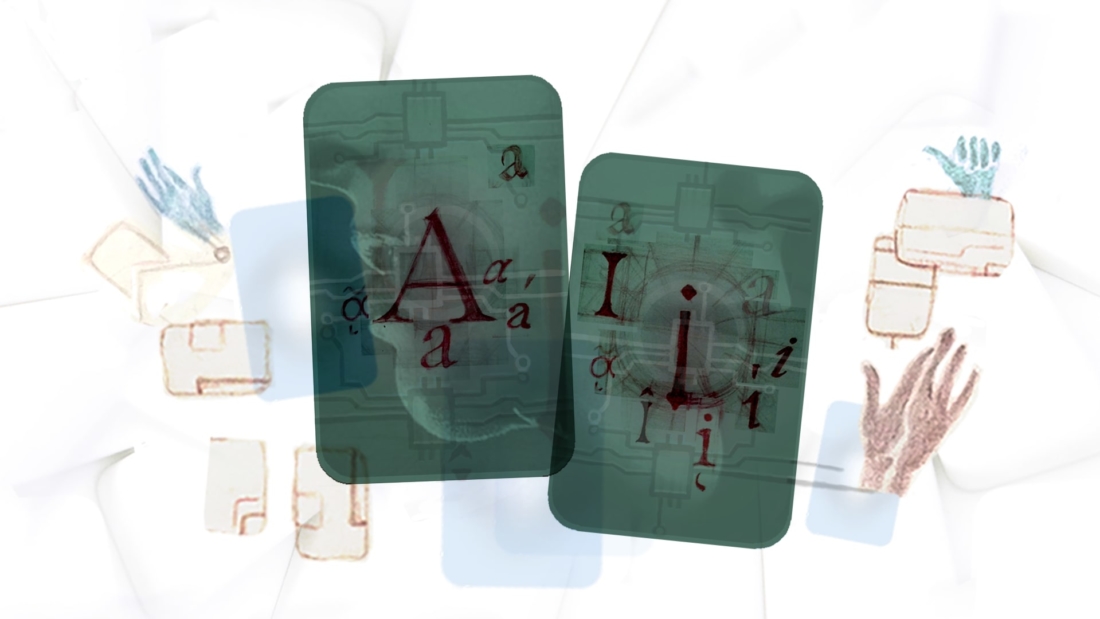
Two digitally illustrated green playing cards on a white background, with the letters A and I in capitals and lowercase calligraphy over modified photographs of human mouths in profile.

What is AI?

Artificial intelligence, or short AI – we all have heard this term and probably we also use it now and then. It is one of the current buzz words. But what do we actually mean when we speak of AI?

Definitions

There are many definitions of artificial intelligence floating around. Some define it through the machine aspect and (human) intelligence:

“Artificial Intelligence (AI) may be defined as the branch of computer science that is concerned with the automation of intelligent behaviour.” (Luger, 2009, p.1).

or:

“Artificial intelligence (AI) represents a highly capable and complex technology that aims to simulate human intelligence.” (Glikson & Woolley, 2020, p.627)

Others through the machine aspect and its abilities:

“An AI system is a machine-based system that is capable of influencing the environment by producing recommendations, predictions or other outcomes for a given set of objectives.” (OECD, 2022, p.23).

Some avoid using difficult terms and define it reversely:

“[Artificial Intelligence is] the collection of problems and methodologies studied by artificial intelligence researchers.” (Luger, 2009, p.2).

And again, others as a process:

“[…] we conceive of AI as a process, rather than a phenomenon in itself. We define AI as the frontier of computational advancements that references human intelligence in addressing ever more complex decision-making problems. In short, AI is whatever we are doing next in computing.” (Berente et al., 2021, p.1435).

The tricky word

Why are there so many different definitions for AI? Well, artificial intelligence is a tricky word. Maybe most of us can agree on the definition of artificial: something that does not occur naturally, something that is human made. But what about the term intelligence? When is somebody, or something intelligent? Is it the IQ, how good they are at calculating, how well they can judge other people’s emotional states? What are the criteria for intelligence?
And then: is artificial intelligence in its core the same as human intelligence? (If you thought: well, of course! Then just another aspect: what about creativity? Or self-awareness? Is this part of intelligence?) Can we use the same criteria to judge AI and human intelligence?

What is AI?
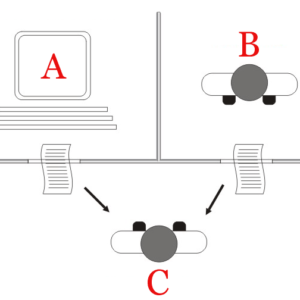
The Turing Test (Source: Juan Alberto Sánchez Margallo).

A famous test for judging the intelligence of AI is the Turing Test, originally called the Imitation Game.  As the name hints, it was invented by famous Alan Turing and is a (theoretical) test in which a machine needs to perform a task (e.g., answer questions). The original name also hints at the idea behind the test: Based on the output of the machine (e.g., an answer to a question) a human needs to judge whether they are interacting with a machine or another human being. If the machine manages to pass as a human, the AI has passed the Turing Test and is considered intelligent (Luger, 2009).

You can see that the Turing Test has a quite specific definition of intelligence – if a machine appears to be human.


Narrow vs. general AI

But is this really what we mean with intelligence? What about a machine that is able to compute extremely fast and to give you an answer to a problem in less than a second, while a human needs days, if not years to solve it – is this machine not intelligent? Most would say it is very intelligent, as it outperforms a human! On the other hand – ask this same machine to perform the task of distinguishing a person crying from laughter and another person crying from sadness. It will fail in giving you the correct answer. Now we would say it is not intelligent at all. And this is because machines are only intelligent in a narrow field.

One speaks of narrow/weak vs. general/strong AI (Glikson & Woolley, 2020). Narrow/weak AI can perform specific tasks, for example, face recognition. General AI refers to a machine that is super-intelligent in “all” aspects. Strong AI is usually what is envisioned in dystopian futuristic books and movies (e.g., 2001 Space Odyssey or the robots in the Alien movies).
However, it is important to note down that we are far away from general AI.
Some think there are aspects of human intelligence that we will never be able to implement or that we do not need/want general AI, others believe that it is just a question of time until we reach strong AI.

So, what are examples for AI?

What is AI?
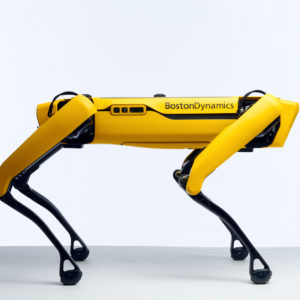
Boston Dynamic’s dog Spot (Source: Spectrum).

AI encompasses a variety of intelligent systems with many different algorithms. Some follow rational programmed rules, some are agent-based and situated (Luger, 2009). Some of them come with a body, like robots. Boston Dynamics are an impressive example of smart robots (see the picture of their dog Spot) already in use or co-bots on shop floors or mobile telepresence robots in hospitals (this is what Alejandra is looking at!). On the other side are bodyless intelligent systems. AI encompasses a variety of these, a subpart being machine learning (ML). Note that often Machine Learning is what people refer to when they talk about AI.

We speak of machine learning if the machine learns by itself without somebody explicitly programming a set of rules it needs to follow. The system manages to learn from the given inputs. Machine learning itself is again a huge field and can be divided into different approaches (e.g., unsupervised learning, supervised learning, reinforcement learning – I can recommend Daugherty & Wilson’s book: Human + Machine for more details (Daugherty & Wilson, 2018)).

Some concrete examples of AI that you have probably encountered already: Apple’s Siri, Amazon’s Alexa, GoogleMaps, Instagram/Facebook sorting your feed and giving you suggestions, Amazon suggesting related products, or Netflix recommending what to watch next.


So you see – already knowing what AI is can be difficult! Maybe next time you read or hear the word AI you will take a minute to think about the use of the word in the context and figure out what kind of AI they mean.  🙂


P.S.: Credits for the featured image to Alina Constantin / Better Images of AI / Handmade A.I / CC-BY 4.0.

Bibliography

Berente, N., Gu, B., Recker, J., & Santhanam, R. (2021). Managing Artificial Intelligence. MIS Quarterly, 45(3), 1433–1450. https://doi.org/10.25300/MISQ/2021/16274

Daugherty, P. R., & Wilson, H. J. (2018). Human + Machine: Reimagining Work in the Age of AI (1st ed.). Harvard Business Review Press.

Glikson, E., & Woolley, A. W. (2020). Human trust in artificial intelligence: Review of empirical research. Academy of Management Annals, 14(2), 627–660. https://doi.org/10.5465/annals.2018.0057

Luger, G. F. (2009). Artificial intelligence: structures and strategies for complex problem solving (6th ed.). Pearson Education.

OECD. (2022). OECD Framework for the Classification of AI Systems. OECD Digital Economy Papers, 323(February). https://doi.org/https://doi.org/10.1787/cb6d9eca-en